

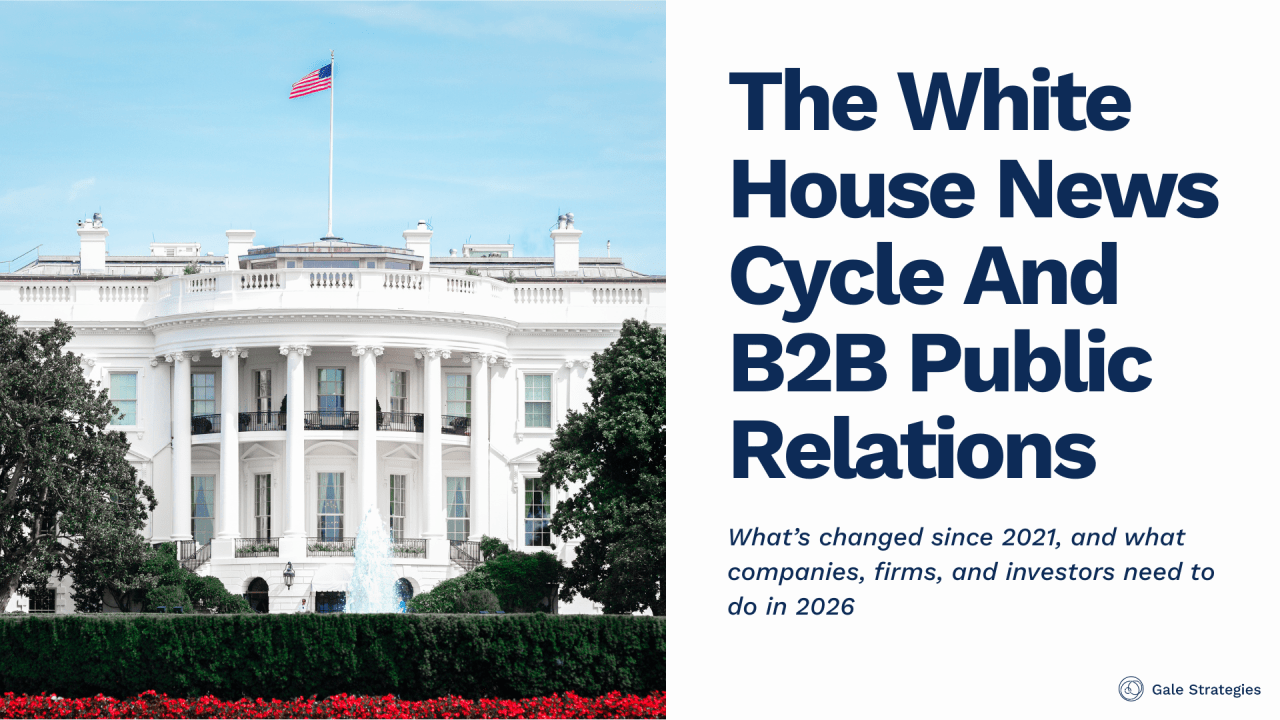

What’s changed since 2021, and what companies, firms, and investors need to do in 2026
For much of the last decade, B2B public relations operated with a clear boundary: The White House mattered for politics, but business had its own media logic.
That boundary has collapsed.
In 2025–2026, the White House is no longer a background variable in business coverage. It has become a primary organizing force of the news cycle, shaping not just political headlines, but markets, sectors, and corporate narratives.
For B2B companies, professional services firms, and investors, this marks a fundamental shift in how communications must work.
What’s different now, and why prior playbooks fail
Then: 2021–2022
In the early Biden years, even amid major events, business news remained largely issue‑driven and distributed:
- Markets focused on inflation, supply chains, and the Fed
- Corporate coverage centered on earnings and recovery
- Policy mattered, but mostly through agencies and long timelines
The White House influenced outcomes, but it did not dominate daily business narratives. PR strategies could afford to treat Washington as context rather than catalyst.
Now: 2025–2026
Today, the environment is fundamentally different:
- White House actions routinely move markets and sector sentiment
- Executive decisions are covered in real time by business desks
- Policy signals often matter more than data releases
- Conflict, litigation, and executive authority are recurring headlines
In short, the White House has become central to how business risk is framed, not occasionally, but continuously. Beyond ideology, it’s about media structure and attention economics.
Why this matters for B2B public relations
The rise in White House dominance changes the nature of reputational risk.
In a policy‑driven business news cycle:
- Silence is no longer neutral
- Delayed responses signal unpreparedness
- Overconfidence is punished
- Credibility is inferred from policy awareness
PR teams are no longer just shaping messages. They are helping stakeholders interpret uncertainty.
The implications for B2B companies and firms
1. The White House must be treated as a standing PR variable
In earlier years, companies could plan around quarterly cycles and predictable media beats. In 2026, White House actions create unexpected narrative shocks.
This means B2B PR functions must:
- Track executive actions and signals daily
- Understand potential second‑order business impacts
- Prepare messaging beforeheadlines break
- Not to take partisan political positions, but to avoid being caught flat‑footed
2. Messaging must emphasize preparedness over insulation
One of the most damaging phrases we hear in this environment is “We’re insulated from politics.” Markets and media no longer believe that.
What resonates now is:
- Operational resilience
- Policy adaptability
- Governance rigor
- Scenario planning
In a White House‑centric news cycle, credibility comes from acknowledging exposure and demonstrating readiness, not pretending neutrality equals immunity.
3. Executive visibility requires greater discipline
When the White House dominates attention, concerns about surveillance and politicized markets are escalated, executive commentary carries more weight, and more risk.
Effective leaders in 2026:
- Speak calmly about uncertainty
- Avoid speculation on policy outcomes
- Frame their companies as stable navigators rather than commentators
PR’s role is to ensure leadership is fluent without being political, informed without being reactive.
Why this is especially acute for private equity and investors
As we move through 2026, pressure on private equity exits adds a layer of urgency. And this is against a background in which private capital has come in and out of the sites of political leaders already.
In a White House‑driven media environment:
- Policy headlines influence valuation sentiment
- Buyers price uncertainty more aggressively
- Exit narratives are stress‑tested publicly
For PE‑backed companies, PR now directly affects:
- Perceived durability
- Management credibility
- Exit timing and optionality
Communications that ignore the White House context risk undermining value at precisely the wrong moment.
The SaaS‑to‑AI transition compounds the challenge
At the same time, many B2B companies are navigating a narrative shift from a SaaS world to an AI‑defined one.
This matters because:
- Layoffs are part of that scenario
- AI equals geopolitics
- AI policy, regulation, and national positioning are White House issues
- Business claims are scrutinized through a political and regulatory lens
- Overstating AI capability invites skepticism in a charged environment
The smartest companies in 2026 are not chasing AI hype. They are illustrating concretely how AI is actually fitting into a volatile policy and economic landscape.
What B2B PR must do for the remainder of 2026
Treat White House pressure as permanent, not episodic. Midterms are coming. This is the operating environment now, not a temporary spike.
Integrate PR with policy awareness, legal, and IR. Disconnected messaging is a liability.
Shift from promotion to interpretation. Helping stakeholders understand uncertainty is more valuable than amplifying growth claims.
Reward restraint. Measured, informed communication builds reputational equity when attention is concentrated at the top.
The new rule of B2B communications
When the White House dominates the news cycle, reputations are built on stability, not volume.
The companies, firms, and investors that adapt their PR strategies accordingly will not only weather 2026, they will emerge with stronger trust at a moment when trust is scarce.
At Gale Strategies, we believe this shift represents an opportunity for leaders who recognize that communications is no longer about visibility alone, but about credibility under pressure.
And in today’s environment, the White House is no longer optional context, it is core.