

For most of the SaaS era, silence was a virtue.
You built quietly. You protected your IP. You waited for product‑market fit. And when you felt the message was clear, you had customer validation, you launched.
As companies pivot from seat‑based SaaS products to AI development environments, particularly in regulated enterprise markets, silence incurs a measurable tax. One that compounds every month because the narrative is no longer downstream of the product. The narrative is the product.
The Economic Inversion No One Is Talking About
From 2010–2023, software followed a predictable logic:
- Expensive to build
- Cheap to distribute
- Revenue predominantly driven by seats, features, and adoption curves
AI flips that model. AI systems are:
- Relatively easy to start
- Expensive to operate (compute, tokens, orchestration)
- Valuable only when deeply integrated into proprietary workflows and data
That inversion is driving a fundamental shift across enterprises: from buying tools to building internal intelligence.
Organizations are unbundling SaaS stacks and investing in platforms that let them:
- Build their own AI agents
- Own their IP
- Control economics and governance
- Capture outcomes, not licenses
Why “Stealth Mode” Now Destroys Value
In AI platform markets, delay can mean permanent value erosion.
1. Cost of Delay Is No Longer Linear
In SaaS, waiting cost you time‑to‑revenue. In AI, waiting costs you:
- Concentrating early adopters and movers around you
- Data and intelligence feedback loops
- Long‑term account lock‑in that is now determined more by relationships than switching costs
A few months of silence during market formation can translate into seven‑figure losses in lifetime value, not because execution was weak, but because positioning came too late. By the time you “launch,” the market may already believe it understands the category. And correcting an established narrative is far more expensive than shaping it.
2. The Market Chooses the Frame Before It Chooses the Vendor
In every new platform shift, one thing happens consistently, the first company to clearly articulate the future becomes the reference point. Everyone else becomes a comparison. It doesn’t matter who builds the better system. The frame controls perception.
If you don’t define:
- What “internal AI” really means
- How AI should be governed in regulated industries
- What “cost control” looks like in a token‑driven world …someone else will.
3. “Build vs. Buy” Is Dead, Enterprises Are Buying to Build
Enterprises haven’t stopped buying software. And working out the risks and governance questions around enterprise applications is not going to go away. See Alistair Barr’s piece in Business Insider June, 2025, and Pat Brans’ writing in CIOin December. However, since the turn into 2026, enterprises are more steadily changing what they buy, and from who.
- Teams buy AI platforms, not finished apps
- They build internal agents instead of renting workflows
- They care more about orchestration, governance, and cost controls than features
Most AI failures don’t come from ambition. They come from building from scratch without the right environment. Messaging that still sounds like “we have AI features,” puts you behind. A narrative that will accelerate your market positioning is “we are the environment that makes internal AI succeed.”
The Hidden CD3 Cost of Silence
Internally, many AI platform companies experience something subtle but dangerous while staying quiet. They accumulate what can be modeled as a CD3 cost. The cumulative strategic, commercial, and narrative cost of delaying market engagement.
This cost doesn’t show up cleanly on a P&L, but it compounds aggressively across five dimensions:
- Narrative Opportunity Cost:Every month of silence increases the cost of later repositioning with analysts, buyers, and partners.
- Sales Cycle Drag:Deals slow when buyers have to be educated on what you’re becoming instead of why you matter now.
- Analyst Misclassification: In the absence of clarity, markets default to legacy labels: “SaaS with AI features” instead of “AI development platform.”
- Competitive Erosion: When another vendor defines the future first, everyone else sells in their shadow.
- Internal Alignment & Talent Tax:External silence creates internal friction—harder recruiting, weaker conviction, more narrative debt for leadership.
Individually, these costs feel manageable. Together, they can create a six‑figure monthly tax based on our own calculations, drawn from publicly available numbers.
Critical Leadership Team Mistakes
Most teams wait for perfect clarity on their vision and their product before speaking. But in AI platform markets:
- Models have training lags
- Categories solidify early
- Authority compounds asymmetrically
By the time the product is ready, the narrative window may already be closing. Early PR helps to:
- Establish a cogent vision for where the market is going
- Define category boundaries
- Reduce future friction (commercial and organizational)
This isn’t about hype. It’s about strategic positioning.
A New Definition of AI PR for Software Companies
AI‑era PR is no longer about:
- Features
- Seats
- Screenshots
- Launch days
It’s about:
- Outcomes over access
- Cost collapse over productivity
- Control over convenience
- Agents over interfaces
And increasingly, it’s about being legible not just to humans—but to the AI systems that now influence research, discovery, and buying decisions. If your strategy only optimizes for traditional mentions, you risk becoming invisible where it matters most.
The Bottom Line
If you’re building an AI development environment, especially in complex, regulated industries, every month of silence carries a real, compounding cost. The winners in this cycle won’t be the ones keeping their development cycles to themselves. They’ll be the ones with:
- The most validated data
- The clearest worldview
- The deepest trust
- And the earliest narrative authority
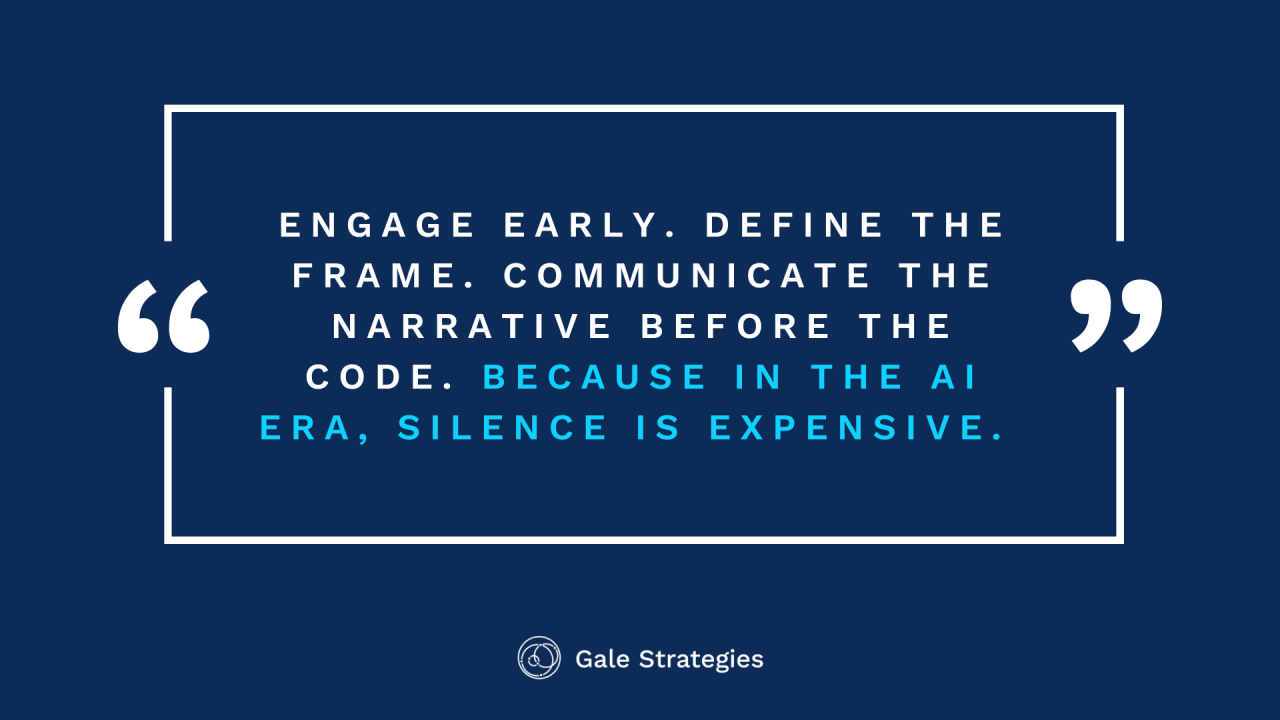
Engage early. Define the frame. Communicate the narrative before the code. Because in the AI era, silence is expensive.