Categories
Legal Media Relations

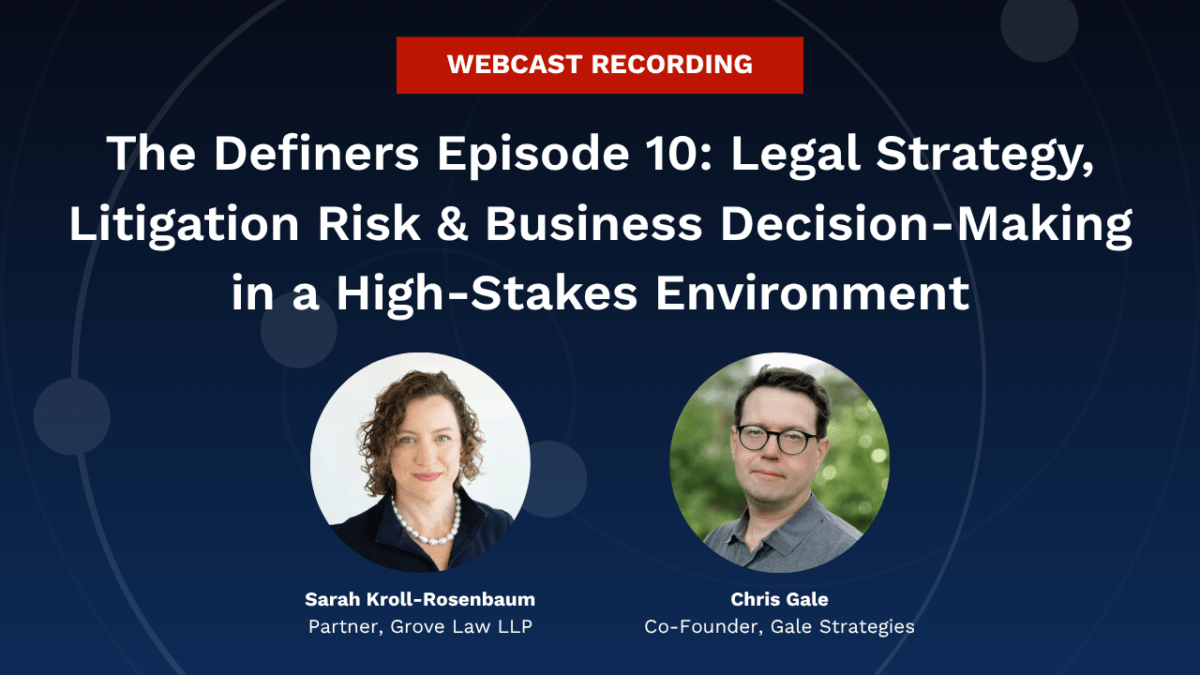
The Definers Episode 10: Legal Strategy, Litigation Risk & Business Decision-Making

In today’s high-stake environment, legal risk is no longer something organizations simply manage, it’s something that actively shapes business outcomes.

Join Chris Gale, Co‑Founder of Gale Strategies, in conversation with Sarah Kroll-Rosenbaum, Partner and co-founder of Grove Law LLP, for a practical discussion on how litigation, regulation, and legal strategy are increasingly influencing executive decision‑making.

Drawing on her experience at the center of complex disputes, Sarah will explore how early signals of risk are often missed, why the most effective organizations surface and address issues before they escalate, and how litigation can evolve from a defensive necessity into a strategic lever. The session will also examine how leaders navigate uncertainty, align legal and business teams, and manage the growing connection between legal exposure and reputational impact, while offering a forward‑looking view on how legal strategy is becoming a continuous, embedded capability across operations, growth, and governance.


Chris Gale: Welcome everybody. This is The Definers webcast and podcast and we have Sarah Kroll Rosenbaum of Grove Law and we’re gonna start shortly, but if you are here to hear about legal strategy, litigation risk, and business decision making in high stakes environment, you are in the right place and I am Chris Gale, co founder of Gale Strategies, and your host today together with Nicole Kaptson who’s in the background, and Sarah. I think this is on a number of our past episodes, but as a past supervisor of mine used to say, don’t punish the prompt. So let’s get going. Sarah, we’re so excited to have you on, As everybody knows who follows us, this is our part of our Definers Series where we talk to folks who are defining an aspect of their industry.

There tends to be a technology aspect of that and I feel like and we feel like what you’re defining within the legal industry which we think has applications beyond the law and business of law, is almost like a returning to a sort of fundamentals of sort. That’s our impression, but yeah, if we could hand it over to you, can you share with the audience a little bit about your background, where your practice focuses, and we’ll start off there.

Sarah Kroll-Rosenbaum: Wonderful. Well, you so much, Chris and Nicole, for inviting me to join you. I am honored to be on the show. I am a co founder of Grove Law LLP, which just celebrated its first birthday last month. Grove is a mission driven law firm.

We’re based in Los Angeles and New York City. And our mission is to provide optimal client service through authentic lawyering rooted in integrity.

Chris Gale: And tell us a little bit more about some of the other partners and how you came together, shared backgrounds, but a Yeah, leading

Sarah Kroll-Rosenbaum: no, okay, great. Well, can dive in here. Well, Grove is a beautiful combination of a long time shared dream that I’ve had with my co founding partner, Hannah Scholl, who has been a dear friend and colleague for almost twenty five years, more than that in friendship. My team of my close, close partners, Anthony Spartalotti and Nancy Sotomayor, with whom I have worked here in California now for many years. And we brought our worlds together, if you will.

Anthony and Nancy and I were partners at an MLAW one hundred, and Hannah was in house at Visa. And part of our mission, of course, as I said, is to provide optimal client service. That’s something that Anthony and Nancy and I had a lot of experience trying to do from the outside, right, as outside counsel. And Hannah had experience receiving or having opinions about receiving as the client Visa. And so by sort of prioritizing that idea, together we are trying to bring to market a really client driven approach to how we solve problems.

You’re on mute, Chris.

Chris Gale: Again, thank you. So litigation is a hot environment, high pressure, and you get to see in real time where disputes originate, how companies are responding, which patterns lead to better or worse outcomes. So from your vantage point, what are the most important trends that you’re seeing in litigation and legal risk right now?

Sarah Kroll-Rosenbaum: Yeah, that’s a great question. I think that, I mean, just to say sort of an interesting vantage point. So I’m very interested in vantage point. What would you, you mentioned sort of the focus on Definers and Technology and how we are in a way coming back to sort of first principles. We’ll talk much more about, I think today about sort of the modeling and framework of how we look at things.

But I’m very interested in vantage point and from where within a system, a participant observes the system, right? And so meaning I’m a litigator, I’m a complex litigator, I was trained to be a complex litigator as were my colleagues, right? However, over the years of our practice, all of us have had experience sort of saying, okay, wait, does the litigation itself solve a problem or does the client really need something else? And so we see the intersections, if you will, of the legal system through litigation, the egos of lawyers, which I think everyone listening to this will probably have some experience with, meaning we wanna be good at what we’re doing. We wanna say, I’m smart and I’m capable and look at this cool trick I can do and this highly competitive, very pressure filled legal experience, but then we have clients who are like trying to do business, right?

And so we also have very, you know, no one is a stranger to major economic change, major technological change, major political changes, right? And so, the law almost always is retrospective, right? It’s always about what happened before, whether it’s litigation about something that already happened, whether it’s about regulations that are new in response to what was already happening. So we see a lag. And I think what we are seeing generally is, I mean, certainly there’s lots of litigation, there’s state regulation where federal regulation maybe has changed or waned for businesses.

And there’s a tremendous amount of economic pressure on companies. And so, just to be clear, like we represent companies, 99% of what we do is represent companies. And so there is a lot of legal work to be done out there right now. I think we can talk more about that

Chris Gale: for sure. One thing I think I’m hearing is that, at least in the area of law where you’re situated and your clients are situated, state law might be a little bit on a relative basis less impactful, that the economic pressures of the businesses themselves are creating sort of a dynamic in the courtroom, am I hearing that right?

Sarah Kroll-Rosenbaum: So I think state law is actually very, is increasingly impactful. And what we’re seeing is increasing state regulation. So where there may have been sort of, maybe under prior administrations, more federal regulation or more federal enforcement, there may have been less state law and regulation, right? And I mean, this is in gross terms, but there’s always a sort of a rebalancing, so the regulation doesn’t ever disappear, right? We see very significant regulation in places like California and New York and Oregon, in Illinois, for example, in certain areas.

And so in an example, I represent staffing companies, I represent a lot of staffing companies, and we see a lot of state regulation in that area. And a lot of that is about tracking economic trends. For example, following In the healthcare staffing market, for example, the pandemic, during and after the pandemic, states said, Wait a second, we’re gonna regulate healthcare staffing companies because they’re coming into our state and doing a ton of business all of a sudden, right? Likewise, there’s antitrust regulation. This is at the federal level, but not only states too, looking at the way what we call MSPs are operating.

When we have the economic relationships between staffing companies in order to provide their clients with better service. So we see that business drives and law follows, right? And what I’m interested in is trying to help my clients do more business, do better business, do smarter business with less friction in the legal world, by understanding how the law can support what they’re doing and how they can understand where the obstacles exist, because they always exist.

Chris Gale: That’s fantastic, and it reminds me of I’m over on the other side of the Atlantic than usual, and as I was talking to someone over here about about this webcast, and they were talking about increasing fragmentation in jurisdictions, so there’s a lot more that we had to do to get through airports and across borders than there was in the past and there’s talk in the country I’m sitting in at the moment about there being more of a fragmented environment within which this country and its companies exist. That’s interesting of hearing it also from the healthcare perspective. Could we dip into where flashpoints come up, where litigation comes from, where it originates? Yeah.

Sarah Kroll-Rosenbaum: Sure. I mean, I would say litigation doesn’t always come from one place, right? But I’m reminded of, well, I think that, so I, you you and I have talked before books and great books, I love borrowing from other industries. So we, one of the books I’ve really appreciated is Charles Duhigg’s book on super communicators. And he talks about the difference between, you know, it says, which conversation you have?

Are you having a feelings conversation, an identity conversation or a logistics conversation? And so it’s relevant for my work so much because we see litigation arise because feelings, big time feelings, right? Logistics, like we are two companies, so let’s talk about feelings. Company A is super pissed at company B because company B took their market share or won the contract or whatever it is, or took some action because somebody was upset and violated the contract knowingly, right? Whatever it is, I’m making these things up, but we have underlying tensions that are legitimate human tensions that result in legal problem and litigation, right?

And by the way, that’s so much of what our job is, is to deal with legitimate, to solve problems, if you will, between people through the legal process. That’s why we have the rule of law, right? My point is not to say everyone needs to go sit down and, know, come, you know, try to, they should drive, we’ve tried in the legal system to come up with, you know, early mediation and efforts to try to have resolution, but oftentimes we have feelings driven conflict. We have a lot of logistics driven conflict. Like we’re just trying to do something in the world.

We’re just trying to do something in the market and our operations don’t allow it, or our operations are making mistakes. And this is something that I think we will see increasingly around technology and around AI adoption at companies, because some companies will do a better job than others at laying that out, right? And it’ll make mistakes and we’re still gonna be responsible for it, right? So there’s a lot of underlying logistics to that, right? And then we certainly have identity too.

I’m the one who should have this and therefore I’m going to sue you to keep that right, right? And so it’s a really, from the sort of, where do these problems arise for me, the way I’ve developed, and I think this might be an appropriate time to talk about how I think about integrity as a framework, because it’s the way we look at, the way I like to with my clients, at problems, right? So integrity is a nice framework. I’ve developed something called a SWRL, a systems wide integrity risk lens, which is simply I talked about vantage points before, how do we take our vantage points and from wherever we sit, whether you’re the CEO of a company, whether you’re the CTO of a company, whether you’re the general counsel, a board member, or a guy who works in operations, you take your vantage point and say, look across the system and say, where’s the risk? And this is where we’re here to help because you’re gonna need help from somebody, many different people, many different people with advice and expertise to say, let’s look across this whole system, get out of fragmentation and look for where the risk is.

And it’s not to be formulaic, but it’s to try to be holistic in its impression. So when we talk about integrity, when I talk about integrity, I’m looking for two things at the same time, okay? Using both definitions of integrity, one is about truth, about which for me is about purpose. So is it genuine somebody has integrity if they’re a truthful, genuine person? And really what it is, is like, are they true to themselves, right?

Are they true to their own purpose? And structural integrity, does the house hold up and not fall down? Does the boat float without springing leaks? And when you can do both of those things at the same time, you have integrity, okay? Now I like that as a framework because it allows us in complex systems to say, how can this whole thing align, right?

We’ve got from a business perspective, maybe several different entities that are set up working together. We’ve got money flowing from different directions through different companies. And our purpose is to be of service in the market, right? So how can we do that in as frictionless a way as possible? From a legal perspective, we’ve typically, we’ve got in The United States, we’ve got federal law, constitutional, statutory, regulatory, case law, court driven, court interpreted law, same thing on the state side, all piled up on top of each other.

And 90% of what we’ve got in business too, just commercial agreements, just layers and layers of commercial agreements. And so what it’s, to go back to basics and this is like the original technology, do those things align? Or are we tying our shoelaces together in our purpose? So is our feeling, going back to that, clear in our purpose and driven out through all of those different structural measures, right? Are we, know, is our identity clear?

Are we clear in our identity about what our purpose is? And if we have strong feelings about certain things, which if you’re a mission driven organization, if you are trying to do a very specific, you may, right? And is that mission, are we being true to that purpose at every stage throughout our operations, our relationships, the systems in which we operate? And so that’s how I use integrity in the work and it’s replicable. The way I think it relates to your point about technology is that all technology is rooted in some original system that works.

It works here and then we can scale it. Integrity as a model works as a simple concept that allows for scale.

Chris Gale: I was writing it down because sometimes we feel the technology isn’t necessarily rooted in a particular system that is scaling and our own personal view within our firm amongst a number of our clients is that typically means that the technology is going to have a lot of difficulty. So you mentioned feelings, logistics, and identity. I don’t know if those were if that’s a sort of exclusive, like, particular

Sarah Kroll-Rosenbaum: three Those are Duhiggs themes. Right?

Chris Gale: That’s right.

Sarah Kroll-Rosenbaum: I’m borrowing his idea and applying it, but, you know, those are Duhiggs ideas.

Chris Gale: So is there more that you can say about feelings? Because feelings can be used pejoratively, which is to say, oh, well, you feel this way, and there’s a separation between that, and let’s say, you know, the facts or what what have you. Yeah. Yeah, say more about feelings and the importance of feelings.

Sarah Kroll-Rosenbaum: Sure, so, I mean, I think, look, I think feelings are really important. And I mean, I’ve helped, I don’t know how many C suites make decisions. When we are, like one really interesting thing about being a lawyer is that my client is the company, it’s not the people who are the actual humans I’m interacting with. And their client is also the company, right? And so it’s this interesting idea that we live with that we have fiduciary duties to an idea, to an entity, and that entity has a purpose, okay?

And that purpose is what we’re trying to support in this integrity model. And I am very interested in helping my clients distinguish between their reactions, which are often very much feelings based, and their calculated, educated, thoughtful response, okay? And, you know, Viktor Frankl is famously misquoted, because I don’t think he actually said it and it’s not actually in his book, but, you know, talking about the space between, you know, reaction and responses, opportunity to find freedom or whatever the quote is. But, you know, people like, are people and we have strong reactions. We have strong like, yes, more, more.

I wanna go get this. I’m excited about it. I’m having like a giant dopamine hit from winning right now in whatever this thing is. And, or I’m so angry and like, or I’m so scared. Like, I mean, how many CEOs have I advised where like, they’re like, are you kidding me?

I have to go tell my board that this guy sued us again, like really? I am like, you know, and so we have feelings as humans, like we are not AI, you know? And so we have feelings and we need to, I think it’s so valuable to have them and have a space to be like, okay, I can look at them and have them and feel them and see them and distinguish from the reminder. And this is again, why integrity is a useful tool. Because it’s like, oh, I can actually like put on my whiteboard or wherever I’m putting it, I can write down purpose.

Like this is the purpose, this is what we’re trying to do. This is how we’re trying to be of service in the world. This is how we’re going to market. This is how we are going to improve market systems for millions of people, right? And you can write that down.

And then when you get sued, when you witness yourself or your colleague flipping out because you’re like, Oh, come on, make this go away. This couldn’t be the worst timing, right? Or we’re gonna go get them, now is the best time, right? You can witness that and say, does that swear with our mission? Because what we want is long term, long term repetitive successive growth for most companies.

Certainly there are those out to be like, we’re gonna go out and pop in five years and then sell and that’s it. Maybe, but like that’s their purpose, right? But again, you got to say, there’s an opportunity to say, again, vantage points, there’s a vantage point of feelings and there’s a vantage point of purpose. When we’re making decisions, we got to go back and look at the vantage point of purpose.

Chris Gale: So in terms of decision making in the current environment, is there, and I’m wondering a little bit from our script here, but is there such a thing as a bad win in medication for instance?

Sarah Kroll-Rosenbaum: Sure, I mean, sure. I mean, think that I think where you’re going and I appreciate it and I’ll hit that outside ball. As you know, I like a good baseball metaphor. I mean, needs to be about allowing that purpose to succeed. And so if your lawyers or you are, if we got a litigation and the whole thing is about winning that case or winning the motion or winning the appeal or whatever it is, like, you don’t wanna forget about winning the battle or lose the war is not worth it often, right?

And so the reminder to go back to purpose and say, how can we focus on what really matters? And it allows us to say, hey, egos down, lawyers, outside counsel, lawyers down, go and do we settle or do we litigate to the death and litigate for twenty years and had that too? We make different decisions when we’re purpose driven. And so instead of somebody coming from the outside and saying, Chris, here’s what we’re gonna do to litigate your case and here’s what we’re gonna win and how I’m gonna win this case. If you hear that, you say, okay, good for you, but how am I, Chris, gonna win that case?

Chris Gale: And how do you uncover, I think you’re talking about purpose, if I recall correctly, How do you determine purpose with a client? And I’ll stop the question there because I have a follow-up, but I wanna hear the answer to this. I think

Sarah Kroll-Rosenbaum: it’s a great question. I think, I mean, the answer for me is like that client being them, doing them, getting paid to do them successfully in the world. So like, how are they being of service? So this is an authenticity question. Like, how are they being authentic?

And which is, are they bringing themselves? Are they bringing to the world? When we see, in my experience, I mean, I’ve supported hundreds of companies, when they are doing them, when their machine is working and they’re being well led in this is who we are and this is what we’re doing, it goes well, right? If we’re just going out to kill the other guys to be the last one standing, often doesn’t go as well. So my point as a lawyer is not really to give business advice, cause I’m not qualified to do that, let’s be clear, maybe I’ve been around a few meetings within the last twenty five years, but it’s my point here is to help say when you’re making decisions that are impactful, that are about millions or billions of dollars.

Right? When you’re making decisions about how you lead with your board and your advisors and your team, how do you do it from a place of saying, okay, everybody’s got a lot going on, but we’re gonna come back to our authentic purpose as a company.

Chris Gale: But are there is there any particular method or questions you ask that you think are particularly successful in unearthing that? I asked for instance, you know, we hit open this up, as a public relations, you know, marketing firm, sometimes we will have clients in a contentious media environment or maybe they will see it as a as a competition potentially with a reporter. It’s hard to in our place, because we’re serving the client, and I think you’re focusing on the client, it’s sometimes hard to come to an understanding with clients of ours for instance about when it is and isn’t a zero sum game and how there can be wins on multiple sides. So if I retreat back for a second, are there particular questions or ways that you set up the conversation with clients to uncover that purpose, or is there a different alternative where you prefer to find clients that are more predisposed to being able to do that?

Sarah Kroll-Rosenbaum: I think it’s both. I mean, I think that the relationship between a client and their lawyer is very specific. It’s got to work, right? It’s got to feel right for the client. It’s got to feel right for the lawyer because it can be, depending, look, there’s small things and then there’s like big long things where I’ve got clients where I’m handling 25 litigations for them, and that those are real relationships where we’re really sitting together and figuring out how are we gonna do this.

And so I’m very upfront with my clients that what I’m here for is for them to make decisions about what they want, and not for me to tell them what they want. But I need to be able to be clear about doing that, sort of my boundaries, if you will, are that we believe in the rule of law, we will act within the rule of law, we believe in the integrity of the rule of law, and that it’s capable of supporting quite a bit of business right now. I mean, people can go out to market and do a lot, And we want to be yes lawyers and not no lawyers. And what I mean by that is to say to our clients, yeah, here’s, if you wanna do whatever you wanna do in the market, here’s either how you can do it or here’s how you can do it, but here are the risks. By the way, some risks are parking tickets and some risks are prison sentences.

So like you choose, you’re adults. Like, I’m not gonna help you commit a felony, but like, this is what your risk is. So it’s always about their choice. It’s always about them understanding what the law requires of them in order to do what they want to do in the market.

Chris Gale: So if I hear you correctly, you’re not deciding what their purpose is, you’re asking a lot of questions and allowing them it almost sounds like therapy in a very productive fashion, which is okay, so ask the questions that allow them to explore that in the case of where they have multiple options.

Sarah Kroll-Rosenbaum: Business needs to drive the purpose and the legal, right? So I think a lot of times people get really scared about lawsuits and they just try to call, the paternalistic thing, come in and fix it, make it go away. And then, you know, some knight in shining armor shows up and says, I’m gonna go get them, you know, and like, okay, good, good for you. And have that skill. Like for those of us who grew up in the big leagues know that like, yeah, we have that skill, we can go out and do those things.

The better thing is to say, what are you really trying to accomplish here? What does it really look like for you to succeed? And if we need to go play that card, like fine, but that’s not, it’s an option. It’s one of many, many, many, many, many options in the giant arsenal of the integrity tools to say, how do we align the systems? How do we align the opportunities and try to reduce the friction so that you can do more business that is more suited to what you want to accomplish in the world.

Chris Gale: This is gonna be my last question. We’re a little bit over time. You alluded to the amount of business that is out there. What evidence can you share with us about you’re a Definer and we wanted you to come on to share this approach and this vision. Can you share more about some of the success that you’re seeing at Grove and the founding of Grove that has provided evidence of what seems like this long view and the immediate returns and rewards you feel?

Sarah Kroll-Rosenbaum: Look, think part of what we’re trying to do at Grove and we’re not alone, I mean, there’s several, many, many company, many firms, law firms that have launched in the last several years to try to provide an alternative to big law. So we are we were very, very, very grateful and humbled to be included in in our first year in the chamber’s recognitions, which is, you know, for whoever cares about, you know, the lawyer contests. It’s nice to show that we’ve got the chops, but we do, we wanna provide an alternative that allows for really creative, different approaches to litigation and to not just litigation, but how we combine litigation, regulatory compliance, looking at transactions, this stuff together, right? And that’s what we’re trying to do. And we are trying to lean into technology and not just our own, but our clients to understand how it’s going to advance our cause or hinder it and how we can help avoid that.

But we’ve seen clients, I mean, just in terms of the numbers, what we’re doing is, knock on wood, working really well. We came in strong and we’ve doubled the number of clients we have. We have prevailed on, I don’t have the exact count, but almost every major motion that we have filed for clients or resolved cases at better than market approaches. So it’s working, and it is a true thrill to be able to do this and really looking forward to We love working creative businesses, and this is certainly a time when the world is calling for innovation and entrepreneurship and new ideas, and we are really here to take part and help that happen.

Chris Gale: Thank you very, very, very much. Thank you for those that stayed on with us, and we can’t wait to share this further with our network because boy, does it mesh really well with what we’re seeing in the space. So thanks very, very much. Thank you all. Have a great day.

Categories
AI Finance Media Relations

Remember the 2023 Banking Crisis?

As we gear up for an August 1st launch of what’s currently being called our Quarterly, we’ve been revisiting a 2023 webcast hosted by MUFG Capital Analytics’ Scott Ramsey: MUFG Webcast, Episode 3.

Why now? Because the themes — trust, technology, and crisis — feel even more relevant today. And not just in banking and finance. They extend across industries, including healthcare, and critically, into marketing and communications.

A Systems Problem, Not a Workforce Problem

Nearly 40% of clinicians already describe their workload as structurally unsustainable. As organizations lean further into algorithmic scheduling and cost controls, the margin for human error continues to shrink.

This goes beyond a workforce issue. It suggests a breakdown of system flows and a lack of systems thinking.

When people are exhausted and unheard, mistakes happen. In healthcare, those mistakes carry profound consequences — clinical, legal, and human.

And marketers should pay attention. In fact, if you read our Definers Monthly newsletter, you will have noted that journalists are tracking this.

The Emergence of Marketing Paralysis

Inside organizations experiencing this kind of strain, marketing is often asked to do more, faster. More messaging, more campaigns, more positioning — precisely when clarity is at its lowest. The result is what we are calling marketing paralysis. Everyone has a point, every stakeholder is partially right, and the system floods itself with conflicting inputs.

Instead of clarity, you get noise. Instead of action, you get stalled execution.

Lessons from the 2023 Banking Crisis

Coming back to MUFG Capital Analytics’ webcast, we saw similar dynamics in the 2023 banking crisis.

While public attention focused on interest rates and balance sheets, the reported structural failures at Silicon Valley Bank and within supervisory systems were also human. Between 2019 and 2021, SVB’s assets more than doubled — from roughly $71 billion to over $211 billion. Human systems didn’t scale with that growth.

Employees were overwhelmed by micro-compliance, endless assessments, and administrative noise. Risk professionals were buried in daily processing, missing macro-level threats — like unhedged long-term bond exposure.

At the same time, internal cohesion eroded. Hybrid structures fractured communication, reduced productivity, and weakened institutional alignment.

Marketing organizations today are experiencing a version of that same problem: too many signals, not enough synthesis. Too much motion, not enough direction. Everyone is “right,” which makes it nearly impossible to move.

Deliberate Calm: A Better Way

There is a better way, but it requires slowing down. And that’s hard — if you read our upcoming post on bot-sitting.

At the same time as the banking crisis, leaders began applying what McKinsey called “deliberate calm” — structured, paced decision-making that creates clarity without sacrificing responsiveness.

That idea matters just as much for marketing as it does for operations or risk. In moments of overload and fragmentation, effective marketing is not about increasing output. It is about restoring coherence, sequencing, and market contact:

  • Clear narrative over constant messaging
  • Defined decision rights over endless consensus loops
  • Structured cadence over reactive bursts
  • Frontline insight over top-down broadcasting

In the banking crisis, organizations that applied this approach contained damage. They created stability at the top while empowering judgment at the front lines.

The lesson translates directly to today’s workplace — and again to marketing specifically:

  • Speed without structure creates fragility
  • Control without agency creates disengagement
  • Marketing without systems thinking amplifies confusion instead of reducing it

What Leaders Should Do Now

This summer is not just a seasonal slowdown (and for many, there may be no slowdown) — it is a stress test. And marketing is at the center of it, whether organizations realize it or not.

Leaders can ask:

  • Are our scheduling and resourcing systems creating predictability, or chaos?
  • Do our people understand how decisions are made — including marketing and public relations decisions — and where they have agency?
  • Are we aligning around a clear narrative, or reacting to every internal voice and external signal?
  • Are we solving problems systemically, or layering on more messaging to compensate for deeper misalignment?
  • Are we listening to how teams interpret our mission, or broadcasting in ways that risk contradiction and loss of trust?

Because when public relations and marketing becomes reactive inside a strained system, it exposes fractures. Mixed signals, inconsistent positioning, and overproduction don’t just confuse markets — they erode trust internally and externally.

Maybe the consequences don’t show up immediately. But when they show up later, they look like:

  • Declining credibility
  • Disengaged teams
  • Missed risks
  • Reputational and legal exposure (follow us on LinkedIn for more on NAVEX’s findings)

Trust Is Built Through Clarity, Not Volume

Across industries — from healthcare to finance to technology — the pattern is the same.

Trust is not rebuilt through volume. Rather, it’s clarity, consistency, and systems that actually support the people inside them.

And above all, leaders must establish visible, transparent patterns of integrity — operational, cultural, and narrative — that give people agency, and that they and we can actually trust.

Categories
AI Media Relations

AI Development Media Relations

Supporting AI go-to-market motions in 2026

Price:

  • $12,486 for the complete cohort marketing program

Program Overview

AI development doesn’t follow a traditional SaaS launch sequence. Cycles are open-ended, customer feedback drives the roadmap, and go-to-market motions evolve in real time. That shift creates competitive space, but only for companies that can build narratives as dynamic as their products.

A cohort-based marketing motion aligns media, messaging, and sales with how AI actually gets built and bought: through small groups of high-intent customers experimenting in parallel, shaping the story as they go.

Objectives

  • Establish a repeatable cohort marketing motion
  • Increase engagement with high-quality, collaborative customers
  • Accelerate internal alignment across product, marketing, and leadership

Cohort Identification & Definition

We start by finding the cohort that already exists, often hidden in your customer base, and giving it structure, language, and visibility.

  • Audit the customer base to identify existing or emerging “accidental cohorts”
  • Define the macro industry challenge and structural breakdown
  • Develop positioning for the cohort as an industry working group
  • Build a value proposition centered on collaboration, experimentation, and leadership
  • Design a messaging framework focused on customer outcomes and learning loops
  • Create a participant communication framework
  • Align internal teams across product, marketing, sales, and leadership
  • Develop core content assets: announcement, messaging, FAQs, program overview

Media Strategy & Sales

Cohorts give journalists what they want most: pattern, not pitch. We build the narrative architecture and the sales motion together so each reinforces the other.

  • Develop a narrative focused on industry challenge patterns and innovation gaps
  • Identify and engage key journalists and influencers
  • Create a framework for ongoing insight storytelling and reporting
  • Align sales on positioning and narrative tools

Deliverables

  • Cohort strategy brief
  • Onboarding and participant communications templates
  • Announcement materials — email, blog, social
  • Sales enablement materials
  • Media pitch framework and angles focused on industry transformation
  • Talking points, media management, and results distribution

Timeline

  • Week 1: Cohort identification
  • Week 2: Program messaging and asset creation
  • Weeks 3–4: Launch and recruitment
  • Week 5–8: Media relations wins and amplification

Interested in building a cohort motion for your AI company? Get in touch →

Categories
Media Relations

The Market Signal Package

Supporting Q2 2026 Enterprise Sprints

Price:

  • $6,878 per press announcement
  • Volume rate: $5,291 per announcement when engaging on three or more announcements

What’s Included (Per Announcement)

Each announcement functions as a contained narrative campaign, not a transactional press release.

Included:

  • Strategic press release writing
    Crafted to connect the company’s news to a broader market movement journalists already care about, not just a company update.
  • PR Newswire distribution
    Distributed via PR Newswire. Newswire fees billed separately; Gale Strategies does not currently add an upcharge.
  • Earned media outreach
    Targeted outreach to priority national business, trade, and relevant local reporters based on the nature of the announcement and the audience that needs to hear it.
  • One social post promoting the news
    Designed for amplification and signal-sending, not filler.

Why This Exists, And Why Now

Q2 2026 is not just another launch window. We appear to be at a narrative inflection point.

As Gale Strategies has outlined in the past two months, AI acceleration and the unwinding debt cycle are compressing timelines, rerating businesses in real time, and reshaping how investors, buyers, and journalists decide what matters and what doesn’t. The market is no longer waiting for clarity; it is pricing its absence.

In this environment, silence is not neutral. Delay is not inexpensive. And “we’ll announce when we’re ready” increasingly translates to ceding the frame to someone else. This offering is designed to help companies:

  • Enter the conversation before the narrative hardens
  • Align announcements with how journalists are now explaining where the world is headed
  • Turn discrete news moments into durable market signals

The Strategic Rationale (Grounded in GS’s Playbooks)

  1. AI Has Changed the Cost of Waiting

In AI platform and infrastructure markets, narrative is no longer downstream of the product; the narrative is the product. A few months of silence during market formation can mean:

  • Lost category ownership
  • Early adopters anchoring elsewhere
  • Journalists explaining the space without you

This is no longer a linear cost. It compounds. Structured, timely announcements are how companies pay the cost of delay before it becomes permanent.

  1. Q2’s Market Rewards Clarity Across Three Layers

As outlined in The Three-part Clarity Playbook for April’s Market, effective communication right now must align three things simultaneously:

  1. What you want to say (your strategy and evolution)
  2. What your audience needs to hear right now (time-to-value, durability, downside risk)
  3. What journalists are trying to explain next (not what happened last quarter)

Most announcements fail because they stop at #1. This offering is designed to connect all three, so news lands as context, not noise.

  1. Momentum Now Beats Perfection Later

Events, launches, partnerships, hires, and milestones are no longer isolated moments. They are raw materials for sequence and persistence.

As we outlined in Before You Leave for Your Event, Read This, the highest leverage teams treat moments as micro-campaigns that compound over time.

Similarly, The Persistence Playbook makes clear that in an AI driven capital reset, the companies that survive and win are not necessarily the loudest, but they are consistently legible to the market. Regular, disciplined announcements signal:

  • Operational momentum
  • Strategic intent
  • Structural endurance

In this cycle, visibility without coherence destroys trust, but coherence without visibility disappears.

Who This Is For

This offering is designed for:

  • Operators pursuing funding, M&A, or major customer inflection points
  • Private capital backed businesses under pressure to show clarity, not spin
  • AI-native and AI exposed B2B companies navigating compressed decision cycles
  • Leadership teams with multiple milestones between April and early summer

Examples of announcement types include:

  • Fundraising announcements
  • Product launches
  • Acquisitions/IPOs
  • Executive hires
  • Data or reports
  • Event attendance/participation as a speaker

If you anticipate three or more announcements, Gale Strategies will waive the standard project fee, reducing the per announcement cost to $5,291, because narrative persistence matters more than one-off hits.

The Bottom Line

The market is being reshaped in public.

Journalists are writing the first draft of the next cycle right now. Investors and buyers are using those explanations to make fast, high stakes calls. And companies that wait for “perfect” risk being explained by someone else.

This Q2 announcement package exists to make sure your company is present, coherent, and correctly framed while the window is still open.

If you’re planning announcements anyway, the question isn’t whether to communicate; it’s whether the market understands what you’re building before the frame sets.

Categories
Media Relations

The White House News Cycle And B2B Public Relations

What’s changed since 2021, and what companies, firms, and investors need to do in 2026

For much of the last decade, B2B public relations operated with a clear boundary: The White House mattered for politics, but business had its own media logic.

That boundary has collapsed.

In 2025–2026, the White House is no longer a background variable in business coverage. It has become a primary organizing force of the news cycle, shaping not just political headlines, but markets, sectors, and corporate narratives.

For B2B companies, professional services firms, and investors, this marks a fundamental shift in how communications must work.

What’s different now, and why prior playbooks fail

Then: 2021–2022

In the early Biden years, even amid major events, business news remained largely issue‑driven and distributed:

  • Markets focused on inflation, supply chains, and the Fed
  • Corporate coverage centered on earnings and recovery
  • Policy mattered, but mostly through agencies and long timelines

The White House influenced outcomes, but it did not dominate daily business narratives. PR strategies could afford to treat Washington as context rather than catalyst.

Now: 2025–2026

Today, the environment is fundamentally different:

  • White House actions routinely move markets and sector sentiment
  • Executive decisions are covered in real time by business desks
  • Policy signals often matter more than data releases
  • Conflict, litigation, and executive authority are recurring headlines

In short, the White House has become central to how business risk is framed, not occasionally, but continuously. Beyond ideology, it’s about media structure and attention economics.

Why this matters for B2B public relations

The rise in White House dominance changes the nature of reputational risk.

In a policy‑driven business news cycle:

  • Silence is no longer neutral
  • Delayed responses signal unpreparedness
  • Overconfidence is punished
  • Credibility is inferred from policy awareness

PR teams are no longer just shaping messages. They are helping stakeholders interpret uncertainty.

The implications for B2B companies and firms

1. The White House must be treated as a standing PR variable

In earlier years, companies could plan around quarterly cycles and predictable media beats. In 2026, White House actions create unexpected narrative shocks.

This means B2B PR functions must:

  • Track executive actions and signals daily
  • Understand potential second‑order business impacts
  • Prepare messaging beforeheadlines break
  • Not to take partisan political positions, but to avoid being caught flat‑footed

2. Messaging must emphasize preparedness over insulation

One of the most damaging phrases we hear in this environment is “We’re insulated from politics.” Markets and media no longer believe that.

What resonates now is:

  • Operational resilience
  • Policy adaptability
  • Governance rigor
  • Scenario planning

In a White House‑centric news cycle, credibility comes from acknowledging exposure and demonstrating readiness, not pretending neutrality equals immunity.

3. Executive visibility requires greater discipline

When the White House dominates attention, concerns about surveillance and politicized markets are escalated, executive commentary carries more weight, and more risk.

Effective leaders in 2026:

  • Speak calmly about uncertainty
  • Avoid speculation on policy outcomes
  • Frame their companies as stable navigators rather than commentators

PR’s role is to ensure leadership is fluent without being political, informed without being reactive.

Why this is especially acute for private equity and investors

As we move through 2026, pressure on private equity exits adds a layer of urgency. And this is against a background in which private capital has come in and out of the sites of political leaders already.

In a White House‑driven media environment:

  • Policy headlines influence valuation sentiment
  • Buyers price uncertainty more aggressively
  • Exit narratives are stress‑tested publicly

For PE‑backed companies, PR now directly affects:

  • Perceived durability
  • Management credibility
  • Exit timing and optionality

Communications that ignore the White House context risk undermining value at precisely the wrong moment.

The SaaS‑to‑AI transition compounds the challenge

At the same time, many B2B companies are navigating a narrative shift from a SaaS world to an AI‑defined one.

This matters because:

  • Layoffs are part of that scenario
  • AI equals geopolitics
  • AI policy, regulation, and national positioning are White House issues
  • Business claims are scrutinized through a political and regulatory lens
  • Overstating AI capability invites skepticism in a charged environment

The smartest companies in 2026 are not chasing AI hype. They are illustrating concretely how AI is actually fitting into a volatile policy and economic landscape.

What B2B PR must do for the remainder of 2026

Treat White House pressure as permanent, not episodic. Midterms are coming. This is the operating environment now, not a temporary spike.

Integrate PR with policy awareness, legal, and IR. Disconnected messaging is a liability.

Shift from promotion to interpretation. Helping stakeholders understand uncertainty is more valuable than amplifying growth claims.

Reward restraint. Measured, informed communication builds reputational equity when attention is concentrated at the top.

The new rule of B2B communications

When the White House dominates the news cycle, reputations are built on stability, not volume.

The companies, firms, and investors that adapt their PR strategies accordingly will not only weather 2026, they will emerge with stronger trust at a moment when trust is scarce.

At Gale Strategies, we believe this shift represents an opportunity for leaders who recognize that communications is no longer about visibility alone, but about credibility under pressure.

And in today’s environment, the White House is no longer optional context, it is core.

Categories
Media Relations

Timing Is Everything: When to Hire a PR Agency

Timing is often the difference between a story that lands and one that disappears. But when is the right time to start telling that story?

Engage PR too early, and you may burn time and budget before you’re ready. Engage too late, and you’re asking PR to amplify something that’s already passed its peak.

This article is designed to help you answer a deceptively simple question: When is the right time to hire a PR agency?

Do you need a PR firm? A checklist.

If you answer yes to one or more of these, it’s time to at least ask the question. If several boxes are checked, the question isn’t if you need PR, it’s when.

You’re planning a moment that needs attention, not just execution

☐ A product or feature launch that needs adoption, not just an announcement

☐ A new partnership or integration with real market relevance

☐ A fundraising announcement (Seed, Series A/B/C, or strategic investment)

☐ A new C-suite or executive hire meant to signal growth or credibility


You’re changing how the market understands you

☐ A brand, positioning, or messaging refresh you need to get out there

☐ A pivot or expansion into a new category, audience, or geography


You have news, but need help making it newsworthy

☐ Original data, stats, a survey, or a report with a clear takeaway

☐ A timely POV or insight tied to a trend, cultural moment, or industry shift

☐ Something genuinely interesting to say, but no clear distribution plan


You’re hitting internal limits

☐ No one on your team “owns” media, narratives, or journalist relationships

☐ You’ve tried DIY PR and results are inconsistent or nonexistent

☐ You need outside validation to build credibility fast


Gut check

☐ You’re asking, “Should we hire a PR firm?” more than once

That question alone is often the signal.

How early should you engage a PR firm?

The short answer: earlier than most people think, but not before you’re ready.

While every situation is different, you don’t want to engage PR the same week you need to get the news out. That eliminates a lot of strategic options. But here’s a quick guide:

  • Fundraising announcements: 6–8 weeks
  • Product launches: 8–12 weeks
  • Executive hires: 4–6 weeks
  • Data or reports: 6–10 weeks
  • Event attendance/participants: 4-6 weeks
  • Submit to speaking engagements/awards: 6-12 months

This time is rarely spent “pitching” (though if you’re going to offer an exclusive or embargo, you should give reporters a few weeks’ notice). It’s spent clarifying messaging, shaping narrative, building materials, and identifying the right angles and outlets.

What happens if you engage too early?No real news or hook yet. Messaging keeps changing. Momentum stalls before launch. PR can’t manufacture urgency if nothing is ready to share.

What happens if you engage too late?Messaging is already locked. Announcement dates are immovable. PR becomes reactive instead of strategic

What happens if you engage at the right time? Clear story, clear audience. Enough runway to shape the narrative, not scramble. Coverage that supports real business goals.

This is the sweet spot.

What should you come prepared to discuss?

You don’t need to have all the answers by the first conversation, but here are a few things you’ll want to come prepared to talk about.

  • Your goal: What are the broader business goals (e.g. awareness, credibility, adoption, category leadership)?
  • Your audience: Who do you actually want to reach (e.g. investors, customers, partners, talent)?
  • Your spokesperson: Who will be the voice behind this PR initiative and what makes them qualified?
  • Your hook: Why does this matter now?
  • Your budget: To set expectations, our Gale Strategies prices are listed here.

When PR is engaged at the right moment, it stops being a last-minute megaphone and starts being a growth lever.

Ready to talk? We’re always open to a conversation about whether PR makes sense right now.

Email us at chris@galestrategies.com

Categories
Media Relations

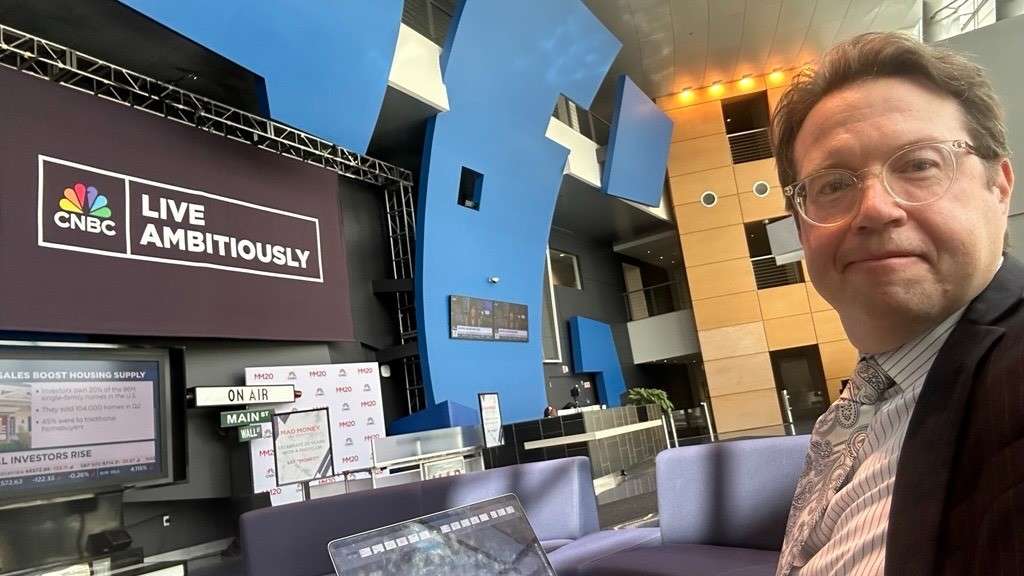
Earning the CNBC Spotlight: Why it’s a test for whether your story really matters

We often get asked “How do you get your clients on national TV?”

The answer is you have to understand that a national television broadcast schedule is finite real estate in an era of near infinite digital and commodified news spaces. It’s also live, adding to its finitude. Anything that gets attention needs to be relevant to the most valuable movements in markets that hour, and for the coming week.

In short, you have to truly earn that attention.

Most stories, companies or investors don’t rise to that occasion, which is as it should be. And it’s not a question of how many drinks you’ve had with members of the CNBC staff or being a second cousin of a producer.

How evocative and how much evidence does your story have that your story that week provides a valuable insight that fits with most of the rest of the news expected that day and week?

Here’s a transparent look at what it actually takes to warrant and manage a top-tier broadcast interview — from pitch to post-production.

Before the Interview: The Groundwork That No One Sees

The journey starts long before the cameras roll, or at least before the digital packets of data get warmed up.

Before a producer even replies to an email, we’ve already done a fair amount of heavy lifting — watching the news cycle carefully, seeing who’s focusing on what, and anticipating what’s going to be in the news next, refining the story in relation to that, and matching it to the right show, and making sure our client’s expertise aligns with what the network is talking about that week.

And let’s be clear what refining means. It doesn’t mean spinning and trying to force the story you want to sell into the news. It means being confident enough to drop the stuff that’s not relevant, focus on the stuff that’s relevant, and figure out how the stuff that takes some care and involves some risk to tell, can be shared prudently.

  • Building the right narrative: CNBC isn’t looking for company updates — they’re looking for insights backed by new evidence that move markets or explain trends. We craft a pitch that connects our client’s perspective to breaking financial or industry news.
  • Timing is everything: Broadcast runs on news cycles, not marketing calendars. Landing a segment often means being ready to pivot quickly when a relevant story hits. Our client was taking calls with producers, often with very little notice, on weekends, from the road, whatever it takes. You’re on their schedule, not the other way around.
  • Relationships matter: Having trusted relationships with the producer (or in this case, working to understand what matters to them and the role of shared stories and histories) helps make you worth paying attention to, but the story has to deliver. The best pitches are clear, timely, and make the producer’s job easier.

During the Interview: Managing the Moment

Once the opportunity is secured, the focus shifts to performance.

We work closely with the client to prepare — not to script them, but to help them show up like a pro.

  • Media training: Even seasoned executives need practice translating complex topics into clear, TV-friendly responses. Some call them soundbites, but really it’s just practice in saying things succinctly and in an authentically engaged manner.
  • Logistics and coordination: From studio booking to camera angles, wardrobe guidance, and tech checks — broadcast interviews are a choreography of details. And we are onsite to help coordinate every step of the way, without getting in the way.
  • Real-time support: On the day of the interview, we’re in touch with producers, monitoring live coverage, and ensuring everything runs smoothly from both sides without losing the invite by getting self involved.

It’s a mix of adrenaline and precision — and when you finally hear the anchor introduce your client live on air, it’s a special kind of thing.

Why? Because again, that three to five minutes is special real estate in the day. If you’ve earned a place in it, it’s because your story truly does matter.

After the Interview: Celebrate the Moment

The segment doesn’t end when the cameras stop rolling — that’s when the celebration occurs.

  • Clipping and sharing: We secure the final recording and share it across the client’s owned channels — LinkedIn, website, newsletters, internal communications, and more.
  • Earned-to-owned storytelling: Earning the attention of CNBC and warranting time in the news day is a mark of your place in the news and business cycle. And we help clients weave it into the appropriate place in their story and evolution.

Final Takeaway

Top-tier media coverage doesn’t happen by luck — it’s built on respect for the news, journalists, and an appropriate strategy, combined with thoughtful persistence, and open partnership.

If you’re a business leader or marketing executive aiming for national broadcast exposure, remember: you have to earn it and work for it, and because of that it’s not just about the moment on screen. It’s about the honest and real story, the prep, and the people behind it who make it happen.

At Gale Strategies, we help clients find where these things exist, earn these moments — and make sure they fit into your ongoing story in the right place.

Categories
Media Relations

How much do public relations and marketing cost?

We don’t see a point in making PR and marketing costs a mystery. Below is the current pricing for media relations and marketing from our team on a per result basis.

It’s based on an average cost of these deliverables across five years. Though we pay attention to how much it’s cost us more recently (with the ambition of bringing the price down where possible).

Are we cheaper or more expensive than other firms? We’ve been told we are a premium service. One that delivers greater specificity and intent in our work than others. We’ve also been told that the premium accurately reflects our drive to do more than churn out deliverables. It reflects our doing the necessary work and thinking that connects those deliverables, and the strategy that animates them into profitable sales growth.

We’d love to get your feedback and questions. Please reach out to us.

Media Relations:

🔹 Media Result Top Tier – $3,815

🔹 Media Result – $2,765

🔹 Byline – $4,445

🔹 Press Release – $2,526


Content/Marketing:

🔹 Social Post – $494

  • Planning
  • Drafting
  • Targeting
  • Graphics
  • Tagging
  • Coordinating interactions with external and internal accounts
  • Posting and management
  • Measurement
  • Coordination with other posts

🔹 Webcast – $5,672

  • Scripting
  • Prep
  • Email promotion
  • LinkedIn promotion and LinkedIn posts
  • Hosting
  • Video editing
  • Development of follow-on clips and content
  • Reporting on attendance, engagement, etc.
  • Posting as a podcast on external platforms

🔹 Blog / Article – $2,947

🔹 Case Study –$3,671

🔹 White Paper – $5,132

🔹 One Pager – $3,485

🔹 Definitive Guide – $7,920

🔹 Audiocast – $4,800


Sales Outreach:

🔹 Monthly SalesOps Cycle – $4,762

🔹 Email Campaign – $2,437

🔹 Email Campaign Nurture – $1,200

🔹 Survey – $2,677 (contingent on a larger program)

🔹 Roundtable – $18,000 (intensive event)

🔹 Awards & Events – $3,088


Website:

🔹 Web Page – $5,902 (highly contingent on the page in question)

🔹 Web Update – $2,400

🔹 Web Maintenance – $1,060

Categories
Media Relations

How to Achieve Top Tier Media Coverage

How to Achieve Top Tier Media Coverage

Top Tier Media Graphic 2

Getting a reporter’s attention in today’s media landscape is more challenging than ever. If you’re pitching top tier reporters and not making any traction, you’re not alone.

Almost half of journalists say they “seldom or never respond to pitches,” according to a recent survey. It likely has less to do with the story your company has to tell, and more to do with how your media strategy needs to evolve to fit within the current state of journalism.

How do you adapt your media strategy to add value to top tier reporters in today’s news cycle?

Download our one-pager to learn more. 

Fill out the form to download our one-pager:

* By downloading, you are agreeing to be subscribed to our email list.

Categories
Media Relations

The Definers Episode 3: Jessica McNellis and How Top Tier Media Happens

How do you get top tier coverage? Do you have a new product launch, partnership, funding, or are you making major strides for the future of your market and not getting proportionate recognition?

Jessica has more than ten years of experience creating and leading B2B public relations for companies spanning the healthcare, technology, legal, and sciences industries. A seasoned media relations professional, she’s earned clients’ interview and byline placements with notable business outlets, including The New York Times, Forbes, Bloomberg, and The Wall Street Journal, and a myriad of regional and trade publications. She has a proven skill for connecting clients’ stories with relevant news and works with clients to ensure media placements are leveraged to further their message with target audiences through engaging content, social, and marketing materials. We ask her why some companies and their media relations succeed, and others fall short.


Chris Gale  00:02

This webcast is prompted by some businesses that have been coming to us to talk about top-tier media relations. There’s especially been a little bit of a surge in the last two months. What seems to be happening, as far as we can tell, is that with interest rates and what’s happening in the venture capital community, there are businesses that need to talk to a larger audience. They see top-tier media as the opportunity to do it because they’re looking at trying to extend their runway. There’s another set of businesses or investors as well. They’re coming to us, and their model helps protect them from that particular environment. Perhaps they are not leveraged, or something about their business means that this is a good time for them. While others might be struggling, they have an opportunity to invest if they raise awareness of what they’re doing. They’re built for this kind of environment where the cheap money goes away, putting the macro stuff to the side, and some folks are joining who do not necessarily come from the private sector.

Everyone’s coming to us saying, “Okay, how do you achieve that top-tier media result? We already have a PR firm, and they’re supposed to be the best in our particular industry, but they don’t seem to be able to bring us the kind of stuff we see you bringing for your clients. How do you do it? So, we decided to just publicly ask Jess McNellis, our principal here at Gale Strategies, how she does it, how we do it here at Gale Strategies, and how she’s done it through her career. There is a Q and A at the bottom. We would love to have your questions and answers. For former colleagues of mine going way back to grad school who might be joining this webcast, sarcasm is welcome, if you wish. So, Jessica, how do we reach top-tier media?

Jessica McNellis  02:08

Top-tier media is certainly a highly competitive space. At the end of the day, it’s often a game of reaching the right reporter at the right time with the right story. Oftentimes, companies focus their outreach efforts on sharing internal news that they’re excited about putting out there, like new partnerships, product launches, and new hires. Then they are disappointed when that doesn’t garner an immediate result in the top tier. If you’re looking to begin building top-tier relationships to drive a feature story in the long term, the best way is to insert yourself into the stories that reporters are already covering, they’re already writing about, so you’re leveraging your expertise to be a resource to them for the topics that are interesting to them. So, when we’re engaging with reporters from the New York Times and Wall Street Journal, a lot of their coverage is often driven around breaking news headlines, what’s timely that day, what’s pressing, what’s happening right now, and tying your story into those timely news hooks.

For example, at present, the election and how each administration’s policies might impact businesses in your industry. Or how Covid at one time was the breaking news headline, and finding a way to talk about how what you were doing would impact the pandemic. Those breaking news headlines and finding a way to bring a fresh story, a fresh perspective, to these angles that they’re already saturated with is a great first avenue to build that relationship. Get in front of them, make your name more familiar to them, and build yourself up as an expert with the idea that, in the long term, they would see more value in some of the Internal news that you’re putting out like those partnership announces, product launches, and other bits like that. Tying your story to those timely news hooks and inserting yourself into the stories they’re already covering is a good first avenue to get a top-tier media hit where you’re included in that story. Then, driving forward a story where you are the headline is certainly more of a feat, but it is still possible in the top tier.

Chris Gale  04:08

Excellent. If I’m a Human Resources consulting firm or I am a law firm, and I have some engagement to announce, you’re saying the industry press might be interested. But if I want to get to the top tier, it’s got to touch a larger trend.

Jessica McNellis  04:35

Ideally, a larger trend. If you do a mini audit of many of the top tiers, oftentimes they aren’t covering partnership announcements unless it includes a household brand name that is appealing to everyone in their audience. Or they won’t cover a new CEO announcement unless it’s at a major corporation or someone coming from a major corporation that’s going to drive those clicks. But if you have a story that’s a new partnership announcement, and through this partnership, you’re going to be addressing this issue that’s important to a high percentage of their readers, the focus of the story could then be on that issue, that trend, with the nod to the partnership as one way that this is being addressed.


Chris Gale  05:25

Excellent. If I don’t have the big-name element, can you give me an example from some of the media results you’ve brought across in terms of a larger trend that a piece of news can fit within?


Jessica McNellis  05:44

An old company I used to work with was in the edtech space. During the pandemic, there was certainly a lot of news and concern around the education sector about whether students were falling behind in the remote education space. Schools were struggling. Teachers were struggling. Administrations were struggling to provide kids that same level of education even though they were doing it through a screen and not getting that same one-on-one attention. So, we had put forward this edtech company to talk about their program to drive more advancement in math, specifically. So, it was very niche. We could focus on that broader trend of students falling behind, while here was an education technology that could specifically address this problem.

That alone might not be enough because I’m sure those reporters covering that topic were getting an influx of pitches from every single education technology company that came out of the woodwork. They were just sifting through them, trying to determine what’s different, what’s new, and what works. So, they really leaned into providing data and collecting data on how students were progressing using this technology as a point to bring forward to the top-tier reporters.

Then, as a second piece, they also had a really interesting founder story that had previously been overlooked in their PR efforts. They had a founder who had been a teacher in charter schools for 10 years and had worked on curriculum. She had also gone to MIT and had this amazing background that she was putting together to create this technology. She had been working at the teacher level, saw an issue, and shifted to create a technology that could create that change. So, we leaned into that human interest piece about the founder, some of those teacher stories, and then also the data piece and how it actually works. We’re not just saying it works anecdotally. It was tried and true at these schools, even if it was at a smaller scale at that stage.

Chris Gale  07:56

If someone doesn’t hire a PR firm, how can they figure this out for themselves? Because I think we’ve all had conversations on the PR side with clients who say, “I have this amazing story.” Is there a way of reading the news to discern what those trends are, that you might have something contrarian, that your news might have something contrarian to say about this larger trend, or to figure out what is the top-tier-worthy part of what you do have?

Jessica McNellis  08:39

Reading those target publications that you’re looking to be featured in, see what type of news they’re covering. See what reporters are covering that news. You can often read between the lines to see what type of criteria they’re looking for. Sometimes that’s a financial criterion. They might not cover deals or funding that’s under a certain value. They might only cover things that check certain boxes that they can pitch to their editors. So, trying to read between the lines and figure out what pieces of the puzzle you might need to bring forward to them can be done just by regularly reading their coverage and getting a feel for their writing and their stories that they’re often picking up.

A second piece to that would be, if you read a story and you think, “I could have said this, my competitor was quoted, and I have the same point of view. I could have been featured here as well.” Then you try and pitch yourself to that reporter. The old story has now already been told. They’ve already written it. It’s no longer new, timely, and novel. You have to bring them something unique. What’s your unique perspective that you’re able to bring to that story? What’s something fresh that they haven’t already covered? Because the likelihood that they’re going to cover the exact same story in the exact same way with the same perspective from a different person is unlikely in this current news environment. I’m looking at what they’re covering and then trying to have an eye for what’s missing from that story, what might have been overlooked, that might not be on their radar yet and would be interesting to their readers.

Chris Gale  10:11

You’ve described a lot of ways to look at news and how it might be relevant to a larger storyline. You’ve talked about reading the news. You’ve talked about reading target publications. You haven’t talked yet about who you know. I think people tend to come to us and say, “What connections do you have top-tier reporters?” Is it the connections that you have with the media or the quality of the story you have in terms of how it taps into these larger trends?

Jessica McNellis  10:55

It’s a common misconception in the PR world that if you have a high Rolodex of reporters, you are just able to call in a favor, and they will write a story featuring your client based on that relationship. I would say I’ve never seen that to be the case. Certainly, having a high Rolodex could be an indication that you are good at building reporter relationships. But, at the end of the day, reporters are looking for the right story for their audience. They also have editors who oversee them in some capacity and determine whether a story can go forward or not. The idea that having a relationship with a top-tier reporter is going to instantly result in a feature in the exact messaging that you want is a little bit unrealistic. Reporters are always putting the story first.

I would say a much better quality to be looking for when you’re vetting PR firms or when you’re looking to do this on your own is just having the story and having the capability to build that reporter relationship. Reporters are often also bouncing around to different positions and different beats. So having one reporter one year that is your tried and true, that’s able to cover all of your news, might move another year to a separate publication, or start covering an entirely different industry, and you’re going to have to work from scratch to rebuild with whoever has taken over that beat. Building reporter relationships is a high priority when seeking out PR firms. Does the firm have someone who can do that from scratch without any inroads – just an email – and shape that story for you, look at your business, see the connection between your business objectives and your story, and how they tie into the publication’s news cycle and what’s interesting to their readers?

Chris Gale  12:45

So, if Gale Strategies, bizarrely enough, was to hire a public relations firm, the reporter relationships and connections are important. But are you saying that it’s sort of a lagging indicator of the quality of the work? In other words, the media relations of the quality of the work that the PR firm is doing is less about their connections, but rather that they have connections because of how they do the media relations.

Jessica McNellis  13:12

Exactly, I would say connections are a good peripheral indicator that a firm is good at building relationships. But, oftentimes, the person that’s going to have an interest in your story could be someone that you’ve never reached out to before or have no connection to. Being able to shape that story and make it interesting to a reporter, make it something that they’re opening in their inbox and asking for a follow-up interview about, is a much more important skill than seeking out PR firms. It’s better than someone who has existing relationships that they can turn to in hopes of facilitating a story.

Chris Gale  13:49

I know that you’ve done work in the nonprofit sector in New Zealand. Is that an illustrative example? You’re not a media relations person embedded in the New Zealand media landscape, but you achieved impressive results in an entirely different sector or news environment than where you had worked previously. How did you achieve that? You didn’t have any connections, but you achieved top-tier, high-quality results. How did you do that?

Jessica McNellis  14:21

That goes back to the point about working on your skills of building relationships. When I was working with the nonprofit in New Zealand, they had a list of top broadcast targets and top-tier New Zealand publications that obviously I had no inroads with. So, we just did the initial work of looking through their stories and what types of stories typically get published in those outlets and tried to draw that line. They had a really interesting human element. They had a beautiful nonprofit story that drove a lot of public interest and had a lot of public impacts. Even at the mid-level, they had a government impact that previously wasn’t being addressed in the media. So, we leaned into that and started to build those relationships.

Once reporters got on the phone with their founder and heard their story, it was an easy road from there. That would be an example of having no existing relationships to work off of and just having to shape a story that aligned with those publications’ audiences. It’s proof that if you have the right story, it does not matter if you had a pre-existing relationship. I could say the same for you at each stage of your career. Chris and I worked together in a past life at another agency. Oftentimes, we were working in different regional markets that you’d never touched before or were working with reporters or lawyers in different countries that you were trying to play catch up on what was relevant to that media market. Oftentimes, that coverage was not a result of having a preexisting relationship with a reporter. It was having to quickly build a relationship with a reporter and align their story with the reporter’s coverage.

Chris Gale  16:11

Anybody who has questions, please fire away, especially if I’m not getting to a question you have on your mind. Most companies come to us, and they want to be in the Wall Street Journal. They’d like to be quoted on something. They’d like to be seen as this source of information. What everybody wants is an article in the Wall Street Journal saying you’re doing this or that thing because it’s presumably amazing. I hear you describing a matching, what sounds like matchmaking. Where, in that New Zealand example, was the thing that they thought they wanted to share with reporters and the thing that reporters were most interested in. Did you need to ask more questions to orient yourself on something else? Did you have to ask certain questions? What were those questions that were uncovered in that or another instance to find the thing that is both interesting to the reporters and useful from a business or organizational mission perspective?

Jessica McNellis  17:57

In that case, what they brought me on for was to get the media coverage around events that they were hosting locally. The top-tier media doesn’t often publish headlines about an event being hosted that’s a little bit self-promotional. It would be something that might be on some sort of an event board or a calendar somewhere, but not a headline. So, we did do the deep dive to say, “Okay, you’re hosting this event, but why are you hosting the event? What are some of the deeper issues behind it?” We ended up digging deeper into why this nonprofit was started, this bigger community issue, some of the stats behind how it was impacting everyone locally, and the opportunity for people locally to get involved through this event and become part of the organization in a way.

So instead of leaning into pitching a story about how they were hosting an event and, if a top-tier reporter wanted to cover that this event was being held, we honed in on how the story was a deep underlying issue that’s impacting the community. The community can get involved in XYZ ways. There is also this event happening this weekend, which makes it semi-timely to cover it now, and then the final stories usually ended up being about this broader issue with a mention of the event, which is what they still wanted. They wanted to get news about the event out there, but the headline was never going to be the event. We just wanted to make sure that the event got noticed in the media. It ended up driving a lot more engagement publicly too, because people were more interested in the piece of the story that they could see themselves in, which was, “How do I get involved? How do I help create change?” Whereas, you know, if they’d spotted a headline about an event across their inbox, they might disregard it. They wanted to see themselves in that story. They were able to see themselves in that story and see how they could make an impact. It continued to spiral from there. We were able to drive even more top-tier immediate interest because people were now talking about it.

Chris Gale  20:01

What you just said was fascinating to me because I have been doing media relations in the government space, but I’ve never done media relations in the nonprofit space. The private sector seems to be constantly up for self-promotion, especially companies selling products. Even in the nonprofit sector, reporters are like, “Yeah, I know you want to write the story about how great your organization is, but we’re not going to do that.” Is there anything that organizations can do in either selecting the story they want to say or enhancing the chances that it airs increasingly on a feature about them and who they are?

Jessica McNellis  21:17

I think it is still trying to do that matchmaking behind the scenes. One example that’s popping to mind is a recent client that we worked with that had a few pieces of news coming out. The piece that they thought was the most noteworthy, that they thought was going to get the most attention was this rush in new customers and new leadership announcement. Internally, I’m sure that was the most exciting element impacting their organization. Then when we were reading through the different announcements, we realized the announcement that was likely to drive the most attention with the media was a piece of research that’s coming out that aligned with what a lot of people were talking about in the broader industry space. It provided statistics that could help prove that point that reporters were starting to toy with. Once we were able to have those conversations, it did drive a lot of attention for that client. Their research was something internally that they thought was important and they wanted to get out, but they didn’t realize that it would be the hook that would be the most interesting to reporters.

It’s easier talking to reporters when you’re able to talk about a story that they’ve already been peripherally talking about or have completely missed and can share data and promise more data to come and offer interviews with expert sources. They were able to be more of the headline because the entire story was about their research. It was hard not to have them be the focus in that instance. But that would be one example of finding the right story within your organization. Something that you might have shelved as just a press release to put on the website might actually be the center stage story that you need to be pushing out to the media. And the story that you thought would be the big headline news might be something that they’re not interested in covering.

Chris Gale  23:18

My final question relates to after The Wall Street Journal feature occurs. What’s your advice on not being caught in a situation where it’s like, “Wait, we’re in Wall Street Journal!” and then nothing happens?

Jessica McNellis  23:47

I think a lot of people make the mistake of thinking that the top-tier media hit is the end of the line when really it just sparks a whole second part of your PR campaign. When you’re looking at top-tier media publications, many of those are blocked behind paywalls. So, while they do reach a wide audience, if you’re trying to have a specific audience within your network read it, the likelihood that they have a subscription is slim. If they have one, have they happened to have logged on that day? Or happened to have read your article when it was being pushed that day or before it got buried in the next day of coverage? Paywalls minimize the eyes that are on that story. To make the most of it outside of the story beyond publishing, you really want to push it on social media, have people within your organization pushing it on social media as well, with their own context, and share on your website, whether that be in a news section or even including the logo on your homepage. People who are quickly bouncing to your website can see that you’ve been credentialed by a top-tier media publication. If you have newsletters or communications that go out to your audiences, your investors, and other stakeholders, you should be featuring that in those newsletters so that they’re getting eyes on that.

At a more micro level, use the top-tier appearance as an excuse to reach out to prospects or clients or partners, to have that one-on-one email touchpoint. There are a million other ways you can repurpose it. Whether it be submitting for awards or when you’re at an event, have printouts or QR code channeling back to it. The expectation that you’re going to get top-tier media coverage, and that’s the end of the road, and there will be this influx of interest from whatever party you were trying to catch the eye of, is certainly unrealistic in the sense that there is a whole part two that lasts weeks.

This topic is probably the subject of a webinar for another time. Also, you can leverage media to get more media once you’ve been credentialed somewhere. You can use it to hopefully get the attention of more media. It continues in a non-stop spiral to continue to drive that engagement.

Chris Gale  26:05

We’re at the end of time. I love where that finished. We can follow up with members of the audience who might be interested in more. That art of achieving the media result starts when you’re planning the media activity and leads to how you’re utilizing it afterward. That method of spending money on media relations to get the most value out of it is, I think, interesting.

Maybe we can have a further conversation about that or include some additional team members on how to get the full value out of the hopefully successful media relations dollars you’ve spent to reach the top tier. Thank you everybody for joining.