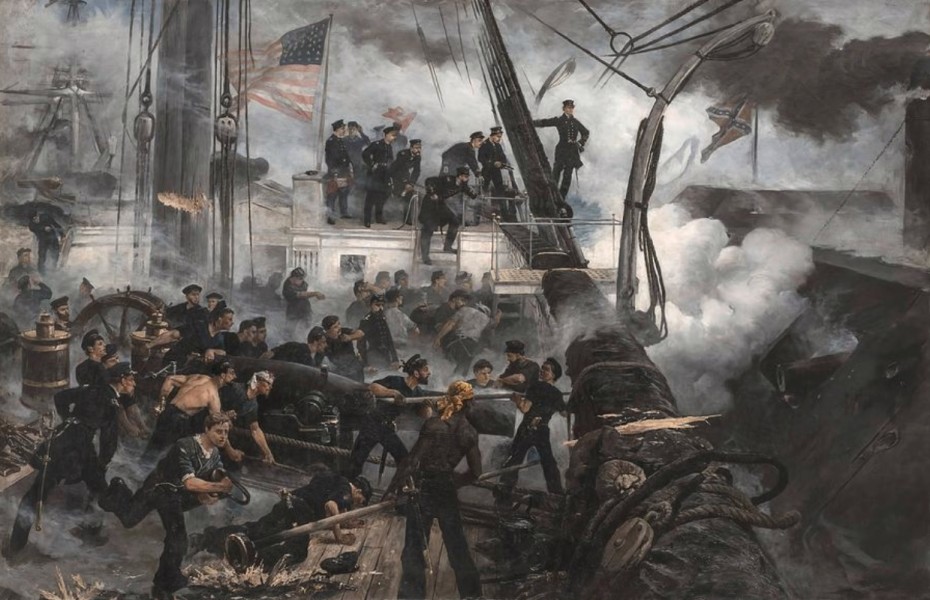
Before 60 seconds were up, one of the U.S. Navy’s most powerful warships had slipped under the surface of Mobile Bay, Alabama. The ship’s pilot and a few more men scrambled out the only hatch available. Everyone else on board was trapped, drowning and soon dead.
As we launch Gale Strategies, a public relations firm for digital thought leadership, I think about that moment. Depressing right?
Actually, it’s what happened next and why it happened that demonstrate that Gale Strategies is ready for the world and why your business is ready if you’re bringing about digital transformation.
Torpedoes
The ironclad USS Tecumseh hit what we call today a “mine.” One of those spiky explosive balls floating below the waves that you have to avoid, if you still remember the game Minesweeper. In this case – back in 1864 – they were called “torpedoes.”
If the just-sunk Tecumseh was one of the U.S. Navy’s most powerful ships, the world’s most powerful was the Confederate CSS Tennessee, and it was coming straight for the clump of Union boats behind where the Tecumseh had been.
“Damn the torpedoes! Full speed ahead” – U.S. Admiral David Farragut is alleged to have shouted.
And despite it being apparent suicide, the fleet pushed forward through the minefield and into the embrace of the Tennessee. By the end of the day, with Farragut literally tied to his flagship’s rigging so he could see above the smoke, the fleet had come out on top in one of the greatest naval victories of the U.S. Civil War.
Apart from all of us wanting to win, what does this story have to do with launching a business or digital transformation? Well first, everything most of us think we know about the Battle of Mobile Bay is wrong. It’s wrong in a way that’s similar to how few really seem to understand digital transformation (more on this later).
Against all odds
“Damn the torpedoes,” has come to mean moving forward despite considerable risk. It’s a cry of the determined who accept their fate and will go against all odds.
But that’s not what Farragut meant.
If he wanted to be more precise he might have said –
“Actually, I’ve calculated the key variables in this scenario and it may not seem like it right at this moment, but we’re in a much better position than the other side. To pull back now in the face of this loss would mean to delay success further.”
Thank goodness that’s not what he said.
Farragut was not impatient, nor reckless. He had a vision, and he could see tomorrow from where he stood.
His fleet had been sitting outside of Mobile Bay for eight months. He had not attacked even when he knew the Confederates were building the monstrous Tennessee, because the U.S. army did not have enough forces in the area to translate a win on the water into occupation of the forts around the harbor and the capture of Mobile itself.
He had to give up at one point while waiting, and leave Mobile Bay to help a failed campaign elsewhere before returning. Eventually the army delivered ground forces, but he did not have iron ships to help with the attack. So he waited as the Confederates strengthened the forts protecting the harbor, laid mines, and finished the Tennessee.
But on August 5th (yes, this Monday is the 155th anniversary of the battle) he finally had the combination of forces he needed to succeed.
Farragut didn’t have absolutely all the variables calculated, but he knew that he was now in position to absorb tragic losses like the Tecumseh and still roll over his opponent.
Farragut was patient, and he knew how to steadily build a winning position, and then when to push it home. He knew when the wave of history was with him.
Digital transformation
Public relations. Your own industry if you’re not in PR. All of it is changing. Your investor deck may hide the fact that deep down inside, you feel like an underdog fighting for an opening. The incumbents may be the world’s most powerful – like that huge CSS Tennessee bearing down on us. You may worry that you’re on the wrong side of the competition’s winning streak. Unknown and unseeable dangers are all about us as we navigate these waters. We will take losses.
But around Farragut and beyond that day in Alabama, slavery would be washed into the past. It had to be. Industrialization in the Northern U.S. would prove more powerful than the feudal plantation economy in the South. Immigration and the influx of Irish and Germans in the North and black troops who joined the Union army together would prove more powerful than the best the South could offer. The war would be grim, but the wave of a new era was pushing across the country.
That wave would be articulated by Abraham Lincoln, through his Gettysburg Address, through the thought leadership of new industrialists, shipbuilders and young women and men who would carry the wave forward. That’s the spirit of Gale Strategies today.
We want to help you articulate today’s wave of digital transformation, to define what the future of your industry will look like, and why you are leading the way. It’s not reckless; we know how to do it.
We’ve calculated the key variables in your scenario and it may not seem like it right at this moment, but we’re in a much better position than it initially appears. To pull back now in the face of distractions and even losses would mean to delay success further.
One hundred and fifty five years after David Farragut said it – Damn the Torpedoes, full speed ahead. I hope you will.