
Categories
AI

The Three‑Part Clarity Playbook for April’s Market

After Gale Strategies’ meetings across Silicon Valley last week—conversations with founders, private capital investors, operators, and senior executives—one thing became unmistakably clear to us: the market is no longer waiting for clarity. It’s pricing its absence.

And AI’s acceleration is no longer theoretical. It is actively pushing layoffs, re‑sorting categories, compressing timelines, and re‑rating businesses in real time. At the same moment, enormous pools of capital remain tied to assumptions formed in a very different environment, assumptions about leverage, growth, defensibility, and what buyers will tolerate.

More than a few of the folks we spoke with independently said decisions made or deferred right now will shape outcomes for the rest of the cycle.

That’s why it’s worth going one level deeper than what we were sharing before these meetings. Because in moments like this, clarity becomes one of the most valuable assets any organization can possess.

The Three-Part Playbook

When companies think about messaging, they usually default to what they want to say. Their roadmap. Their strategy. Their internal logic.

That’s important, but it’s only the first layer.

Effective communication, especially in markets undergoing structural change, requires recognizing three distinct messages.

1. What You Want to Tell the World

This is your strategy, your priorities, your internal narrative. It reflects how you see your own evolution and where you believe value is being created.

Most companies stop here.

2. What Your Audience Needs to Hear Right Now

Investors, buyers, partners, and employees are not neutral listeners. They bring:

  • Specific fears
  • Incentive structures
  • Time pressure
  • Career risk

Is this something we should buy, or can we build it faster, cheaper, and with less risk ourselves with AI?  If we buy, does it meaningfully accelerate our roadmap and ROA, or does it introduce integration, credibility, or obsolescence risk?

Buyers are scrutinizing whether a product or service delivers durable differentiation or merely bundles capabilities that AI and internal teams can now replicate.

The market is rewarding companies that clearly compress time‑to‑value and punishing those that feel incremental, unclear, have dependencies, debt holding them back, or may fold.

What your audience needs to hear today is not what they needed twelve months ago—because the default assumption has shifted from “buy to grow” to “build unless proven otherwise.”

3. What Journalists Are Looking for to Explain Where the World Is Headed

This is where public relations does its real work, and where most companies misunderstand the role entirely.

Journalists are not translating what you want to say. They are translating what the broader market needs to understand next, if you have something relevant to share.

They are looking for signals that map concretely and illustratively to larger shifts:

  • Economic
  • Technological
  • Cultural

Whether you participate in that narrative or not.

To do that, your story must be:

  • Clear
  • Defensible
  • Supported by evidence
  • Validated by credible third parties

If you can align these three—your intent, your audience’s reality, and the direction of the world—you don’t just communicate more effectively. You shape the frame through which your sector is understood.

That’s how categories are defined. And redefined.

Why This Matters Now, Not Later

The urgency we heard in Silicon Valley last week wasn’t rhetorical. It’s structural.

We are living through at least two simultaneous realities:

  • First: AI is actively re‑pricing entire markets. Not gradually, rapidly. Companies that can demonstrate real, defensible AI leverage are being pulled forward. Those that can’t are being discounted, sometimes brutally.
  • Second: A vast amount of private capital is still anchored to legacy models, models built for a world of cheap leverage, forgiving timelines, and narrative optionality.

That combination is creating pressure everywhere:

  • On valuation frameworks
  • On product strategy
  • On category definitions
  • On how relevance itself is explained

This is especially acute right now because many investors and operators understand, implicitly if not explicitly, that the next few months are an execution window. Buyer psychology is forming. Narratives are hardening. Assumptions are being locked in.

Once that happens, clarity becomes much harder, and much more expensive, to reclaim.

Clarity as a Competitive Advantage

What we saw repeatedly last week is that the leaders pulling ahead are not the loudest. They are the clearest.

They understand that narrative is not decoration. It is infrastructure.

They are doing the work to:

  • Translate operational progress into external meaning
  • Align their story with how capital is actually being allocated
  • Make their relevance legible in a market that no longer gives the benefit of the doubt

In moments like this, clarity compounds. Confusion compounds faster. And the gap between the two becomes very difficult to close.

That’s why this three‑part clarity playbook matters so much right now. Not as a communications exercise, but as a strategic one.

Because in a changing market, the companies that define the narrative don’t just survive the transition.

They set the terms of it.

Oh, and we still haven’t addressed the White House issue. To get a head start on that, this article from The Economist is helpful if you want to see how things like geopolitics are figuring into credit risk: https://www.economist.com/business/2026/03/15/trouble-is-brewing-among-americas-corporate-borrowers?

Categories
AI

The Persistence Playbook: What the AI and Debt Supercycles Demand

Anything that can be converted into capital and poured into AI hyperscale infrastructure is being pulled off the walls and melted out of businesses.

Capital and debt trapped in places that are not AI are losing value. And, as the post financial crisis debt cycle shudders to a grim conclusion, there is a lot of offloading risk to retail investors.

This digital blast wave emerging from Silicon Valley and expanding across the landscape, unlocking value, today feels like a black hole eating up the economy closest to where the blast wave first emerged.

Then there is the White House…(imagine me pausing here and looking at you with a meaningful expression before moving on). But we will return to that with a separate piece, so we’ll bookmark it for now.

Meanwhile, debt is rewriting the rules

For more than a decade, private equity thrived on the assumption that recurring‑revenue software was the closest thing to an annuity.

Debt was plentiful, models were stable, and the math worked.

AI‑native tools now threaten to replace, or at least take over, the next evolution of entire software categories at marginal cost – once the infrastructure is built.

Some previously defensible products now face erosion in pricing power, switching costs, or utilization patterns. As this sets in, credit analysts are projecting a meaningful rise in defaults concentrated among highly leveraged software and data services companies, especially those acquired during the low‑rate era.

The barbell strategy

Some operators are holding on while the tide goes out. Strong, cash‑rich incumbents can borrow to scale AI and secure scarce infrastructure, while highly leveraged mid‑tier players face tightening financial constraints. Early AI adopters without audited productivity gains risk burning capital, and leverage magnifies both the upside and the consequences.

The smartest operators and allocators are avoiding the fragile middle. They are running a barbell.

On one end: high‑conviction, capacity‑locking investments. On the other: money making, even low tech, done-by-hand businesses. Or at least products and execution that stay super close to deep enterprise problems and efficiently produce value. Preferably, capital is sourced without leverage, and from places that can be patient.

I know, don’t we all want sources of capital like that? Yes, in theory. But in practice those sources have been ridiculed as amateur or exotic, and cash efficiency in the low tech has seemed out of touch.

Somehow, we’ve valorized professional “smart money” in high-debt efforts thrown at high-growth, but speculative, bets. And sure enough, that movement worked long enough that the smart money is starting to look not so smart.

So how do businesses built like that advertise themselves to investors, customers and acquisition targets who aren’t used to seeing their strengths?

Well, I’m glad you asked.

Narrative clarity to cross the chasm

If you’re unlevered, you’re the exception, and the market gets nervous about exceptions. The ability to articulate why you exist, what you solve, and why now is an economic asset.

Moments that matter—launches, leadership updates, category pivots—must be sequenced, staged, and supported with true narrative infrastructure. This means aligning internal operations, market positioning, and communication well before going public with a story.

Precision, independence, and staying power

Today’s environment rewards organizations that operate with:

  1. Operational Precision:Build systems that scale intentionally, not accidentally. Slowness is not a bad thing in this case. Eliminate waste. Instrument everything.
  2. Capital Independence:Reduce external dependencies where possible. Borrow only for assets with provable, compounding utility.
  3. Strategic Specialization: Become indispensable in a specific domain, if not a few that are interrelated.
  4. Narrative Pathfinding: There are entrenched capital interests trying to get out of a burning building while pretending it’s in fine shape. Trying to look like them is not going to work out well. Find the stories that match the news cycle and help people see you more clearly. (This requires more detail, so stay tuned for how this playbook works in 2026 in a future post.)
  5. Persistence Over Hype:The winners of this cycle will not be those who sprint first, but those who remain standing long after the noise subsides.

The AI supercycle is not a gold rush; it is an infrastructure epoch, spanning power, data, risk, and governance. It rewards those who balance ambition with discipline, who build for endurance rather than applause, and who understand that today’s constraints are tomorrow’s moats.

This is not the era of “growth at any cost.”

This is the era of build, endure, and compound. The growth wave is coming, but you have to survive this part first.

Categories
AI

AI and PR: What we know (so far)​

AI and PR: What we know (so far)

Gale Strategies AI and PR (Dec 2025) copy

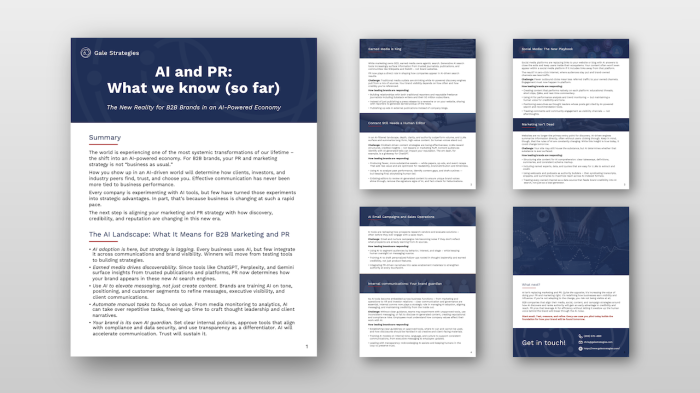
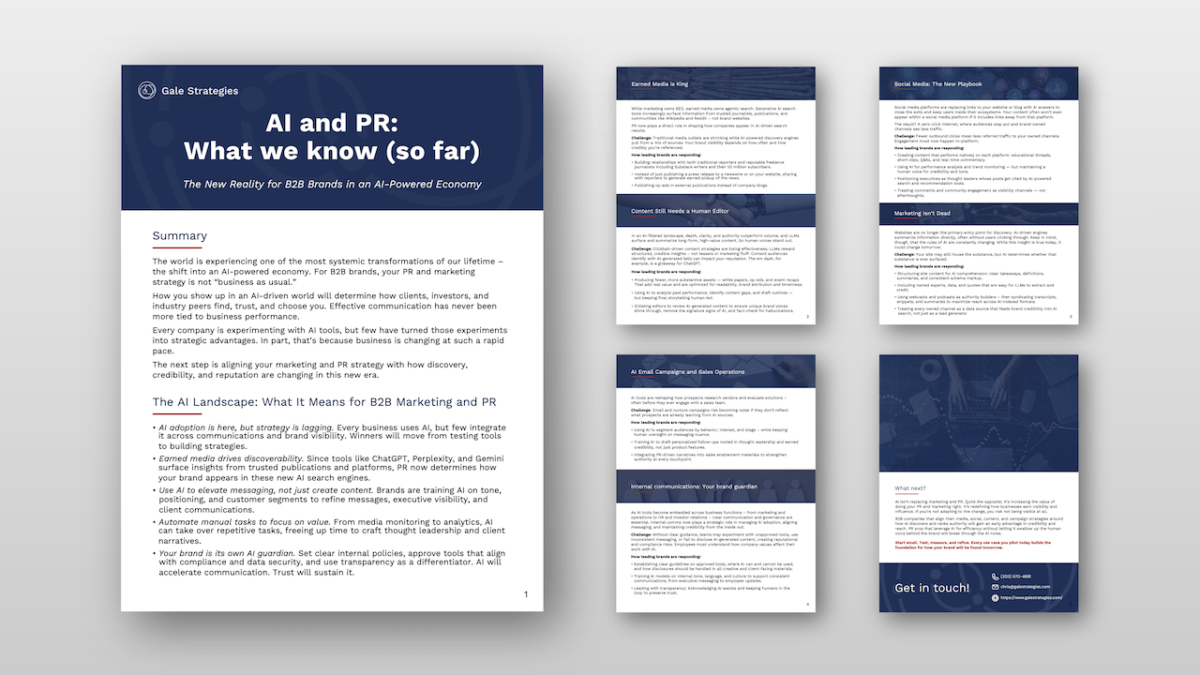
AI-powered search tools like ChatGPT and Gemini don’t rank websites. They surface credibility, pulling from earned media, trusted journalists, and authoritative sources. That makes PR central to how your brand is discovered, trusted, and chosen.

This guide breaks down how AI is reshaping discovery, visibility, and reputation, and what B2B brands should do now to stay relevant.

You’ll learn:

  • Why earned media now drives AI search visibility

  • How to use AI without losing a human voice

  • What the zero-click internet means for content and social

  • How AI is changing email, sales, and nurture campaigns

  • Why internal AI governance protects brand trust

Download the guide to understand how PR works in an AI-powered economy and how to adapt before visibility slips.

Fill out the form to download our white paper:

* By downloading, you are agreeing to be subscribed to our email list.

Categories
AI

Media Relations in the Age of AI

Media Relations in the Age of AI: Four Lessons for B2B in Late 2025

Media Relations and AI Thumbnail copy

AI is no longer a buzzword—it’s redefining how buyers discover, evaluate, and choose solutions. In this new environment, traditional PR alone won’t cut it. B2B leaders need media relations strategies that connect directly to sales, amplify trust, and create momentum across every channel.

Our latest white paper distills insights from industry leaders, live discussions, and real-world client examples into four actionable lessons for thriving in the AI era. From aligning PR with measurable ROI, to harnessing AI for smarter storytelling, to creating a sales-media flywheel, this guide shows you how to stand out in a noisy, AI-driven market.

Download the white paper today and position your business ahead of the curve.

Fill out the form to download our white paper:

* By downloading, you are agreeing to be subscribed to our email list.

Categories
AI

Lessons from “The Innovator’s Dilemma” for Business Leaders Considering Generative AI

Clayton Christensen’s seminal work, “The Innovator’s Dilemma,” has long been a source of guidance for business leaders grappling with disruptive technologies.

As generative AI emerges as a transformative force across industries, it’s worth revisiting Christensen’s insights.

Beware of blindspots:

Christensen highlights the tendency of established companies to disregard new technologies that don’t align with the preferences of their current customer base, especially when the disruptive technology initially offers a lower quality version of the existing technology.

Does ChatGPT or Bard write content of code as well as you would? No, maybe not. But….

Market incumbents often focus on serving their existing customers and optimizing their current products or services to meet their demands. This approach is based on the assumption that sustaining innovation—incremental improvements to existing products—will continue to drive growth and success. However, disruptive technologies often start by addressing a different market segment with different needs, and they initially offer a lower quality or less sophisticated alternative to the incumbents’ offerings.

In this scenario, the incumbent companies tend to dismiss the disruptive technology as inferior or irrelevant. They rely on the feedback from their current customers, who are typically satisfied with the higher quality products they already possess. The incumbents fail to recognize that disruptive technologies have the potential to evolve rapidly and improve over time, ultimately threatening their dominant position in the market.

The book explains that market incumbents face the “innovator’s dilemma” when considering disruptive technologies. They must make a decision: either invest in the disruptive technology and risk cannibalizing their existing business, or ignore it and risk being surpassed by new entrants who recognize its disruptive potential. The incumbent’s focus on current customers and their preferences becomes a barrier to adopting and exploring the disruptive technology.

However, as time progresses, the disruptive technology improves in quality, becoming more appealing to a broader customer base. This evolution allows new entrants to gain traction and expand their market share, eventually threatening the incumbents’ stronghold. By the time the incumbents realize the significance of the disruptive technology, it may be too late for them to catch up or adapt effectively.

“The Innovator’s Dilemma” provides examples from various industries to illustrate this phenomenon. Companies like Kodak, which disregarded digital photography due to its lower quality compared to traditional film, and Blockbuster, which dismissed the potential of online streaming due to its inferior video quality, serve as cautionary tales.

To overcome the innovator’s dilemma, market incumbents must recognize the importance of monitoring emerging technologies and potential disruptions. They should be open to exploring new market segments, even if the initial offerings seem inferior, and allocate resources to understand the evolving customer needs. By embracing a mindset of continuous innovation and being willing to disrupt their own businesses, incumbents can adapt to the changing landscape and proactively respond to disruptive technologies.

Embracing Strategic Innovations:

Christensen emphasizes the importance of strategic innovations, particularly those that challenge traditional norms. Generative AI provides a platform for such innovations, allowing organizations to explore new territories, experiment with novel ideas, and create groundbreaking solutions. Business leaders must foster a culture of innovation and empower their teams to leverage generative AI as a strategic tool. By embracing generative AI, leaders can challenge conventional thinking, disrupt their own businesses, and create new market opportunities.

Adapting to Uncertainty and Iterative Development:

“The Innovator’s Dilemma” underscores the need for businesses to adapt and iterate in uncertain environments. Generative AI algorithms thrive on data and continuous learning, constantly improving outputs through iterative development. Business leaders should adopt a similar mindset, embracing uncertainty and utilizing generative AI to experiment, learn, and iterate. By leveraging generative AI’s ability to generate diverse possibilities and rapidly evaluate outcomes, leaders can gain a competitive edge by iterating and refining their offerings at a faster pace.

Seizing New Market Niches:

Christensen highlights the importance of exploring new market niches that emerge from disruptive technologies. Generative AI could open doors to previously unexplored territories, enabling businesses to identify and capture new customer segments. By applying generative AI to understand customer preferences, customize experiences, and generate personalized products, leaders can unlock new avenues for growth and secure a competitive advantage.

Balancing Existing and Emerging Technologies:

Christensen’s book emphasizes the challenge of balancing existing business operations with the adoption of disruptive technologies. Similarly, business leaders need to strike a delicate balance between leveraging generative AI and optimizing existing processes. Rather than viewing generative AI as a threat, leaders should see it as an opportunity to augment human capabilities and enhance existing operations. By integrating generative AI into the organization’s innovation strategy, leaders can strike a harmonious balance, ensuring the coexistence of both traditional and generative AI-powered approaches.

Not a good idea to sit back:

By recognizing the disruptive potential, embracing strategic innovations, adapting to uncertainty, seizing new market niches, and balancing existing and emerging technologies, leaders can unlock potential in generative AI. As generative AI becomes increasingly prevalent, business leaders who understand and embrace its power will be well-positioned to drive innovation, gain a competitive edge, and secure future success.