
Categories
Media Relations

The Market Signal Package

Supporting Q2 2026 Enterprise Sprints

Price:

  • $6,878 per press announcement
  • Volume rate: $5,291 per announcement when engaging on three or more announcements

What’s Included (Per Announcement)

Each announcement functions as a contained narrative campaign, not a transactional press release.

Included:

  • Strategic press release writing
    Crafted to connect the company’s news to a broader market movement journalists already care about, not just a company update.
  • PR Newswire distribution
    Distributed via PR Newswire. Newswire fees billed separately; Gale Strategies does not currently add an upcharge.
  • Earned media outreach
    Targeted outreach to priority national business, trade, and relevant local reporters based on the nature of the announcement and the audience that needs to hear it.
  • One social post promoting the news
    Designed for amplification and signal-sending, not filler.

Why This Exists, And Why Now

Q2 2026 is not just another launch window. We appear to be at a narrative inflection point.

As Gale Strategies has outlined in the past two months, AI acceleration and the unwinding debt cycle are compressing timelines, rerating businesses in real time, and reshaping how investors, buyers, and journalists decide what matters and what doesn’t. The market is no longer waiting for clarity; it is pricing its absence.

In this environment, silence is not neutral. Delay is not inexpensive. And “we’ll announce when we’re ready” increasingly translates to ceding the frame to someone else. This offering is designed to help companies:

  • Enter the conversation before the narrative hardens
  • Align announcements with how journalists are now explaining where the world is headed
  • Turn discrete news moments into durable market signals

The Strategic Rationale (Grounded in GS’s Playbooks)

  1. AI Has Changed the Cost of Waiting

In AI platform and infrastructure markets, narrative is no longer downstream of the product; the narrative is the product. A few months of silence during market formation can mean:

  • Lost category ownership
  • Early adopters anchoring elsewhere
  • Journalists explaining the space without you

This is no longer a linear cost. It compounds. Structured, timely announcements are how companies pay the cost of delay before it becomes permanent.

  1. Q2’s Market Rewards Clarity Across Three Layers

As outlined in The Three-part Clarity Playbook for April’s Market, effective communication right now must align three things simultaneously:

  1. What you want to say (your strategy and evolution)
  2. What your audience needs to hear right now (time-to-value, durability, downside risk)
  3. What journalists are trying to explain next (not what happened last quarter)

Most announcements fail because they stop at #1. This offering is designed to connect all three, so news lands as context, not noise.

  1. Momentum Now Beats Perfection Later

Events, launches, partnerships, hires, and milestones are no longer isolated moments. They are raw materials for sequence and persistence.

As we outlined in Before You Leave for Your Event, Read This, the highest leverage teams treat moments as micro-campaigns that compound over time.

Similarly, The Persistence Playbook makes clear that in an AI driven capital reset, the companies that survive and win are not necessarily the loudest, but they are consistently legible to the market. Regular, disciplined announcements signal:

  • Operational momentum
  • Strategic intent
  • Structural endurance

In this cycle, visibility without coherence destroys trust, but coherence without visibility disappears.

Who This Is For

This offering is designed for:

  • Operators pursuing funding, M&A, or major customer inflection points
  • Private capital backed businesses under pressure to show clarity, not spin
  • AI-native and AI exposed B2B companies navigating compressed decision cycles
  • Leadership teams with multiple milestones between April and early summer

Examples of announcement types include:

  • Fundraising announcements
  • Product launches
  • Acquisitions/IPOs
  • Executive hires
  • Data or reports
  • Event attendance/participation as a speaker

If you anticipate three or more announcements, Gale Strategies will waive the standard project fee, reducing the per announcement cost to $5,291, because narrative persistence matters more than one-off hits.

The Bottom Line

The market is being reshaped in public.

Journalists are writing the first draft of the next cycle right now. Investors and buyers are using those explanations to make fast, high stakes calls. And companies that wait for “perfect” risk being explained by someone else.

This Q2 announcement package exists to make sure your company is present, coherent, and correctly framed while the window is still open.

If you’re planning announcements anyway, the question isn’t whether to communicate; it’s whether the market understands what you’re building before the frame sets.
Categories
AI

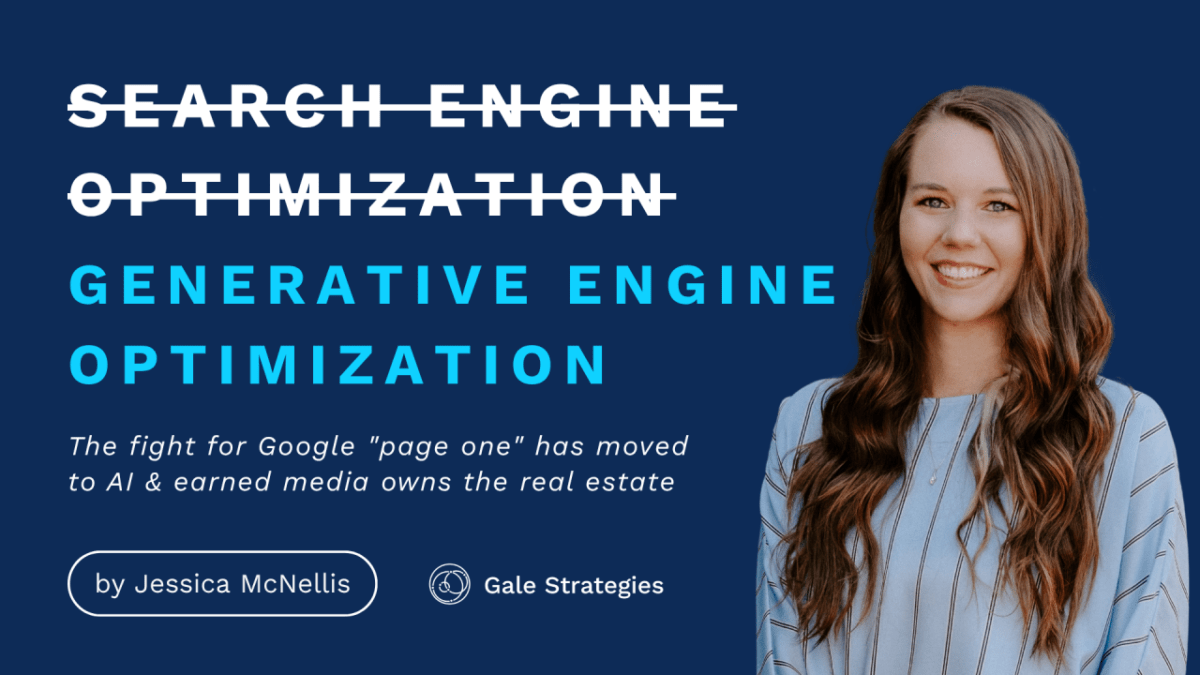
GEO Is The New SEO: Why Earned Media Matters More Than Ever in an AI‑First World

The fight for Google “page one” has moved to AI & earned media owns the real estate

Key Insights:

  • 95 percent of AI citations come from unpaid media sources
  • 82 percent come specifically from earned media coverage
  • Half of all AI citations come from content published within the last 11 months

For more than two decades, search behavior followed a predictable pattern. You opened Google, typed a query, scanned the blue links, and clicked a result from page one. Entire industries were built around winning that real estate.

That era is ending.

Today, people are not just searching, they are asking. And not their network or social media or Reddit. They’re asking AI.

AI tools have quickly become default research assistants for everyone from consumers to journalists to executives. This shift is fundamentally changing how information is discovered, prioritized, and trusted.

Welcome to the era of GEO: Generative Engine Optimization.

From Search Engines to Answer Engines

Traditional search engines return a list of options. Generative AI returns a single, synthesized answer.

Instead of scanning ten links, users receive a confident response that often shapes perception before they ever visit a website or even see a source list. The visibility battle is no longer about ranking links. It is about being present inside the answer itself.

If SEO was about links and keywords, GEO is about narratives, credibility, and trust signals embedded in AI‑generated results.

How AI Chooses What to Trust

AI does not evaluate information the same way Google’s search algorithm does. While owned websites and technical optimization owned SEO, AI systems overwhelmingly rely on third‑party validation to determine credibility, namely, earned media.

According to research from Muck Rack, more than 95 percent of AI citations come from unpaid media sources, and 82 percent come specifically from earned media coverage. That means independent journalism, reputable publications, analyst reports, and expert commentary carry far more weight than brand‑controlled messaging.

Just as importantly, AI strongly favors recency. Muck Rack found that half of all AI citations come from content published within the last 11 months. Credibility is not only earned, it must be consistently refreshed.

AI systems are designed to reduce bias and misinformation. They look for agreement across neutral, trusted sources. Earned media delivers exactly that signal.

Put simply, AI trusts what others say about you far more than what you say about yourself.

Your Website Does Not Control Your AI Reputation

Your website still plays an important role. But as a discovery engine, it can no longer carry the full load.

When someone asks an AI tool, “What are the most trustworthy companies in this category?” the answer is not pulled from your homepage.

It is shaped by how often your brand appears in reputable publications, whether your leaders are quoted as experts, and how consistently third parties describe your role in the market.

If that coverage does not exist, or if it is outdated or inaccurate, AI fills in the gaps without you.

The Early SEO Moment We Are Living Through Again

This moment should feel familiar.

In the early days of Google, brands that invested early in SEO gained lasting advantages. Page one rankings drove credibility, traffic, and revenue for years. Late adopters faced higher costs and diminishing returns.

GEO represents a similar inflection point.

Right now, the AI answer layer is still relatively uncrowded. Many companies are not actively managing how they appear in AI‑generated responses. Recent earned media holds disproportionate influence, and early visibility compounds.

Soon, more brands will compete for the same limited citation space, AI narratives will harden, and changing perception will become significantly more difficult.

The equivalent of page one real estate on Google is being claimed right now inside ChatGPT, Claude, Copilot, Gemini, and future AI platforms.

Why Media Relations Is the Strongest Path to GEO

This is why earned media relations is no longer just a branding exercise or a vanity logo for your website. It is a discovery strategy.

A strong media relations program helps organizations influence how AI understands their category, ensures visibility for high‑intent audience questions, anchors positioning in neutral and trusted language, and refreshes credibility with the recency AI demands.

Earned media does not just drive awareness. In an AI‑first world, it becomes context that shapes future answers. And unlike paid media, it compounds over time.

The Bottom Line: AI is the New Page One

Search has evolved. Discovery has evolved. Trust has evolved.

AI is becoming the primary interface between people and information.

The brands that win in this new era are already investing deeply in earned media relations now, while the opportunity to claim AI answer real estate is still open.

This is the new “page one.”

Categories
AI

AI Is Changing The Timing Of Public Relations

For most of the SaaS era, silence was a virtue.

You built quietly. You protected your IP. You waited for product‑market fit. And when you felt the message was clear, you had customer validation, you launched.

As companies pivot from seat‑based SaaS products to AI development environments, particularly in regulated enterprise markets, silence incurs a measurable tax. One that compounds every month because the narrative is no longer downstream of the product. The narrative is the product.

The Economic Inversion No One Is Talking About

From 2010–2023, software followed a predictable logic:

  • Expensive to build
  • Cheap to distribute
  • Revenue predominantly driven by seats, features, and adoption curves

AI flips that model. AI systems are:

  • Relatively easy to start
  • Expensive to operate (compute, tokens, orchestration)
  • Valuable only when deeply integrated into proprietary workflows and data

That inversion is driving a fundamental shift across enterprises: from buying tools to building internal intelligence.

Organizations are unbundling SaaS stacks and investing in platforms that let them:

  • Build their own AI agents
  • Own their IP
  • Control economics and governance
  • Capture outcomes, not licenses

Why “Stealth Mode” Now Destroys Value

In AI platform markets, delay can mean permanent value erosion.

1. Cost of Delay Is No Longer Linear

In SaaS, waiting cost you time‑to‑revenue. In AI, waiting costs you:

  • Concentrating early adopters and movers around you
  • Data and intelligence feedback loops
  • Long‑term account lock‑in that is now determined more by relationships than switching costs

A few months of silence during market formation can translate into seven‑figure losses in lifetime value, not because execution was weak, but because positioning came too late. By the time you “launch,” the market may already believe it understands the category. And correcting an established narrative is far more expensive than shaping it.

2. The Market Chooses the Frame Before It Chooses the Vendor

In every new platform shift, one thing happens consistently, the first company to clearly articulate the future becomes the reference point. Everyone else becomes a comparison. It doesn’t matter who builds the better system. The frame controls perception.

If you don’t define:

  • What “internal AI” really means
  • How AI should be governed in regulated industries
  • What “cost control” looks like in a token‑driven world  …someone else will.

3. “Build vs. Buy” Is Dead, Enterprises Are Buying to Build

Enterprises haven’t stopped buying software. And working out the risks and governance questions around enterprise applications is not going to go away. See Alistair Barr’s piece in Business Insider June, 2025, and Pat Brans’ writing in CIOin December. However, since the turn into 2026, enterprises are more steadily changing what they buy, and from who.

  • Teams buy AI platforms, not finished apps
  • They build internal agents instead of renting workflows
  • They care more about orchestration, governance, and cost controls than features

Most AI failures don’t come from ambition. They come from building from scratch without the right environment. Messaging that still sounds like “we have AI features,” puts you behind. A narrative that will accelerate your market positioning is “we are the environment that makes internal AI succeed.”

The Hidden CD3 Cost of Silence

Internally, many AI platform companies experience something subtle but dangerous while staying quiet. They accumulate what can be modeled as a CD3 cost. The cumulative strategic, commercial, and narrative cost of delaying market engagement.

This cost doesn’t show up cleanly on a P&L, but it compounds aggressively across five dimensions:

  • Narrative Opportunity Cost:Every month of silence increases the cost of later repositioning with analysts, buyers, and partners.
  • Sales Cycle Drag:Deals slow when buyers have to be educated on what you’re becoming instead of why you matter now.
  • Analyst Misclassification: In the absence of clarity, markets default to legacy labels:  “SaaS with AI features” instead of “AI development platform.”
  • Competitive Erosion: When another vendor defines the future first, everyone else sells in their shadow.
  • Internal Alignment & Talent Tax:External silence creates internal friction—harder recruiting, weaker conviction, more narrative debt for leadership.

Individually, these costs feel manageable. Together, they can create a six‑figure monthly tax based on our own calculations, drawn from publicly available numbers.

Critical Leadership Team Mistakes

Most teams wait for perfect clarity on their vision and their product before speaking. But in AI platform markets:

  • Models have training lags
  • Categories solidify early
  • Authority compounds asymmetrically

By the time the product is ready, the narrative window may already be closing. Early PR helps to:

  • Establish a cogent vision for where the market is going
  • Define category boundaries
  • Reduce future friction (commercial and organizational)

This isn’t about hype. It’s about strategic positioning.

A New Definition of AI PR for Software Companies

AI‑era PR is no longer about:

  • Features
  • Seats
  • Screenshots
  • Launch days

It’s about:

  • Outcomes over access
  • Cost collapse over productivity
  • Control over convenience
  • Agents over interfaces

And increasingly, it’s about being legible not just to humans—but to the AI systems that now influence research, discovery, and buying decisions. If your strategy only optimizes for traditional mentions, you risk becoming invisible where it matters most.

The Bottom Line

If you’re building an AI development environment, especially in complex, regulated industries, every month of silence carries a real, compounding cost. The winners in this cycle won’t be the ones keeping their development cycles to themselves. They’ll be the ones with:

  • The most validated data
  • The clearest worldview
  • The deepest trust
  • And the earliest narrative authority

Engage early. Define the frame. Communicate the narrative before the code. Because in the AI era, silence is expensive.

Categories
Media Relations

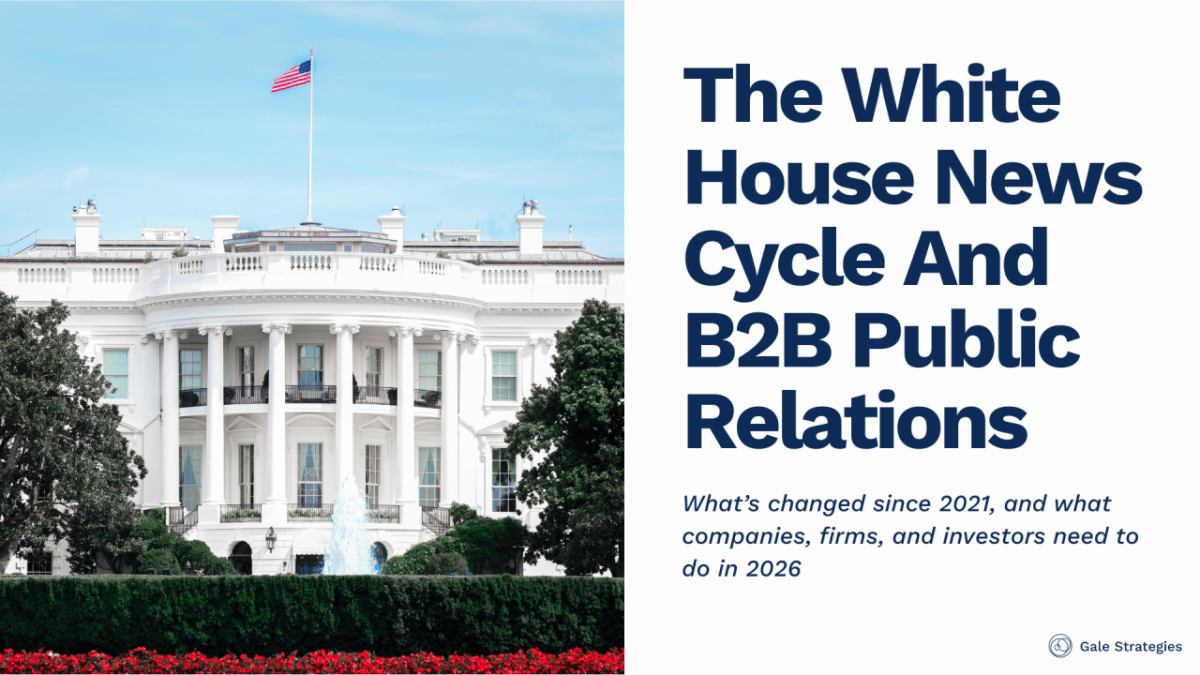
The White House News Cycle And B2B Public Relations

What’s changed since 2021, and what companies, firms, and investors need to do in 2026

For much of the last decade, B2B public relations operated with a clear boundary: The White House mattered for politics, but business had its own media logic.

That boundary has collapsed.

In 2025–2026, the White House is no longer a background variable in business coverage. It has become a primary organizing force of the news cycle, shaping not just political headlines, but markets, sectors, and corporate narratives.

For B2B companies, professional services firms, and investors, this marks a fundamental shift in how communications must work.

What’s different now, and why prior playbooks fail

Then: 2021–2022

In the early Biden years, even amid major events, business news remained largely issue‑driven and distributed:

  • Markets focused on inflation, supply chains, and the Fed
  • Corporate coverage centered on earnings and recovery
  • Policy mattered, but mostly through agencies and long timelines

The White House influenced outcomes, but it did not dominate daily business narratives. PR strategies could afford to treat Washington as context rather than catalyst.

Now: 2025–2026

Today, the environment is fundamentally different:

  • White House actions routinely move markets and sector sentiment
  • Executive decisions are covered in real time by business desks
  • Policy signals often matter more than data releases
  • Conflict, litigation, and executive authority are recurring headlines

In short, the White House has become central to how business risk is framed, not occasionally, but continuously. Beyond ideology, it’s about media structure and attention economics.

Why this matters for B2B public relations

The rise in White House dominance changes the nature of reputational risk.

In a policy‑driven business news cycle:

  • Silence is no longer neutral
  • Delayed responses signal unpreparedness
  • Overconfidence is punished
  • Credibility is inferred from policy awareness

PR teams are no longer just shaping messages. They are helping stakeholders interpret uncertainty.

The implications for B2B companies and firms

1. The White House must be treated as a standing PR variable

In earlier years, companies could plan around quarterly cycles and predictable media beats. In 2026, White House actions create unexpected narrative shocks.

This means B2B PR functions must:

  • Track executive actions and signals daily
  • Understand potential second‑order business impacts
  • Prepare messaging beforeheadlines break
  • Not to take partisan political positions, but to avoid being caught flat‑footed

2. Messaging must emphasize preparedness over insulation

One of the most damaging phrases we hear in this environment is “We’re insulated from politics.” Markets and media no longer believe that.

What resonates now is:

  • Operational resilience
  • Policy adaptability
  • Governance rigor
  • Scenario planning

In a White House‑centric news cycle, credibility comes from acknowledging exposure and demonstrating readiness, not pretending neutrality equals immunity.

3. Executive visibility requires greater discipline

When the White House dominates attention, concerns about surveillance and politicized markets are escalated, executive commentary carries more weight, and more risk.

Effective leaders in 2026:

  • Speak calmly about uncertainty
  • Avoid speculation on policy outcomes
  • Frame their companies as stable navigators rather than commentators

PR’s role is to ensure leadership is fluent without being political, informed without being reactive.

Why this is especially acute for private equity and investors

As we move through 2026, pressure on private equity exits adds a layer of urgency. And this is against a background in which private capital has come in and out of the sites of political leaders already.

In a White House‑driven media environment:

  • Policy headlines influence valuation sentiment
  • Buyers price uncertainty more aggressively
  • Exit narratives are stress‑tested publicly

For PE‑backed companies, PR now directly affects:

  • Perceived durability
  • Management credibility
  • Exit timing and optionality

Communications that ignore the White House context risk undermining value at precisely the wrong moment.

The SaaS‑to‑AI transition compounds the challenge

At the same time, many B2B companies are navigating a narrative shift from a SaaS world to an AI‑defined one.

This matters because:

  • Layoffs are part of that scenario
  • AI equals geopolitics
  • AI policy, regulation, and national positioning are White House issues
  • Business claims are scrutinized through a political and regulatory lens
  • Overstating AI capability invites skepticism in a charged environment

The smartest companies in 2026 are not chasing AI hype. They are illustrating concretely how AI is actually fitting into a volatile policy and economic landscape.

What B2B PR must do for the remainder of 2026

Treat White House pressure as permanent, not episodic. Midterms are coming. This is the operating environment now, not a temporary spike.

Integrate PR with policy awareness, legal, and IR. Disconnected messaging is a liability.

Shift from promotion to interpretation. Helping stakeholders understand uncertainty is more valuable than amplifying growth claims.

Reward restraint. Measured, informed communication builds reputational equity when attention is concentrated at the top.

The new rule of B2B communications

When the White House dominates the news cycle, reputations are built on stability, not volume.

The companies, firms, and investors that adapt their PR strategies accordingly will not only weather 2026, they will emerge with stronger trust at a moment when trust is scarce.

At Gale Strategies, we believe this shift represents an opportunity for leaders who recognize that communications is no longer about visibility alone, but about credibility under pressure.

And in today’s environment, the White House is no longer optional context, it is core.