
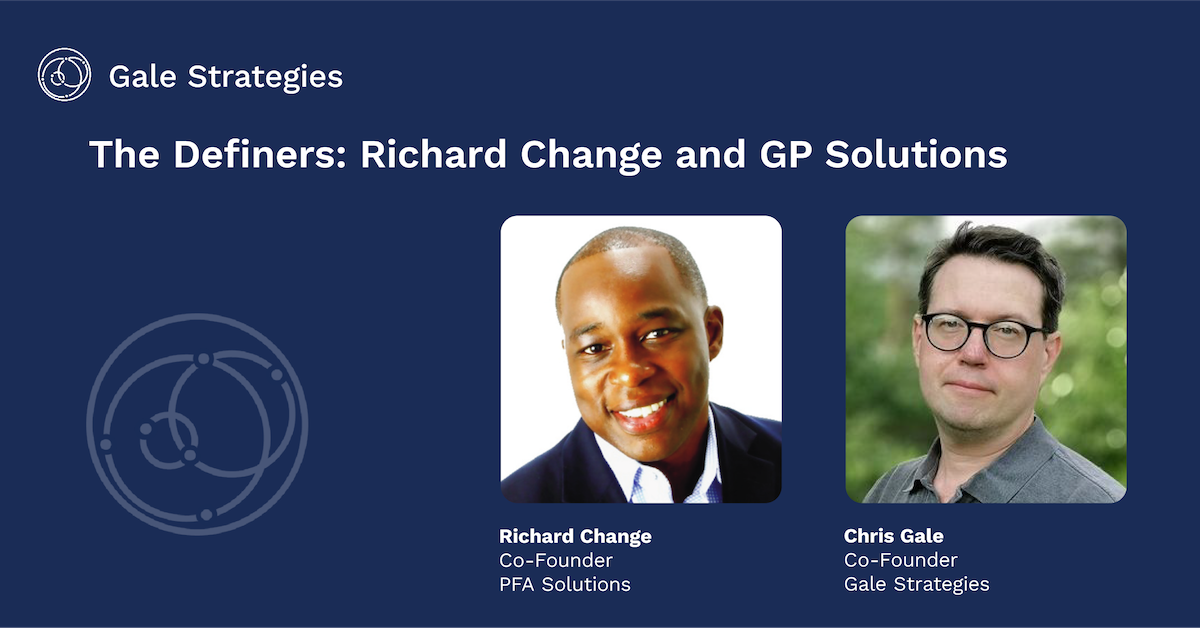
Richard Change and his team have defined what “GP solutions” mean in the private capital software market. If you’re a category creator, or you aspire to be one, join us March 5th and come armed with the questions you’d like to ask someone who’s been there and is doing that today. For our part, we’ll ask Richard how he uncovered an unmet need no-one else was willing to tackle, how his team are solving the problems holding others back and how PFA Solutions is enabling a movement of and by their customers, for their customers.
Chris Gale 00:02
Richard, it’s fantastic to have you on. I’m personally super excited because we serve a lot of founders and CEOs who basically want to do what you’re doing at PFA Solutions, which is defining an unmet need and then defining how that is going to be addressed together with your clients. We wanted to have this webcast so that you could share what you’re doing with clients of ours and folks in our network across multiple different industries. Can we first give folks an overview of PFA Solutions and your market?
Richard Change 00:55
PFA solutions started back in 2013. We’re focused on general partner solutions, general partners being the investment management arm in private equity. They’re the people who are responsible for doing the investment when it comes to private equity. We focus on solutions that meet their needs. Those solutions evolve around carried interest management. That’s how GPs are compensated. It’s simply the profit of investments that they make, as well as timing and compensation – your basic bonus and salary information, bringing it all together. That’s one-half of our application.
The other half gives GPs a better view of the performance of their portfolio and ties that information into transactional systems plus what they store offline in Excel. That’s the picture that we paint on the performance side. It’s a SaaS-based platform helping general partners manage carry and compensation and performance.
Chris Gale 01:58
To give folks some perspective, what kind of growth have you seen? There was an announcement of $1 trillion in total assets across your clients’ firms. Can you tell us more about the scale of the market you’re serving and the growth that you’ve seen?
Richard Change 02:15
We did exceed $1 trillion of assets under management by our clients, which brings us to close to 50 general partners that are using our SaaS platform at this point – internationally, as well. From a growth standpoint, the last three to four years have seen steady growth for us. We continue to focus on making sure we service existing clients and new clients equally. That’s first and foremost for us. Because in this industry, it’s a small, tight-knit community. You know, your reputation goes a long way in gaining new business.
Chris Gale 02:58
You’ve mentioned GP solutions. Until recently, nobody was talking about GP solutions. For audience members who are not as deep into the private capital sphere, LPs are limited partners. They are the investors. The GP is the private capital firm, the private equity, or VC firm. There are software companies that do accounting and operations software for private capital, but everybody focused on the LP experience, primarily.
Richard Change 03:36
That’s the first need that an investment firm has, meaning that you have to collect capital from your investors; you have to have a platform that manages notifications, distribution notices, and tax statements. For most GPs, the first thing they get going, from a technology standpoint, is making sure they’re servicing their investors or their LPs properly. That takes precedence over anything else. Because if you don’t do that, first, the GP portion may not necessarily matter. So, a lot of the technology is focused on the LP side. On the fund accounting side, there are big traditional software vendors in the space that help with the accounting as well as the distribution of information to the investors themselves. We always felt like that was well spoken for. For us, we saw the need on the GP side, the gaps, and the lack of modern technology. Excel still drives so much of what they do. Those were the things that we look to solve for – helping the GP automate and start to scale as they grow bigger.
Chris Gale 04:48
Serving the client base that you just described and the total assets across those clients. How come nobody else has done it or has done it in the focused manner that PFA Solutions has?
Richard Change 05:05
Probably because it’s a bit bespoke. Coming up with a model that fits 80 percent or so was a bit of a challenge. We passed that point, having a software platform that will essentially solve 80 percent of what we would see from a new GP out of the box. It took us a while to get there. We’ve now crested over that path. It’s the outliers and nuances that we may run into but, out of the box, we’re able to set things up, get the data into our platform, and get them operating based off what knowledge and experiences we’ve gained over the years, and push that back into the platform. Long story short, it’s not as easy.
Chris Gale 05:53
There are two things we’ve noticed about our most successful clients, especially in the last year when interest rates went up and companies out struggled. One is a main focus of this conversation: establishing peer-to-peer customer networks. The second is saying something that your competition doesn’t say or even is unwilling to say. That’s what you’re describing about the difficulty of the bespoke solution that’s required.
Are traditional SaaS providers that focus on the LP experience potentially afraid about talking too much about GP solutions, or is it more that they don’t have a solution? They don’t want to talk about it because it’s not an area that they can focus their engineering talent towards, for instance. You’re the only ones talking about GP solutions.
Richard Change 06:55
You’re starting to see some smaller players coming into the market. Thinking about that market, GPs of a certain size start to experience the pain points here. The other driver for us, and a true catalyst, was the pandemic. We addressed essentially everything that a GP operationally thought about – it needs to be electronic, it couldn’t require that face-to-face meeting with someone. To have a digital platform where employees and investment partners of the firm can go in and pull down their carried interest or pull down their compensation statements was another driver for us as well.
Exasperation with the competition for talent within the market. That’s a huge driver. If we think about GPs in general, their focus is always on doing great deals. You need people to help to make those great deals. The competition for talent continuously makes attaining, keeping, and retaining those talented individuals is something that they have to prioritize. There are a lot of GPs and a lot of investment firms out there now that like to keep talent. What better way to make sure that they stay with this firm than explaining their relationship to them exactly from a compensation standpoint? That has been the other driver for us over these last three to four years. It’s really about compensation for the talent. Firms want to digitize their employees’ experience.
Chris Gale 08:40
Excellent, thank you. I want to come back to that point about the pandemic. But before we do, I’m now thinking about the sequence of your biography. If we go back to the origins of PFA, you were in a role inside a large, well-known firm. You could have continued at that firm, potentially, or at a different firm, but instead, you decided to go out on your own. Can you tell us about that decision? What drove you to do that? Because it can be kind of scary.
Richard Change 09:34
Yes. Tons of fear and trepidation for sure. You know, I would say one of the big drivers was just talking to other GPS at other firms and seeing that they suffered from the same sort of situation that my firm did, meaning a lack of technology on the GP side to help automate and systematize a lot of the data and processes that were in place. That was a big driver for us. Here’s a big gap in the industry, from a technology standpoint. There are solutions that we’re familiar with and know how to build, audit, and think about them at scale. Let’s build out a platform where we can help GPs manage this because it does become a bit of a pain for a lot of our GPs as they continue to grow. Complexity continues to grow with the size, quite honestly.
Chris Gale 10:25
Why PFA? Was there not a software company or consultancy out there doing that? Why not try and advance that from within the GP?
Richard Change 10:38
We didn’t see a software company doing it and addressing GPs. We just looked around high and low. We saw some looking to shoehorn GP operations into what they’re doing for the LP into those systems. It’s not a natural fit. Because, if you think about the users you take care of for a second – I hate to dive into the nuance here – but it’s not the model. Your investor goes and says, ‘Hey, you know, I’m going to commit X amount of dollars to this fund.’ That is the basis of our distributions and contributions that will be called. For that investor, you should show how the math actually works out. It’s pretty simple. It was complicated outside looking in. But, basically, your commitment drives all the downstream calculations for calls and distributions. On the GP side, when we think about carried interest in the profits that are shared, there is no commitment necessarily. It’s arbitrary. It’s all based on my feelings for you as a team player. I’m going to get X amount of percentage points on this particular deal or shares on this particular fund. That’s how those calculations are done. It’s a bit arbitrary on the GP side. And it’s not arbitrary on the LP side. I have a basis for commitment that I’m going to use to calculate and call capital and distribute returns to you. Showing the math is easy on the LP side. It’s much harder on the GP side because it’s all arbitrary.
Chris Gale 12:13
When PSA Solutions started, though, you were not a software company. You were doing consulting and professional services. What exactly was PFA doing at that point?
Richard Change 12:25
We were doing technology consulting back to the industry. Part of what we wanted to do those first couple of years was pay the mortgage and fill the book of business – footprint and foundation. We started doing what we knew best: custom application development, enterprise reporting, and back to the same industry. In the first six to nine months, we thought would be industry agnostic. But you end up sticking to what you know. GPs that we were familiar with reached out and needed help. That really got the ball rolling for us in the industry.
Chris Gale 13:05
Were you always thinking about developing a software solution? Or were you at that point from the very beginning, and the consultancy was in a way, like you said, to pay the mortgage? It sounds like you were scoping out where the most useful problems to solve were exactly. In engineering and software development, you have a very strong background. When did you decide, “Okay, this is it. Let’s start building something.” What triggered that?
Richard Change 13:49
One of the main triggers was working with a GP at the time and realizing that everything that they needed to do by quarter and reporting when it came to carry as well as performance, all started with Excel. It wasn’t a system that they ran through first to grab this information and press a button to click a report. The basis for what they did started in Excel. They reviewed that information in Excel and then put that information in the system to essentially act as a data storage mechanism. It didn’t provide the calculations. Everything’s done offline. It dawned on me that this is still a huge problem within the industry. Excel is still the gatekeeper for data. We also didn’t see a carried interest management solution out there. For a lot of our clients, when they sign on to work with us and to leverage FirmView, we’re pretty much converting every single client from Excel. There’s still a huge gap. Excel still runs the roost when it comes to data within the industry was one driver. The lack of technology products available to GPs was the other. I always felt like this industry was underserved from a general technology standpoint. That underserved group is even higher on the GP side.
Chris Gale 15:36
This is interesting. You see a need, from the GP side, that you don’t see others addressing. You decide then to scope out the needs in the consulting process and develop software because there’s really not a software solution out there. You’re working with your former self from a certain perspective, right? You brought your former selves together to sort of talk to each other.
Why the decision to bring customers to customers together on a peer-to-peer peer basis? You held a roundtable at the beginning of this year and one last year. Tell me about that aspect of it. I’ve noticed that our most successful clients and folks in our network who define a market make peer-to-peer conversations happen that you seem to be quite dexterous at facilitating.
Richard Change 17:10
The private in private capital markets and private equity isn’t a misnomer. Naturally, the industry keeps a lot of what they do close to the vest. A lot of it’s due to just competition for new deals or talent that’s understandable from a competitive edge standpoint, but also creates these islands, right? How do I think about compensating or developing a carried interest plan for this particular fund? Or what are the tax ramifications? We structure up phantom equity this way, or these hours that end up getting created, a lot of times don’t get the benefit of an industry standard, the benefit of hindsight, or lessons learned from other GPs. What we wanted to focus on for our roundtable was not a solution or our platform. It’s first and foremost about connecting GPs to each other. It’s making sure that they’re not alone. The challenges that they’re facing are being felt by others in the industry. They can look around that room. Now they have 40 to 50 other people that they can reach out to and ask questions. Yes, you know, there’s our platform that can help with that process. But there are things that our platform can’t do depending upon the decisions that the GP makes. To me, essentially, that’s knowledge, that’s information that’s just as valuable as a software platform. Thinking about some of the decisions good or bad that have been made, how do you push that back to the same community so someone doesn’t repeat the same mistakes that someone else made? That’s the most valuable thing that we get out of our client roundtables. It’s that information sharing.
So, we started the roundtable. Last year was our first year. It was connecting people with each other. This year, we took it another step further and brought in tech specialists to also help the group think about and answer questions about structuring plans and tax implications that need to be considered because of new changes in tax laws. It’s not just the blocking and tackling of having a system that does X. It’s all the upstream decisions that affect our system that we want to help our clients with. It’s not just about what they do in our system, but the decisions that will eventually affect how they use any system.
Chris Gale 20:01
It’s an area where there is sensitive information, there are islands of expertise developing, and therefore there is an opportunity. Folks are coming to you and saying, “Can we create a connection and another island over here?” But that provides an opportunity for you to bring folks together in a way that is meaningful to them serving a need, not just you pushing out a message. The reason why I’m checking in with you on this is because we have other clients who, for instance, might be in the healthcare space. There are physicians out there and health system leaders out there who may say, “Our stuff is incredibly sensitive.” They may not necessarily be in such a competitive situation, though, unless you have two hospitals in a similar catchment area. They may feel competitive. But I think what you’re saying is, whenever you see islands that are underserved, and whenever you see difficult challenges, that are not being addressed, there stands an opportunity, that’s where the software provider in your case can step up, because, and go beyond just providing software.
Richard Change 21:21
Right. At the end of the day, something I’ve always strongly believed in was that, yes, we can provide software that does X and could get your dry cleaning, even. But it’s the other things that aren’t software-related that we like to provide as well. It is a relationship that we’re building with that potential client to understand and help them utilize our platform and think about the decisions that they’re making, thinking about the plans or structures, thinking about what’s going on in the market. That’s one of the most helpful things that we provide – backing. Yes, the software is great. It does X, Y, and Z. You’re able to automate push-button imports. That’s fantastic. But can we help someone think through the structure for a new carry plan and their tax implications? That’s the value I think that we also provide back to our clients – helping them think through not only implementing the software but also how they think about their plans. What are some other reasons other firms do this instead of the way you’re doing it? What are some of the pitfalls? That’s our secret sauce, I guess.
Chris Gale 22:36
It’s interesting you say that because there are firms out there that provide consulting on carry and comp and there are accounting firms and fund administration firms. PFA is very careful with talking about who’s at your roundtables. But folks at those roundtables know that it’s an amazing group. You don’t necessarily see consulting firms necessarily able to pull them together. I’ve wondered, is there something about the fact that you’re a software firm that allows you to have conversations that maybe consultants haven’t discussed before? You seem to be able to bring folks together around what is needed in the market, in a way that seems to be relatively unique.
Richard Change 23:45
It’s probably the company that we keep, quite honestly. We have a client that utilizes a platform. That client is going public. They’re interested in how other publicly traded private equity firms on our platform handle this situation. That’s outside of carry. But we served as a conduit between those two firms. They’re looking to see how they should handle this new SEC regulation. “How did you guys think about it?” We were able to connect those two firms. That’s one of the things that we kept seeing. We’re becoming the conduit between a lot of firms. Sometimes it’s just knowledge that we already had based on experiences with all of these different clients of different sizes as well. Other times it’s the company that we keep. Being able to share some of those lessons learned or how we’re going to approach X is one of the things that our clients look to us for a lot.
Chris Gale 24:49
A follow-up question is about your software company. We’ve been to our share of software company user conferences. Are there things that you take from the two roundtables? Are there things that you take from those conversations that you put into the product? Roadmaps? You have my last question. We’ll be coming back to the pandemic. But you have individual one-on-one conversations. Is there anything in the roundtable environment that facilitates the product roadmap process?
Richard Change 25:33
The piece that we pushed into the platform in the previous year was based on feedback we got from the roundtable. They wanted more ad hoc reporting capabilities within the tool. So that’s something that we focused on for the last 18 months. We’re continuously pushing that capability out to all of our clients. It definitely informs where we should go in our roadmap. It also helps us think about potential new modules that we should look at. When we first started FirmView, it was carried interest that we were going to help clients manage. It quickly evolved to compensation. So now I have my carry and my compensation all stitched together. Then clients came back and said, “Well, as you’re managing those pieces, what about our internal core investment that our employees are also investing in within the firm, too?” Taking a step back, this year it dawned upon us that we’re focused on everything that’s GP-related.
So, just based on our client feedback, we’ve rolled out the compensation module, the core investment module, and now, our most recent one is our compensation planning recommendation module where clients can facilitate their year-end process through our application. I would say the majority of our roadmap comes from our clients’ feedback. Each and every year, we do a survey and collect that information. We start to make decisions about where we’re going from a platform standpoint. I will say, this year, though, the demand was less about new features and more about new ways to collaborate with each other. That was one of our biggest takeaways – that wealth of knowledge, how do we tap into that? How do we get to a point where we can, you know, communicate, and talk about how we’re utilizing your platform with others? User groups were the new feature. An enhancement that we’re going to make is allowing others to communicate with each other, how they use the platform, and how they think about their compensation plans in general.
Chris Gale 27:52
Here’s my crazy question building on what you said about the pandemic. For marketing media relations teams during that period, everything had to do with the pandemic and how it was going to change work. That’s definitely been true. Our webcast series was partially an outgrowth of the pandemic. I’m not sure how much this connects with the B2B SaaS space, but we’ve heard stories about companies that had enormous success with the digitizing and virtualizing of work that came out of a tragic event. Then there was a cliff that was gone over. It seems PFA’s trajectory, even through the doldrums of higher interest rates, has continued to be up and to the right in the progression from the pandemic into the current environment. I connect that with what you’re describing about people and wanting a network effect for your customers. Is that a way that you’re sustaining that initial hit of growth? It seems like you’ve built off of this networking effect.
Richard Change 29:33
I think it helped. That provides validation, for one, that you have market fit, and you have a product that’s meeting the needs of specific competitors that they view in the market against themselves. I think that helps. Don’t get me wrong. If you’re able to get over X number of clients, that at least validates to everyone that you have a great product, you have something that they should be utilizing or thinking about utilizing. That’s helped tremendously, I would say. The other thing is that this need hasn’t gone away. Right. I do think that, you know, more and more firms as they continue to scale and grow, this need becomes even more relevant for them.
Chris Gale 30:24
Thank you so much. Thank you, everybody. We’ll let folks know about the next webcast, which will be coming up later in March.
Richard Change 30:36
Thank you.