Categories
Technology

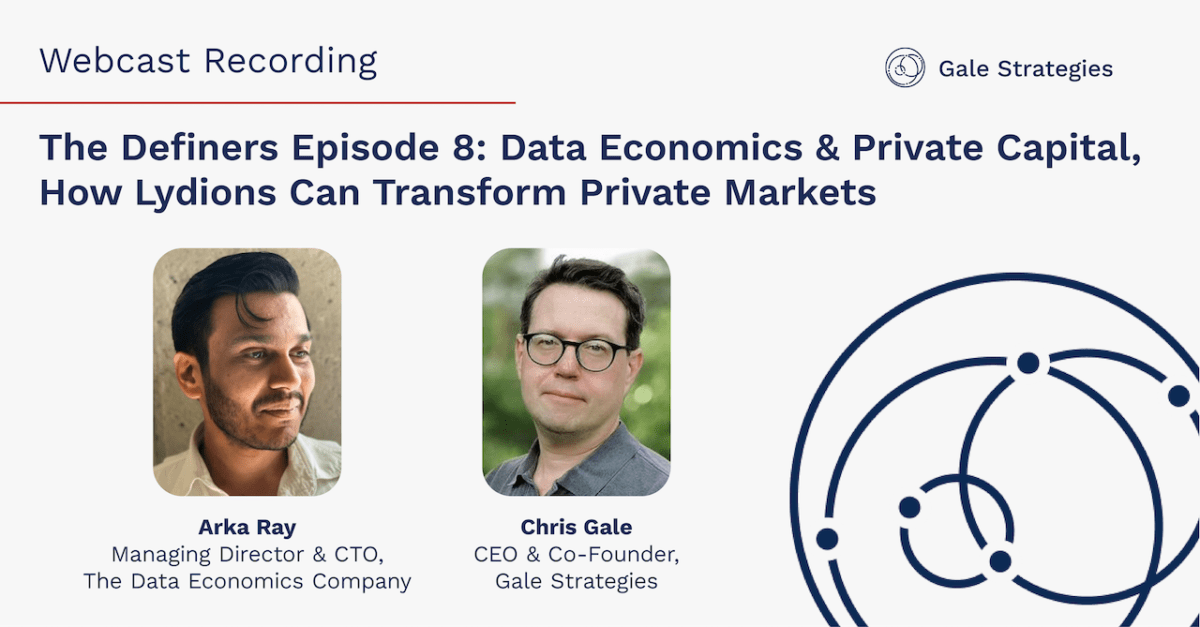
The Definers Episode 8: Data Economics & Private Capital, How Lydions Can Transform Private Markets


Explore how data economics can solve real challenges in private markets. In this episode of The Definers, Chris Gale and Arka Ray of The Data Economics Company explain Lydions, data-native economic objects that embed ownership, provenance, and incentives into workflows. These structures turn static data into living assets. You’ll learn practical use cases and the foundations of data ownership, interoperability, and valuation, and how data can drive trust, efficiency, and liquidity.

Categories
Sales

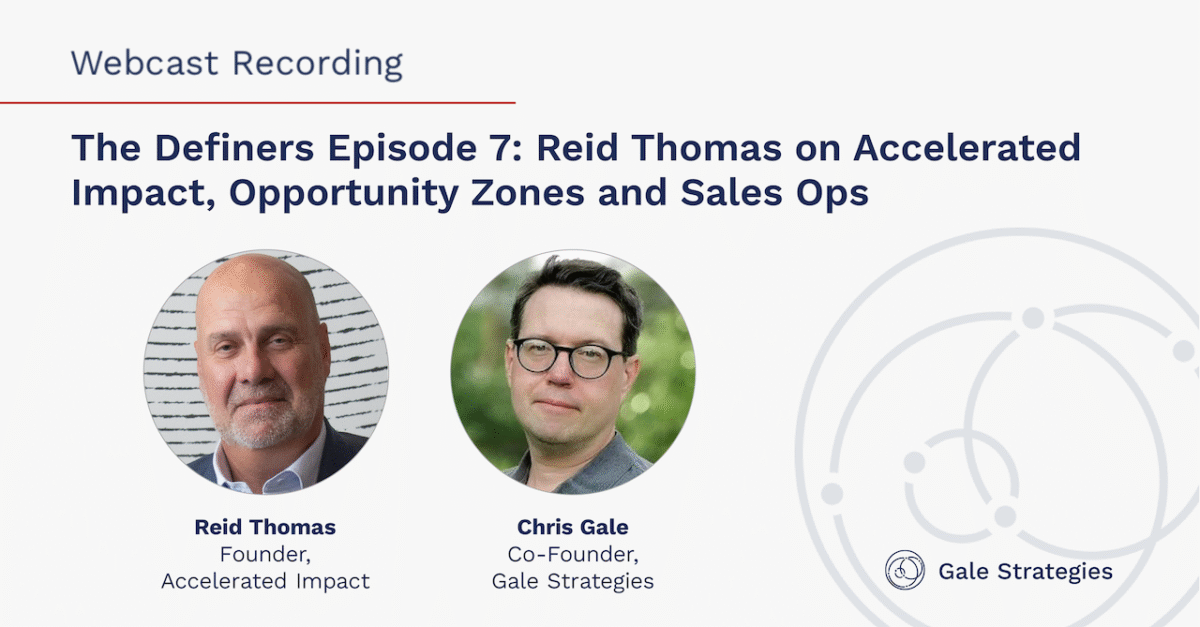
The Definers Episode 7: Reid Thomas on Accelerated Impact, Opportunity Zones and Sales Ops

Learn how real relationships and smart systems create growth that automation alone can’t deliver. Reid Thomas currently stands to define the Opportunity Zone market—and he has the sales ops experience to back it up.

Through his new venture, Accelerated Impact, Reid is opening opportunities that blend financial returns with meaningful community outcomes. But Reid is just as known for his contrarian approach to sales in an era obsessed with AI and automation. Learn more about his unique sales playbook and how Accelerated Impact is shaping the Opportunity Zone space.

Categories
Sales

The Definers Episode 6: A sales ops approach to professional services business development

For those who have been doing public relations and marketing for law firms or accounting firms, here’s a webcast on integrating that work into a CRM like Salesforce, Hubspot or ActiveCampaign and implementing sales ops. If you’re like us you’ve earned media results or implemented marketing campaigns, but you’ve remained vulnerable to partners asking how effective it really is. Impressions and share-of-voice remain unconvincing. And to be honest, how convinced are we ourselves privately?

In the webcast below, we share lessons from integrating public relations and marketing into a firm’s CRM, and leveraging sales ops processes to skip over indirect metrics of impact, and focusing on actual revenue. And most importantly, we share lessons from driving public relations and marketing more directly to what makes your firm’s sales cycle work, and your true differentiators.


Categories
Private Capital

The Definers Episode 5: Tide Rock’s success raises questions about private equity

In a recent article, The Wall Street Journal reported that investment firm Tide Rock buys up small companies as private-equity firms do, but it shuns the often steep debt that buyout shops use to fund acquisitions.

In another article, The Deal reported that Tide Rock seeks companies that either have strong reoccurring customers, are resilient because they have diverse customers or operate in an industry with low volatility, or that sell essential products or services to loyal customer bases.

What is the Tide Rock team getting right that others miss, and what can we learn from it?

We ask Tide Rock President Brooks Kincaid how unlevered buyouts work, what that tells us about the leverage accepted in traditional private equity, why that matters for founders looking to exit or grow, and Tide Rock’s operations mindset.


Chris Gale  00:02

Brooks, thank you very much for coming on. I am super excited. Gale Strategies loves working with Tide Rock because what you guys do is just fascinating, especially in today’s environment. Folks coming onto this know that Tide Rock practices unlevered buyouts, which usually throws folks from the very beginning because buyouts are usually levered. We’ve all been reading about how much leverage there is and how much debt there is out there. So, before you tell us about Tide Rock, any insight on how leverage somehow became the orthodox/normalized thing out there in all of this credit and debt that’s in the private capital markets these days?

Brooks Kincaid  00:59

First off, Chris, glad to join you, and look forward to chatting here.

To answer your question, I think at the end of the day, it’s great to use other people’s money to make money for you. Debt can – or at least in general – end up being a lower cost of capital. And interest is tax deductible. So, those are both attractive elements that can lead to it being a tool in the leverage buyout structure. As someone who’s trying to raise capital, it makes returns look good or makes an investment potentially pan out. Debt can make returns look better in a spreadsheet. If you’re modeling it versus living in maybe the real world, you can underestimate the risks of investment and the ability to support that debt. So, the positive impacts of it help drive its use. If you start thinking about some of the risks, though, you may underestimate the impacts of sizable, unexpected events, which in the last couple of years have been particularly notable, are things like the loss of a major customer, a global pandemic, COVID, material supply chain shocks. Things like that don’t necessarily make their way into financial models as cleanly as the use of leverage might.

The use of leverage allows for a fund to also buy bigger companies. You can make your equity dollars go further and, in buying bigger, not be overly concentrated. You can effectively just spread the wealth a little bit more. That all sounds really good, and that is a core reason why it’s become a pretty common use. But it does underestimate the risk that exists. That is particularly true when you start looking at the use of leveraged buyouts when you’re investing in smaller companies. They are just more exposed to some of the risks for which debt is not a great tool. Some of the uses of debt and the covenants and other things that come with debt make it a square peg in a round hole, at least in our view, for use with small businesses.

Chris Gale  03:27

I like that you’re pointing to risk. Just to be clear, when we’re talking about debt or leverage, we’re talking about transaction leverage, like you would have a line of credit, I imagine?

Brooks Kincaid  03:45

We’re talking about amortizing transaction leverage. For example, we’re buying a company, and a third party is coming in to support and contribute to the sources of capital necessary to close that transaction, like underwriting the deal alongside the equity sponsor and then putting in a structure for the repayment of that debt in both interest and principal. That is different in our view from what I would consider growth-oriented capital – be it equity or the use of a line of credit. There are certainly working capital needs in all businesses that lend themselves to using a tax-efficient, interest-bearing line of credit, but that is very different than covenant-related amortizing debt.

Chris Gale  04:32

Perfect. Okay, so you used the word “growth” and used the word “risk” before. I know the story of Tide Rock, but if I first hear what you were saying about leverage before, are you saying that Tide Rock purely protects against risk? Or what do you accomplish for investors on the upside? What’s the attraction to Tide Rock for investors?

Brooks Kincaid  05:01

The attraction for investors to Tide Rock is that we can deliver the alpha that can come from investing in smaller businesses without the same risk that you might otherwise expect if you were to structure it in a leveraged buyout transaction. What we also do is further reduce the risk by focusing on effectively returning capital, or returns, to our investors sooner by virtue of consistent quarterly distributions. So, if you think about it, an investor comes in, they have principal at risk in any private equity environment. They’re putting that principle at risk to get returns back from that. In our world, because we make distributions consistently and at a high yield level, our distribution to paid-in capital, the sort of realized returns, is right out of the gates. So, a quarter into investing with Tide Rock, you’ve taken principal risk off the table because you’re getting a distribution out. If you’re doing it in a leveraged buyout transaction where you’re not receiving those distributions, you’re betting on the total value to paid-in capital, and the large majority of that is in what’s considered residual value to paid-in capital, so paper gains and all of that are terms related to the return that an investor is expecting on their capital. In our case, we are aiming to provide very high total value to paid-in capital, or multiple of invested capital, but along the way, making sure that our realized returns are there, which, at the end of the day, just reduces the risk for our investors. That’s what we’ve been able to demonstrate and attract investors to from the very beginning, as we’ve been able to do not only on an individual company basis but throughout all of Tide Rock as we grow our portfolio and further reduce risk via diversification. That combined return profile has become very attractive for our investors.

Chris Gale  07:22

Okay, so then I’m going to ask, maybe, the public relations question. You’ve talked about the benefits in return for the investor, the positive side, and the absence of the negatives of debt. So, you and the team that built Tide Rock in the early days, in the chicken and egg sequence. Was that debt bad? Can we do something without debt? Or was it [a case of] we really want to achieve higher returns? Maybe if we get rid of debt, we can do that.

Brooks Kincaid  07:58

I think, to some extent, it’s a both/and. The original premise is that we believed that the micro market or the lower middle market was a sector with inefficiencies that was an area of opportunity for us. We believe that, to be successful, we need to have a greater focus on operational improvements and fundamentals of value creation in our investments versus financial engineering – in broad strokes, let’s say the financial spreadsheet, leverage-oriented model that I was referencing before I put that in sort of the financial engineering bucket. With that, we were saying, ‘Hey, we’re going to focus on driving fundamental value creation,’ and that was going to enable us to build successful businesses that not only would be able to generate free cash flow but also create equity value growth or multiple expansion over time. So, from day one, we said, ‘Hey, we’re not going to lever our transactions because that won’t allow us to then efficiently pass through returns on a regular basis to our investors, and it will distract not only ourselves but our operators from the fundamental value creation and operational enhancements that we wanted to have them focus on.

If you think of a smaller company, there is a lot of fish to fry. You’re a CEO or a management team. You are fundamentally focused on value creation or operational enhancements. It’s complicated to then also have to think about managing your covenants and third-party banks, who, frankly, don’t care as much. They care more about making sure that their debt gets paid back, and so that creates another distraction relative to the focus on value creation. So, to your question, it was that they were the chicken and the egg at the same time. We were able to start small, at least from a focus standpoint, number or quantity of companies, make sure that we were able to execute upon that thesis, that we could drive fundamental value creation through operational enhancements in an unlevered structure, and create value that attracted additional investment dollars, which allowed us to go do that across multiple companies, which further reduced risk it by diversification. That snowball started to roll, and now it’s become easier for us to do that at scale.

Chris Gale  10:38

This is, maybe, my last question contrasting Tide Rock explicitly to the LBO or the sort of classic private equity model. But I know that some folks are on this call who are also taking on what is the standard orthodox model in their particular industry and challenging it anytime you’re presenting something new. I remember when Ryan was working with the Wall Street Journal on this. Tide Rock is doing something different. When did you start seeing investors and also sellers start to realize after seeing you that they were accepting something that you shouldn’t accept in private equity, in that amount of leverage? And when did you start seeing people understand that Tide Rock represents something that I think we’d like to see as more of a standard if more firms could do it?

Brooks Kincaid  11:39

I think, like most things, ideas are great. Proof is better. As we grew in scale, we started to show this was a model that worked not only for one company, not only for three companies, not only for five companies, that then started to build upon itself and investors who had, let’s say, larger pools of capital to allocate, maybe being concerned of, ‘Hey, I like this strategy, but I like it as a one-off,’ versus ‘Can I deploy $10, $50, $100 million behind it to do it at scale?’

As we started to show that, yes, not only could we do it on an end of one, but we could do it across five companies, 10 companies, etcetera, that started to build upon itself. That was complemented by the fact that, as we were scaling, we were also further reducing risk by virtue of diversification. That was really the tipping point. I think for sellers, it depends on which one you ask. So, for certain sellers, I think a lot of them resonated out of the gates with – ‘I’ve never liked debt. I didn’t want to have debt on my business, and I understand that maybe that prevented me from growing. I’ve always wanted to grow, but if push came to shove, I was not going to threaten my livelihood and my net worth by putting debt on the business.’ They were told by their advisors, ‘Hey, this is the only option that exists. Either you’re going to get sold to strategic, or you and your people may or may not exist anymore. You can get bought by a private equity firm, but you’re going to have some leverage on the business, and if you want to roll equity with them, you’re just going to ride that risk.’ They didn’t know that we existed. So, there is an education that comes with each of our engagements to help the sellers understand how we’re different, why we’re different, and what that means for them, whether they’re looking to completely exit and move on, or they’re or they’re or they’re going to roll some equity, and they want to be part of a second bite at the apple. Fortunately, that education resonates pretty well with a lot of them because they philosophically are aligned with it. That’s just something that we have to educate them as we go through the process.

Chris Gale  13:59

I want to come to operations. You were talking about the philosophies of some of these sellers or some of these businesses that you’re acquiring. Some individuals listening here are big fans of operations and know an awful lot about very operationally intensive businesses like electronics manufacturing. You have this insight about leverage, but you were talking earlier about enabling the operations, enabling the execution of these companies. What advice or lessons can you share with others who’ve come to realize that insights are cheap if you don’t have the operations down? What do you do there?

Brooks Kincaid  14:52

Like I said, from day one, the focus was on fundamental value creation. You need to have successful operations across all aspects of the business to do that and to do that well, particularly given the sort of size and scope of business that we are typically buying, or our entry point. Our focus early days was not only on the fundamental structure – okay, we’re unlevered – but then also on how are we going to support our businesses? And we wanted to say, ‘Hey, insight is necessary. It is important. But if it’s insight alone, you’re then exposed to too many exogenous things that you can’t control.’ That’s not something where were comfortable with. So, we wanted to complement the insight thesis, and investment thesis, with a playbook orientation. We were going to say ‘Hey, we’ve learned a lot as it relates to operations, be it in sales, actual operations, finance and accounting, talent acquisition, marketing, all aspects of some fundamental business operations. We’re going to distill a lot of that learning and love and leverage that to provide a bridge to our companies from their current point where we come in, to what they need to be as they realize their fullest potential. And the earliest of those was focusing on the top line, on revenue, most often our sellers, founder, owner, and closely held business. They have a very high-quality product service. They’ve got some unique aspect or differentiation that is attractive to us, but the world doesn’t know about it. And between two choices, many have said, ‘Hey, I’m focusing on making sure that I maintain that quality product and service, and I don’t want to rock the boat at least. I don’t want to rock it too much. I mean, I don’t want to take on risks that I’m uncomfortable with. I don’t want to change my lifestyle.

There becomes an artificial constraint on the company’s growth. One of our earliest insights and focuses, is on saying, ‘Okay, how do we come in and start to apply a playbook mentality to relieving that constraint and allowing for the business to start growing?’ We have an internal saying that the sale solves all problems now – obviously not all problems, but it certainly helps – and a growing company then provides for the investment into resources and other aspects of operational enhancement that are necessary to support that growth and continue that growth. We initially focused on providing the playbook to sales, then translating that down into the supporting elements of sales – talent, marketing, corporate development, finance, and accounting – everything to make sure that we can support a growing organization. We went as far as to structure our organization to reflect that. A typical company at our entry point isn’t going to have a CMO, isn’t going to have a talent acquisition department, isn’t going to have a finance and accounting department, or maybe they have an accountant, but not a CFO. They probably don’t have dev, and they certainly don’t have someone who’s focused on operational excellence. We have constructed Tide Rock to have all of those things – and not just external accountants. They’re fundamental parts of Tide Rock, and that allows us to function as a bridge for the companies as they go from where we start to where we are trying to take the company and realize its highest and fullest potential.

Structuring that way also allows us to make sure that the specific functional elements of the playbook are appropriately communicated to the appropriate people in the organization. So, we’ve got a CEO, but we want to make sure that our VPs of sales in the companies are operating according to the playbook at the highest and best potential, and they’re operating their business in the best way possible. The controllers are the same thing. So, if we can professionalize and improve all aspects of or all functional areas of business, we help the CEO execute upon the insight that we had and give him or her a significantly higher likelihood for success. That’s ultimately our game. We believe a playbook, operations-oriented perspective towards insight-driven investment pieces is going to have a much higher likelihood of success if we focus on the operations versus just the insight.

Chris Gale  20:03

Excellent. I was smiling there. Brooks probably understands, because we have a list of questions, and I have questions, and Brooks, much like my middle school teacher in theater, kept up with me when I jumped to the chorus and in the middle school musical. I think you covered both points. The one thing I wanted to maybe ask is we haven’t touched on fit-for-purpose yet, and I know that you guys have talked about fit-for-purpose and the benefits on many levels, including operations. What can you tell us about that?

Brooks Kincaid  20:48

So, fit-for-purpose, meaning sort of how we fit for people who are looking to sell their company or at least bring on a partner, I think there are two different profiles, both of which Tide Rock has unique value props for. The first would be a closely held founder-led company or seller who is looking to retire, either because of personal reasons, just they’re ready for retirement, health reasons, etc. Tide Rock’s value prop for that seller profile is, one, we are going to be a good landing spot for their legacy and their people. Our orientation is towards growth, versus, say, coming in for cost reduction and so we’re going to be giving them their employees, that opportunity to go and realize career growth and expansion and to build upon their legacy. Some of these people have spent 10, 20, 30, 40 years building this business. They want to see it continue beyond them. And that’s certainly a value-prop we provide. Number two is that we don’t have a third-party dependency for sources of capital. We are the decision-makers. I’m the head of our capital employment side of things, so myself and our investment committee decide whether we’re making the deal or not. We are not dependent upon a third party to decide whether they are going to fund the deal, which can drag on both in terms of time and just deal execution risk and then three timing.


So, because we have the capabilities in-house, our ability to execute diligence and make a just yay or nay decision is in a matter of weeks, not months. We can execute a deal from LOI to close in 45 to 60 days, not six months or nine months. And when you’re running a business and you’re looking thinking about exiting, it’s difficult to both do a once-in-a-lifetime transaction, while also having to wear the multiple hats that inevitably, the owners and CEOs of these small companies typically do. So, when you combine all of that, that’s a fundamental value prop to that profile of the seller. The other profile that is applicable, and we’ve had several of this type, are parties who have realized that they’re starting to reach a ceiling with either their capacity or their risk tolerance, etc. They do fundamentally believe in the growth proposition for their business, and they see it. So, they’re looking for a growth equity investor. They’re, they’re comfortable giving up majority control, which we require, but they want to take a second bite at the apple. So, we allow them to come in with philosophically aligned preferences for growth orientation, lack of risk, adding leverage, and an opportunity to realize the benefit of that direct role along the way via quarterly distributions. So, it’s not only on the come, they’re getting it every quarter, and the opportunity to go realize additional value, equity value growth, which, if we realize our investment objectives, should give them sometimes equivalent to what they took out on the front end.

For founders or sellers, that combination of values is really important. One other thing I would add is that there’s also an option value for them of being able to continue to ride and see that second bite of the apple but understand that it’s not solely dependent upon them. Yes, we’re going to come in and give them a lot of resources and support functionally, but we do also have a top internal talent acquisition department that can help identify who’s going to be the new torch bearer of the company. As this person eventually wants to take retirement, we can then go find the right person to take over that CEO reign as the company grows and scales and potentially moves on to another chapter of ownership.

Chris Gale  25:15

Fantastic. We have time for questions from the audience, and I do have one here. How do you source deals in the micro-EBITDA environment you’re working in? How do you find these businesses and these founders and the types of operations you’re looking for?

Brooks Kincaid  25:45

We have a couple different channels. We built a sizable corp-dev department internally. And so over time, we’ve developed an engine for sourcing and finding companies in our size range and investment area. And we spend a good amount of time on direct B-to-B outreach, engaging with founders and owners and their advisors to make sure that we’re not only aware of them, but also when they are interested in selling, and so there’s a lot of direct proprietary sourcing that we do, and that serves two functions. One is not only the proprietary platform science, the initial investment in a company, but our model is often investing in the company and pursuing organic growth, but also inorganic growth. One plus one equals three. So that corp-dev department can source a new platform, but once we’ve got a new platform, they can then also go and source purpose-specific add-ons for that company. That’s one channel another is we maintain a broad network of relationships with other deal-sourcing providers. We have brokers and buy-side individuals, people who are boots on the ground, talking to founders and owners all the time, and ultimately resonate, can provide can connect us with sellers for whom our value-prop resonates. Those are the primary channels we don’t generally engage with, investment banks and conventional like big bake-off processes when they just don’t generally fit for us, and given the size range in which we play, those are typically less applicable. The last part is, we also engage with a lot of advisors. So even including this, the former owners of companies that we buy typically know owners of other businesses, and if their experience has been positive with us, as many have had, then they become a very good deal referral channel for us.

Chris Gale  28:07

I don’t think I can slip in an additional question and finish on time. So, for any remaining questions, we will circle back to you directly, if Tide Rock will help us out with that. Thank you very much, Brooks. I really appreciate this. Thanks, everybody, for joining, and happy holidays.

Brooks Kincaid  28:31

Thanks, Chris. Happy holidays everyone.

Categories
Operations Private Capital

The Definers Episode 4: Private Capital Consulting With Kwame Lewis

There’s private capital technology consulting. There’s private capital fractional CFOs. There’s private capital operations consulting. There is private capital funds administration. But is anybody really knitting it together into a single coherent package that anticipates what’s coming next for the private capital industry’s very considerable operations blind spot?

We won’t speak for our guest, but Gale Strategies will go on the record saying that the “front office” of private capital – for all their purported understanding of how technology rips up and transforms the playbook for every other industry – is missing the boat on their own industry (please pardon the mixed metaphors). But there are exceptions, and those exceptions are the ones to watch. We’re talking about front offices that get it and who see the CFO/operations leader in the correct light in view of every other industry. And a consulting firm to watch in that context is LewisLevy who are defining the seem between more traditional consulting for private capital that represents the opening way forward.

Chris Gale  00:02

As I think many attendees know, but there are probably folks that don’t know, The Definers webcast and podcast series on Spotify focuses on folks who are defining their marketplace, either in the process of defining it, or having successfully defined the marketplace and are leading where it’s headed.  LouisLevy Consulting is a relatively new venture, though it’s a relatively new venture doing something that you’ve spent a career focusing on developing. Can you update us on what you’re doing and the service that you’re offering?

Kwame Lewis  00:44

Thanks, Chris. Thanks for having me here. LouisLevy Consulting is the brilliant child of myself and my partner, O’Neil Levy. We are former PwC auditors. Actually, O’Neil was my manager. That’s very exciting. Anything that I know is because of him, or don’t know, haha. We both were in the industry. I was a CFO at ACORN Investments. He was a finance director at Bain Capital. And then we ended up finding ourselves at TMF Group doing CFO services. Chris has heard this tagline from me. While at TMF, we did another podcast called having the CFOs be their best selves. That’s what we’re here to do. We’re here to help, especially fund CFOs be their best selves. There’s a lot of consulting out there for corporate consulting for companies and that type of thing. But there’s not been a focus, at least in my estimation, on the funds and the funds CFO, the fund complexes, and so on. There are folks out there that do it. But you know, what I want to do is come up with this new name, this new focus, called funds consulting, focused on fund managers, their back offices, their operations, making sure they have the same strategy and vision work and processes and procedures that many of the other companies have.

It’s focused on the managers, because, again, managers have a very short, I call it life span, compared to some other companies, right? If you think about it, the fund managers that are out there in front of the private equity and VC space have only been out there for maybe  50 to 60 years. They haven’t been out there for hundreds of years, compared to companies and so on. They’re still trying to find themselves. There are lots of things going on, too, including outsourcing and co-sourcing and technology. There’s lots of different things that are out there. Trying to figure out the minutia, figure out what’s going on out there, is a lot. CFOs have their day jobs. They still have to run their finance teams, run their operations, keep the GPs happy, keep investors happy. Having a firm like LewisLevy to come in and provide that short-term help and expertise is something where I think there is a need in the market. It was a great 2024. We’re already up to 12 clients and growing, and I’m very excited to continue to see what this need in the market could present. What are those 12 clients asking you to do that they can’t? You and I both know that many tech consultancies could help.

Chris Gale  03:45

Private capital identifying tech and integrating and implementing it. There are fractional CFO services. There are fund administrators. Tell me more about this category you’re defining – fund consulting. What is it that these 12 clients are really looking for?

Kwame Lewis  04:04

That’s a great question.  This is how we break up our firm. I call it the three pillars of LewisLevy. The first one is that fractional CFO. Think of folks that don’t have a CFO. You know, newer funds, emerging funds maybe on fund one, fund two, and they can’t afford, or don’t want to afford, to bring a CFO in-house. They come to us to help them to stand up their finance functions and offer them advice. You know, O’Neil and I have more than 40 years of experience between us in the industry – answering questions, answering technical questions, working with auditors and fund administrators, etc. Just being the CFO for those clients. That’s half of our clients.

The other half is this, the pure play: funds consulting, whereby we come in on a short-term basis and do whatever the client wants. One project we’re doing is financial statement prep. I did a technical accounting memo this year that was cool, bringing back my PwC days. We helped one client switch fund administrators, which is a thing, by the way, guys. Folks have not thought about that. There’s a lot that goes into that. Any type of switch, switch of fund administrators, switch to technology causes risks. There are technology folks out there, technology consulting, but just the daily like actual consultant moving things around, doing reconciliations, etc. is challenging We help clients with that. That’s the second pillar.

The third is called a staff augmentation. If somebody leaves, or somebody goes out on maternity or you need someone to come in and do some short-term projects and stand up what’s happening at the fund, we could come in and do that. I say this, especially to all my fund administrator friends: we don’t do fund administration. We live with the fund administrators, complimenting them, helping them be better. You know that some of their clients may say they’re not getting what they need from their fund administrator. Usually, the reason for that is they just need a CFO. They need someone to pay attention to the fund administrator and the client, translating what needs to happen to make that relationship go more smoothly. Same thing with the auditors. We do audit prep. We do tax prep again. We don’t do the tax filing, but there are a lot of things that need to get done for the audit and for tax that we will be able to help facilitate. We stand in the gap. We try to help our clients just get things done and try to be quick and nimble about it as well.  Literally anything that you can think of to help folks do or be successful, we will do.

Chris Gale  06:58

It strikes me that’s a diverse set of services, rather than partnering with a consultancy that focuses on a subset of those, is there a common thread that you’re finding runs through them?

Kwame Lewis  07:17

Yeah, funds. Other consultants, like in the Big Four, or other consultants you see out there, will have more generalist approaches. We have chosen this niche of being a funds consultant.  Because of our backgrounds, because we’ve sat in the seats of CFOs and controllers and so on, we could help make things happen a little bit more quickly, speak the language, that type of thing.

We also love the emerging managers. Few firms out there do that, help emerging managers get up and running. But if you want to start a fund, like Kim Kardashian – by the way, she started a fund – the first person they should be going to for a lot of people is going to their lawyers or their bankers or fund admin. Really they should come to a funds consultant/fractional CFO for funds because we could help shepherd and tell you what you need to do, walk you through some of the terms, and the LPA and different things like that. You really can come look for us to get your fund off of the ground. That’s emerging managers and established managers, helping them with strategy, and thinking through just how they want to grow their firm. They’re going to raise another fund. Should they outsource that? Should they should they bring in technology? Should they co-source? There are a lot of different things that need to be thought about. We could help them think about it and document it. That’s the other thing. With our audit backgrounds, we’re really, we really focusing on documentation, and a lot of people don’t. They just don’t have the time, etc. We get to come in and help do that for them.

Chris Gale  09:03

Tell me more about that documentation, because I think I have a sense of where that might be headed.

Kwame Lewis  09:11

There are two things I compare it to. First, a lot of the audience may know that there’s a second thing called SOC twos, or SSAE 16s, that fund administrators do. Basically, they document and test the operating effectiveness. They call it the controls of an organization. Generally, fund managers don’t do that. They don’t need to do that, but what they do need to do is to document what happens. Because guess what? People move on. People switch around, especially in this environment. Folks are changing jobs and doing different things like that. You know that documentation remains and stays with the firm. Once that person leaves or whatnot, you want to be able to figure out what they were doing. The other thing it does, with the SEC coming in and looking at your processing procedures, folks have compliance procedures but having an accounting policy manual lets them know that you’re a mature firm. You thought about your documentation. You thought about your policies and procedures. You’ve documented it. It just helps these exams go much smoother compared to having to cobble it together and scramble when they get in. Documentation is very key for this industry. Because of time and resources, however, people have their day jobs, and they focus on getting that done, which is important and true, but to find that time to be strategic and to do that documentation, that’s where we could be helpful.

Chris Gale  10:58

What goes wrong when you don’t do documentation?

Kwame Lewis  11:15

Lots of things go wrong when you’re not doing documentation right. Things get missed. You have errors. Once someone is not around, or anything happens, all of a sudden the folks who remain have to pick up and do it. That’s where we come in, offering short-term resources. You may not be able to hire another person on the next day, but you could bring in LewisLevy to stand in the gap. It puts pressure on resources when you have to figure out and explain and train folks to do stuff when someone moves or changes and so on. If you have that documented, if you already have that there, then you know that’s helpful. There’s a checklist, a control element to make sure that the same things happen across your funds, right?  Lots of people have two to five funds. They have co-investing entities. They have SPVs, a lot of different things happening. Having that documentation, that checklist, to make sure that things happen in a standardized way reduces errors, reduces strain on resources, that type of thing.

Chris Gale  12:36

From what I’m hearing, conversations can start with any number of pain points. I need help with this, I need help with that. I need help with an emergent thing. It’s an acute thing. I want to solve this. Knowing past conversations between you and me, there’s a difference between hustling and getting stuff done and then documenting how it got done so that it can be done better and better. Maybe you want to establish the preconditions for things like automation or software or data organization.  I’ve been involved in many things where a manual or an SOP has been set up to the point where it’s super comprehensive, and so much so that people like me are like, ‘Oh, I don’t want to read it. I just want to, you know, just show me how to do it so I can do it.’ How do you both document effectively and then facilitate that documentation being used and becoming a living thing rather than something that goes on the shelf?

Kwame Lewis  14:00

That’s a great question. The answer is technology, right? Like everything else. There is technology out there that brings it to life. I think you’ve spoken with them. Exchangelodge is software that we partner with. We do all the documentation with Exchangelodge. It’s what I call an audit program. There’s a workflow component to process, a documentation component so when you put it in there once, it’s repeatable. You could say in these five steps, Sally would do step one; Joe would do step two. It’s all alive within the software, this dashboarding, which everybody’s very excited about. Because you just want to look on your phone or on your laptop at any given time to see where everything is. You don’t have to call someone and say, ‘Oh, where are my financial statements.’ You could go in there and see the status of everything.  You have your processes in there. You have that checklist effect where you make sure it’s standardized and repeatable. There’s a repository of information in there as well. You can put in documents. There are audit trails in there to see who did what, when, and who changed what. It is cool and exciting. Exchangelodge brings this new, exciting feel to documentation, especially within funds. This particular software is focused on funds, private capital, that type of thing. It’s really cool and exciting.

Chris Gale  15:54

Are there particular experiences that led you to decide to focus on this? I’m focusing on this documentation idea because, in our work, you’re describing a thing that a lot of our clients have become super focused on. We serve clients in the health tech and biopharma space where we have seen demand from, let’s say drug companies, shift from ‘Can you help me find discoveries?’ to ‘I can’t find enough pathologists, and I don’t want to burn out the people I have, but I need to figure out how to get more work done.’ We need to solve these workflows. There is this focus on workflows – not even necessarily individual productivity, but the productivity of the team as a whole, and how each individual works with themselves. What I’m interested in is, in private capital or in the fund space, are there triggers that, if I put you on the spot, are there particular triggers that highlighted for you that not enough people are doing this? It’s creating a problem if they don’t, or rather, people can succeed if they focus on this.

Kwame Lewis  17:44

There are two – I call them two stories. I’m a storyteller. One story is, again, back in my time at ACON Investments, we had a contractor there and the contractor outstayed me. I left. He just did everything that I wanted, which was fantastic. I had my staff, and then I had this contractor that did all these wonderful special projects whereby, because there are things that pile up on folks’ desks, there are things for this guy, and he would do them. He did implementations. He did anything you wanted done. He would do it. I try to emulate him, or at least have LewisLevy emulate him, to be that solution, folks’ short-term solution. It’s a series of short-term projects that have kept him busy for 10 years. That was one. The second thing we did was purely by happenstance. We had a summer intern reach out to us. Just, randomly, she did an internal audit. I was like, “Yay, great.”  I took her, and we literally did interviews with all of my staff and docs, came up with this documentation, and did this whole procedure manual.

This is something that obviously we’re focusing on in funds, but this is for every industry, including healthcare, pharmaceuticals, etcetera – having that person to document everything, see where and what your current state is. Another thing you hear a lot about Chris is transformation. Everybody’s about transformation. Transformation, transformation. But can you transform something you don’t know? What are you transforming from? What are you transforming to? Taking that stock – it’s another PwC term, they call it taking stock probably, like, 20 years ago – taking stock of what you have, seeing what the current state is, documenting what is happening today. In that document, you already start to see there may be holes, there be maybe areas of improvement that you want to plug in. It gives you that pathway and direction to say, “Okay, now I know what my areas of improvement are. What could fix it? Is it more people? Is it technology? Is it AI? I know everybody’s excited about AI, but what are we trying to fix today? That’s where that documentation, taking that time to take stock of where you are today, will help lead you into tomorrow.

Chris Gale  20:29

I’m going to reveal ignorance on my part because we serve a lot of tech companies. We serve GPs. We do serve some professional services firms, but I don’t have that much experience serving consulting firms. Is that documentation process that you’re describing typical of the consulting process? Or is that something that you’re focused on, or maybe something you’re importing into the fund space?

Kwame Lewis  21:02

Within consulting, the pure play consulting term is called the “target operating model.” What they’re trying to see is what the model is today, and then, based on preset terms and conditions, what we want the target operating model to be tomorrow.  That’s something that consulting firms focus on, I think. It’s our background of being auditors. My partner, Neil – we had a meeting this morning – and he’s a big believer in documenting even the meetings, like having agendas ready and having the things written down. It’s really cool. It just solidifies your thoughts. It helps prepare you for that meeting. That’s how we try to approach it at Lewis Levy, to try to document as much as we can. We don’t want to be there forever, by the way. That’s the nature of consultancy. We’re not going to be the CFO for 10 years. We’ll be there for a year or two. But, when we leave, we want to have that legacy that continues to propel our clients forward.

Chris Gale  22:26

You’re bringing in elements of a sort of consulting model that really hasn’t been deployed in the fund space, it sounds like. Maybe there are people familiar with it, but no one’s drilling down on it in the way you are.

 Kwame Lewis  22:46

It’s not that everybody doesn’t do it. What I’ve noticed is, the top 10 to 15 firms would have something in-house to do it. Or they may reach out to the auditors or reach out to the big four, and so on. Who would say no, right? Because if you know Carlisle is calling you to do something, you find people, and you do it, right? But being able to have that particular expertise, especially for the middle-market managers – the vast majority of managers out there are middle-market – the next level will be emerging managers. They need help with documentation for the established managers, documenting their processes. They just need someone to provide that expertise to help them think through as they do that fund launch to make it easier. Usually, what ends up happening, especially with emerging managers, it’s just a GP take. I call it the short straw man, right? They draw the short straws, and someone has to go look at fund administrators and treasury and lawyers. You know that’s not what they want to do. They want to be out there doing deals. We help that. We help take the operational burden off of them and help them there. People do it. But again, the focus is more on the day job, getting things to happen, making things happen.

Chris Gale  24:13

If I understand you correctly, firms, when they reach a certain scale, have to do it because, if they don’t, they aren’t going to stay at that scale very long, or they are going to plateau, right? What are the advantages of doing it sooner? I’m asking a theoretical question. In your experience, if you think about firms that have integrated a documentation approach to their processes earlier, what have you seen in terms of how that allows them to grow and progress differently?

Kwame Lewis  25:04

Basically, this is how you know private equity and venture capital firms work. They raise funds. They raise fund one, fund two, from three, and fund four. As you raise more and more funds, there are different nuances to the funds, right?  There may be co-investments that go along with it, or there may be a different structure – AIB, or they may have parallel funds, or they may have different investors – so there are a lot of things that go on and happen. And so, to remember all those things, to remember the simple things like “Why did we do this in fund one versus fund two, and now we’re going to raise fund three?” How are we going to do it? What are we going to do? In this case, that documentation helps with the strategy? The strategy of building your firm from fund one to fund 10 is totally different as you go along. Trying to document and remember all the things that happen as you go along is almost impossible. Really. It’s almost like every fund is its own little new company. You have to remember all the nuances. Then other people use different strategies, right? You have a private equity fund versus a credit fund versus a real estate fund versus, you know, something else, right? Trying to remember all these strategies, all these nuances in your head, and having them not documented anywhere, it’s crazy to think that somebody could do that.  That’s why I’m spending that time and understanding documenting what’s there so that it stays within the firm. Even if personnel changes or people get promoted or move on to other things, you know that that documentation is there forever.

Chris Gale  26:40

I’m inferring from what you’re saying that, if a process was working, you probably practice it internally at LewisLevy as well. Is documentation a one-time thing, or is it an ongoing process? I’m re-asking a previous question, but I’m fascinated by this ongoing documentation process.

Kwame Lewis  27:20

It’s like anything else, always evolving. That’s why having software, trying to do it in software, versus doing it in Word or Excel, is very powerful. You can see that evolution in front of you. For example, you have a fund one and they had, you know, 10 investors doing one set of things. You go to fund two. You would think, “Okay, well, all my processes should be exactly the same for fund two. Oh, but wait. Now we have foreign investors.” So, you can see in front of you how things more often change and evolve. Doing it in technology helps do that and helps keep everyone on the same page. The other thing with errors, Chris, is that maybe someone didn’t see something somewhere because it’s in somebody’s email. This helps everybody play from the same score sheet and keep everyone together and keep everything in one place.

Chris Gale  28:18

We’re out of time. If you’re open to it, I’d like to have a follow-up conversation. I know people that we do work with would like to hear more about this. This is called The Definers, and it would be really interesting if someone could see the client list because what you’re describing seems to be an exceptionally hard skill for any organization to have. We’re about to have an off-site on Wednesday here at Gale Strategies, where we’re going to be trying to work out processes so we can continue to scale. It does seem to be a topic of the moment for what we’re seeing in our marketing world in multiple industries. You’re a friend of the firm. I would be willing to bet that if we were to look at those 12 clients and the ones that are long-term clients for you, it’d be really interesting to see what their trajectory is compared to other firms in that life cycle.

Thank you, everybody. We really appreciate it. Stay tuned. We’ll have more. Thank you so much. Kwame.

Kwame Lewis  29:39

Thank you for having me.

Categories
Media Relations

The Definers Episode 3: Jessica McNellis and How Top Tier Media Happens

How do you get top tier coverage? Do you have a new product launch, partnership, funding, or are you making major strides for the future of your market and not getting proportionate recognition?

Jessica has more than ten years of experience creating and leading B2B public relations for companies spanning the healthcare, technology, legal, and sciences industries. A seasoned media relations professional, she’s earned clients’ interview and byline placements with notable business outlets, including The New York Times, Forbes, Bloomberg, and The Wall Street Journal, and a myriad of regional and trade publications. She has a proven skill for connecting clients’ stories with relevant news and works with clients to ensure media placements are leveraged to further their message with target audiences through engaging content, social, and marketing materials. We ask her why some companies and their media relations succeed, and others fall short.


Chris Gale  00:02

This webcast is prompted by some businesses that have been coming to us to talk about top-tier media relations. There’s especially been a little bit of a surge in the last two months. What seems to be happening, as far as we can tell, is that with interest rates and what’s happening in the venture capital community, there are businesses that need to talk to a larger audience. They see top-tier media as the opportunity to do it because they’re looking at trying to extend their runway. There’s another set of businesses or investors as well. They’re coming to us, and their model helps protect them from that particular environment. Perhaps they are not leveraged, or something about their business means that this is a good time for them. While others might be struggling, they have an opportunity to invest if they raise awareness of what they’re doing. They’re built for this kind of environment where the cheap money goes away, putting the macro stuff to the side, and some folks are joining who do not necessarily come from the private sector.

Everyone’s coming to us saying, “Okay, how do you achieve that top-tier media result? We already have a PR firm, and they’re supposed to be the best in our particular industry, but they don’t seem to be able to bring us the kind of stuff we see you bringing for your clients. How do you do it? So, we decided to just publicly ask Jess McNellis, our principal here at Gale Strategies, how she does it, how we do it here at Gale Strategies, and how she’s done it through her career. There is a Q and A at the bottom. We would love to have your questions and answers. For former colleagues of mine going way back to grad school who might be joining this webcast, sarcasm is welcome, if you wish. So, Jessica, how do we reach top-tier media?

Jessica McNellis  02:08

Top-tier media is certainly a highly competitive space. At the end of the day, it’s often a game of reaching the right reporter at the right time with the right story. Oftentimes, companies focus their outreach efforts on sharing internal news that they’re excited about putting out there, like new partnerships, product launches, and new hires. Then they are disappointed when that doesn’t garner an immediate result in the top tier. If you’re looking to begin building top-tier relationships to drive a feature story in the long term, the best way is to insert yourself into the stories that reporters are already covering, they’re already writing about, so you’re leveraging your expertise to be a resource to them for the topics that are interesting to them. So, when we’re engaging with reporters from the New York Times and Wall Street Journal, a lot of their coverage is often driven around breaking news headlines, what’s timely that day, what’s pressing, what’s happening right now, and tying your story into those timely news hooks.

For example, at present, the election and how each administration’s policies might impact businesses in your industry. Or how Covid at one time was the breaking news headline, and finding a way to talk about how what you were doing would impact the pandemic. Those breaking news headlines and finding a way to bring a fresh story, a fresh perspective, to these angles that they’re already saturated with is a great first avenue to build that relationship. Get in front of them, make your name more familiar to them, and build yourself up as an expert with the idea that, in the long term, they would see more value in some of the Internal news that you’re putting out like those partnership announces, product launches, and other bits like that. Tying your story to those timely news hooks and inserting yourself into the stories they’re already covering is a good first avenue to get a top-tier media hit where you’re included in that story. Then, driving forward a story where you are the headline is certainly more of a feat, but it is still possible in the top tier.

Chris Gale  04:08

Excellent. If I’m a Human Resources consulting firm or I am a law firm, and I have some engagement to announce, you’re saying the industry press might be interested. But if I want to get to the top tier, it’s got to touch a larger trend.

Jessica McNellis  04:35

Ideally, a larger trend. If you do a mini audit of many of the top tiers, oftentimes they aren’t covering partnership announcements unless it includes a household brand name that is appealing to everyone in their audience. Or they won’t cover a new CEO announcement unless it’s at a major corporation or someone coming from a major corporation that’s going to drive those clicks. But if you have a story that’s a new partnership announcement, and through this partnership, you’re going to be addressing this issue that’s important to a high percentage of their readers, the focus of the story could then be on that issue, that trend, with the nod to the partnership as one way that this is being addressed.


Chris Gale  05:25

Excellent. If I don’t have the big-name element, can you give me an example from some of the media results you’ve brought across in terms of a larger trend that a piece of news can fit within?


Jessica McNellis  05:44

An old company I used to work with was in the edtech space. During the pandemic, there was certainly a lot of news and concern around the education sector about whether students were falling behind in the remote education space. Schools were struggling. Teachers were struggling. Administrations were struggling to provide kids that same level of education even though they were doing it through a screen and not getting that same one-on-one attention. So, we had put forward this edtech company to talk about their program to drive more advancement in math, specifically. So, it was very niche. We could focus on that broader trend of students falling behind, while here was an education technology that could specifically address this problem.

That alone might not be enough because I’m sure those reporters covering that topic were getting an influx of pitches from every single education technology company that came out of the woodwork. They were just sifting through them, trying to determine what’s different, what’s new, and what works. So, they really leaned into providing data and collecting data on how students were progressing using this technology as a point to bring forward to the top-tier reporters.

Then, as a second piece, they also had a really interesting founder story that had previously been overlooked in their PR efforts. They had a founder who had been a teacher in charter schools for 10 years and had worked on curriculum. She had also gone to MIT and had this amazing background that she was putting together to create this technology. She had been working at the teacher level, saw an issue, and shifted to create a technology that could create that change. So, we leaned into that human interest piece about the founder, some of those teacher stories, and then also the data piece and how it actually works. We’re not just saying it works anecdotally. It was tried and true at these schools, even if it was at a smaller scale at that stage.

Chris Gale  07:56

If someone doesn’t hire a PR firm, how can they figure this out for themselves? Because I think we’ve all had conversations on the PR side with clients who say, “I have this amazing story.” Is there a way of reading the news to discern what those trends are, that you might have something contrarian, that your news might have something contrarian to say about this larger trend, or to figure out what is the top-tier-worthy part of what you do have?

Jessica McNellis  08:39

Reading those target publications that you’re looking to be featured in, see what type of news they’re covering. See what reporters are covering that news. You can often read between the lines to see what type of criteria they’re looking for. Sometimes that’s a financial criterion. They might not cover deals or funding that’s under a certain value. They might only cover things that check certain boxes that they can pitch to their editors. So, trying to read between the lines and figure out what pieces of the puzzle you might need to bring forward to them can be done just by regularly reading their coverage and getting a feel for their writing and their stories that they’re often picking up.

A second piece to that would be, if you read a story and you think, “I could have said this, my competitor was quoted, and I have the same point of view. I could have been featured here as well.” Then you try and pitch yourself to that reporter. The old story has now already been told. They’ve already written it. It’s no longer new, timely, and novel. You have to bring them something unique. What’s your unique perspective that you’re able to bring to that story? What’s something fresh that they haven’t already covered? Because the likelihood that they’re going to cover the exact same story in the exact same way with the same perspective from a different person is unlikely in this current news environment. I’m looking at what they’re covering and then trying to have an eye for what’s missing from that story, what might have been overlooked, that might not be on their radar yet and would be interesting to their readers.

Chris Gale  10:11

You’ve described a lot of ways to look at news and how it might be relevant to a larger storyline. You’ve talked about reading the news. You’ve talked about reading target publications. You haven’t talked yet about who you know. I think people tend to come to us and say, “What connections do you have top-tier reporters?” Is it the connections that you have with the media or the quality of the story you have in terms of how it taps into these larger trends?

Jessica McNellis  10:55

It’s a common misconception in the PR world that if you have a high Rolodex of reporters, you are just able to call in a favor, and they will write a story featuring your client based on that relationship. I would say I’ve never seen that to be the case. Certainly, having a high Rolodex could be an indication that you are good at building reporter relationships. But, at the end of the day, reporters are looking for the right story for their audience. They also have editors who oversee them in some capacity and determine whether a story can go forward or not. The idea that having a relationship with a top-tier reporter is going to instantly result in a feature in the exact messaging that you want is a little bit unrealistic. Reporters are always putting the story first.

I would say a much better quality to be looking for when you’re vetting PR firms or when you’re looking to do this on your own is just having the story and having the capability to build that reporter relationship. Reporters are often also bouncing around to different positions and different beats. So having one reporter one year that is your tried and true, that’s able to cover all of your news, might move another year to a separate publication, or start covering an entirely different industry, and you’re going to have to work from scratch to rebuild with whoever has taken over that beat. Building reporter relationships is a high priority when seeking out PR firms. Does the firm have someone who can do that from scratch without any inroads – just an email – and shape that story for you, look at your business, see the connection between your business objectives and your story, and how they tie into the publication’s news cycle and what’s interesting to their readers?

Chris Gale  12:45

So, if Gale Strategies, bizarrely enough, was to hire a public relations firm, the reporter relationships and connections are important. But are you saying that it’s sort of a lagging indicator of the quality of the work? In other words, the media relations of the quality of the work that the PR firm is doing is less about their connections, but rather that they have connections because of how they do the media relations.

Jessica McNellis  13:12

Exactly, I would say connections are a good peripheral indicator that a firm is good at building relationships. But, oftentimes, the person that’s going to have an interest in your story could be someone that you’ve never reached out to before or have no connection to. Being able to shape that story and make it interesting to a reporter, make it something that they’re opening in their inbox and asking for a follow-up interview about, is a much more important skill than seeking out PR firms. It’s better than someone who has existing relationships that they can turn to in hopes of facilitating a story.

Chris Gale  13:49

I know that you’ve done work in the nonprofit sector in New Zealand. Is that an illustrative example? You’re not a media relations person embedded in the New Zealand media landscape, but you achieved impressive results in an entirely different sector or news environment than where you had worked previously. How did you achieve that? You didn’t have any connections, but you achieved top-tier, high-quality results. How did you do that?

Jessica McNellis  14:21

That goes back to the point about working on your skills of building relationships. When I was working with the nonprofit in New Zealand, they had a list of top broadcast targets and top-tier New Zealand publications that obviously I had no inroads with. So, we just did the initial work of looking through their stories and what types of stories typically get published in those outlets and tried to draw that line. They had a really interesting human element. They had a beautiful nonprofit story that drove a lot of public interest and had a lot of public impacts. Even at the mid-level, they had a government impact that previously wasn’t being addressed in the media. So, we leaned into that and started to build those relationships.

Once reporters got on the phone with their founder and heard their story, it was an easy road from there. That would be an example of having no existing relationships to work off of and just having to shape a story that aligned with those publications’ audiences. It’s proof that if you have the right story, it does not matter if you had a pre-existing relationship. I could say the same for you at each stage of your career. Chris and I worked together in a past life at another agency. Oftentimes, we were working in different regional markets that you’d never touched before or were working with reporters or lawyers in different countries that you were trying to play catch up on what was relevant to that media market. Oftentimes, that coverage was not a result of having a preexisting relationship with a reporter. It was having to quickly build a relationship with a reporter and align their story with the reporter’s coverage.

Chris Gale  16:11

Anybody who has questions, please fire away, especially if I’m not getting to a question you have on your mind. Most companies come to us, and they want to be in the Wall Street Journal. They’d like to be quoted on something. They’d like to be seen as this source of information. What everybody wants is an article in the Wall Street Journal saying you’re doing this or that thing because it’s presumably amazing. I hear you describing a matching, what sounds like matchmaking. Where, in that New Zealand example, was the thing that they thought they wanted to share with reporters and the thing that reporters were most interested in. Did you need to ask more questions to orient yourself on something else? Did you have to ask certain questions? What were those questions that were uncovered in that or another instance to find the thing that is both interesting to the reporters and useful from a business or organizational mission perspective?

Jessica McNellis  17:57

In that case, what they brought me on for was to get the media coverage around events that they were hosting locally. The top-tier media doesn’t often publish headlines about an event being hosted that’s a little bit self-promotional. It would be something that might be on some sort of an event board or a calendar somewhere, but not a headline. So, we did do the deep dive to say, “Okay, you’re hosting this event, but why are you hosting the event? What are some of the deeper issues behind it?” We ended up digging deeper into why this nonprofit was started, this bigger community issue, some of the stats behind how it was impacting everyone locally, and the opportunity for people locally to get involved through this event and become part of the organization in a way.

So instead of leaning into pitching a story about how they were hosting an event and, if a top-tier reporter wanted to cover that this event was being held, we honed in on how the story was a deep underlying issue that’s impacting the community. The community can get involved in XYZ ways. There is also this event happening this weekend, which makes it semi-timely to cover it now, and then the final stories usually ended up being about this broader issue with a mention of the event, which is what they still wanted. They wanted to get news about the event out there, but the headline was never going to be the event. We just wanted to make sure that the event got noticed in the media. It ended up driving a lot more engagement publicly too, because people were more interested in the piece of the story that they could see themselves in, which was, “How do I get involved? How do I help create change?” Whereas, you know, if they’d spotted a headline about an event across their inbox, they might disregard it. They wanted to see themselves in that story. They were able to see themselves in that story and see how they could make an impact. It continued to spiral from there. We were able to drive even more top-tier immediate interest because people were now talking about it.

Chris Gale  20:01

What you just said was fascinating to me because I have been doing media relations in the government space, but I’ve never done media relations in the nonprofit space. The private sector seems to be constantly up for self-promotion, especially companies selling products. Even in the nonprofit sector, reporters are like, “Yeah, I know you want to write the story about how great your organization is, but we’re not going to do that.” Is there anything that organizations can do in either selecting the story they want to say or enhancing the chances that it airs increasingly on a feature about them and who they are?

Jessica McNellis  21:17

I think it is still trying to do that matchmaking behind the scenes. One example that’s popping to mind is a recent client that we worked with that had a few pieces of news coming out. The piece that they thought was the most noteworthy, that they thought was going to get the most attention was this rush in new customers and new leadership announcement. Internally, I’m sure that was the most exciting element impacting their organization. Then when we were reading through the different announcements, we realized the announcement that was likely to drive the most attention with the media was a piece of research that’s coming out that aligned with what a lot of people were talking about in the broader industry space. It provided statistics that could help prove that point that reporters were starting to toy with. Once we were able to have those conversations, it did drive a lot of attention for that client. Their research was something internally that they thought was important and they wanted to get out, but they didn’t realize that it would be the hook that would be the most interesting to reporters.

It’s easier talking to reporters when you’re able to talk about a story that they’ve already been peripherally talking about or have completely missed and can share data and promise more data to come and offer interviews with expert sources. They were able to be more of the headline because the entire story was about their research. It was hard not to have them be the focus in that instance. But that would be one example of finding the right story within your organization. Something that you might have shelved as just a press release to put on the website might actually be the center stage story that you need to be pushing out to the media. And the story that you thought would be the big headline news might be something that they’re not interested in covering.

Chris Gale  23:18

My final question relates to after The Wall Street Journal feature occurs. What’s your advice on not being caught in a situation where it’s like, “Wait, we’re in Wall Street Journal!” and then nothing happens?

Jessica McNellis  23:47

I think a lot of people make the mistake of thinking that the top-tier media hit is the end of the line when really it just sparks a whole second part of your PR campaign. When you’re looking at top-tier media publications, many of those are blocked behind paywalls. So, while they do reach a wide audience, if you’re trying to have a specific audience within your network read it, the likelihood that they have a subscription is slim. If they have one, have they happened to have logged on that day? Or happened to have read your article when it was being pushed that day or before it got buried in the next day of coverage? Paywalls minimize the eyes that are on that story. To make the most of it outside of the story beyond publishing, you really want to push it on social media, have people within your organization pushing it on social media as well, with their own context, and share on your website, whether that be in a news section or even including the logo on your homepage. People who are quickly bouncing to your website can see that you’ve been credentialed by a top-tier media publication. If you have newsletters or communications that go out to your audiences, your investors, and other stakeholders, you should be featuring that in those newsletters so that they’re getting eyes on that.

At a more micro level, use the top-tier appearance as an excuse to reach out to prospects or clients or partners, to have that one-on-one email touchpoint. There are a million other ways you can repurpose it. Whether it be submitting for awards or when you’re at an event, have printouts or QR code channeling back to it. The expectation that you’re going to get top-tier media coverage, and that’s the end of the road, and there will be this influx of interest from whatever party you were trying to catch the eye of, is certainly unrealistic in the sense that there is a whole part two that lasts weeks.

This topic is probably the subject of a webinar for another time. Also, you can leverage media to get more media once you’ve been credentialed somewhere. You can use it to hopefully get the attention of more media. It continues in a non-stop spiral to continue to drive that engagement.

Chris Gale  26:05

We’re at the end of time. I love where that finished. We can follow up with members of the audience who might be interested in more. That art of achieving the media result starts when you’re planning the media activity and leads to how you’re utilizing it afterward. That method of spending money on media relations to get the most value out of it is, I think, interesting.

Maybe we can have a further conversation about that or include some additional team members on how to get the full value out of the hopefully successful media relations dollars you’ve spent to reach the top tier. Thank you everybody for joining.

Categories
Finance

The Definers Episode 2: Mike Trinkaus and Co-Sourcing

Mike Trinkaus and his team have defined what “co-sourcing” means in fund services. Category creators and those on their way to being one are joining us March 26th to find out what makes 4Pines Fund Services so successful in what they do. We’ll ask Mike why other fund administrators are reluctant to take up co-sourcing in the same way his team does, why it’s a winning formula for 4Pines, and what the innovation stack they’re building looks like to better serve their clients.

Chris Gale  00:02

This is the second episode of our series here at Gale Strategies, the Definers. I’m super excited to have Mike Trinkaus here, our client at 4Pines Fund Services. We call the series the Definers because we love to work for companies and individuals that are actively defining the future of their particular industry or an aspect of their industry. What we mean by that is: pursuing a business model – disruption is an old and maybe tired word – that’s changing the industry. Then, because we’re marketing and communications folks, leading the industry actively in the thought leadership of not just doing the thing, but also helping to articulate and explain it and bring together a movement.

Mike here is an embodiment of what we get excited about. We find ourselves often talking to folks in our network or other clients and saying, “You should look at this guy, Mike Trinkaus, and the team at 4Pines. They’re doing something particularly interesting.” We’re going to ask Mike about that. And we’re going to zero in on one thing in particular that folks in our network have been excited about and asked us about. We’ve pointed to Mike so many times that we thought he might come on in person and explain himself instead of us being the filter.

Talking about something that your competition is unwilling to say or can’t say – fans of Hamilton Helmer may be familiar with counter positioning – there are elements of that.

Mike, I just realized. Can you do a quick intro about 4Pines?

Mike Trinkaus  02:04

Thanks for having me. I appreciate the opportunity to speak to you. I’ll first say that I’ve never thought of, certainly myself and us at 4Pines as definers or anything along those lines. But it has been a really interesting journey to watch what we’ve been able to do with you guys around certain aspects of the message that we want to get out there, and how that’s currently making its way through the market. So that is pretty exciting and I can’t wait to dig into that a little bit.

But who we are: we’re a fund administrator. We do back, middle, and front office work for venture capital firms, buyout firms in the private equity space, and secondary shops-funded funds. We do a little bit of credit in real estate, and real estate space as well. But we’re essentially a managed services firm with a little bit of a hint of a technology angle as well because we’re very, very big on and using technology in efficient and effective ways. Very big picture, that’s kind of who we are. We care about people first and foremost. And we couple that with the technology piece.

Chris Gale  03:20

Before 4Pines, you are a former CFO, and one of your cofounders, Celeste Barone, is a former CFO of portfolio advisors. Celeste, I think, came from Commonfund.

Mike Trinkaus  03:35

That’s exactly right. Essentially, we’re a group of executives who came together through a variety of different careers. Celeste and I both came from the PE industry. We both spent a number of years as CFOs in the space. Our CFO has an engineering background, did a lot of contract manufacturing, and ran global teams in his career. Our CTO is an expert in automation who came from IBM. Our head of product is a longtime fintech guy. We brought together those collective experiences to end up where we are today with this philosophy, vision, and strategy that we have at 4Pines.

Chris Gale  04:25

You are a fund administrator with a CTO, which is fascinating. Maybe I’ll come back to that in a second. The thing that you talk about that other fund administrators sometimes talk about, but not with the clarity and with the sort of bravery that 4Pines does, that’s co-sourcing. Can you explain what is co-sourcing?

Mike Trinkaus  04:55

Absolutely. Happy to do so. I do get asked that question a lot – exactly what co-sourcing means. You know, over time, I’ve started to parse this into two places. There’s this holistic definition, which is a bigger picture, a broader concept that I’ll talk about in a second. And then there’s the everyday operational piece. So let me start with the bigger picture, the holistic piece. Co-sourcing is part of a broader vision that we have around the industry in and of itself, and where we think the industry needs to go and shift towards as the market changes and as the industry changes. As you start focusing on partnering with your clients – truly collaborating with your clients and doing things that incentivizes each other to work together in the same direction – as opposed to what we’ve historically done in this space, which is, “I go behind the curtain on this side. I do the stuff I’m supposed to do. You sit on this side. You hope that I’m doing the stuff that I’m supposed to be doing. You hope that it’s right. And you hope that I meet the deadlines, without any visibility into what we’re doing at all.” We want to redefine what all of that means. As part of the redefining, of what we think the fund advisor business should be doing going forward, we’ve landed on co-sourcing.

On the operational level, the definition of co-sourcing is quite simple. We want to partner with our clients. We want to collaborate with our clients. So, one of the best ways that we think to do that is to jump into the software, the tech stack of our clients, and, in particular, their accounting technology platform. That opens up the power dynamic a bit in the relationship. Historically, firms would outsource. We would have all of their data, and it put them in a tough spot if we weren’t delivering. One of the things I said when I first got into this space was “My background is as a CFO and as an operator. How do I protect myself against that?” If you go back 10 or 11 years, we were only 30 to 35 percent outsourced as in industry. One of the things that I used to hear a lot was, “You have my data. I don’t want to do a data migration.” My initial thought was, “Okay, let’s take that off the table. Let’s talk about what co-sourcing is, and how co-sourcing can address your biggest concern that you’re giving me for not wanting to outsource.” That really started the journey of what co-sourcing means and how you define it. Very simply put, we operate on our clients’ platforms.

Chris Gale  07:58

On one hand, it’s a simple concept. But the impact of it once you go down that road – it opens up a lot of different possibilities of what you could be doing, which I want to get to further on.

To recap, the traditional model would be outsourcing. If I was the front administrator, and you were a private equity CFO, I would have the general ledger on my side. Then you have a deadline coming up, you wonder where the work is. It’s coming. But you can’t really see it. If you aren’t happy with my work because my team is changing or I’m missing deadlines, you’ve got to extract all that data. You might actually have a set of books on your side that you’re checking against the GL that’s on my side. What you’re saying is, “Now I’m going to be honest.” With co-sourcing, I’m going to be doing the work on your side. All of the value that I’m creating, all the workflow, is going to be visible to you. You know exactly where I am.

Mike Trinkaus  09:29

In a nutshell, that’s it exactly. We’re opening up what used to be a black box to our clients, the GPs, and we are saying, “Hey, the model has to change. We want to partner. We want to collaborate. We want to provide transparency to our clients because the market is changing. The needs are changing. The strategies around information and access to that information are changing the tech analogy is changing.” Ten years ago, you couldn’t do a lot of these things efficiently and effectively. Today, a lot of GPs are resetting their internal operating model around data, how they’re using it, and how they’re connecting across different platforms. In our view, we don’t want to be a problem in that process. We want to facilitate that process. We want to help move data if we need to so that you can get it to the places without downloading and uploading and using a manual process to get to where you need to be. I think you described it quite well.

Chris Gale  10:45

Why are you virtually the only one of the fund administrators talking about co-sourcing so enthusiastically? I’ve seen others quoted where it’s like, “If clients want to do it, we can do it.” But you’re an evangelizer.

Mike Trinkaus  11:01

Yes – 100 percent. One, we’ve spent a lot of time thinking about the operating model, and what it means to be a co-sourcer. I can talk about some of the challenges around it because it’s a trade-off with everything we do. Our operating model has been built and designed with the vision of this from the beginning. When we started in January 2020, what we put in place lends itself a lot more easily to a co-sourcing model. There are reasons for that. That’s why we’re so gung-ho about it.

There are two things. One, because we focused on it from day one, we can put forward an operating model that allows us to not succumb to some of the challenges of co-sourcing like the incumbents because of how their operating model is built. You know, they’re challenged on the legacy side because they’re not built for this. They are built for the old model that is closed off, that isn’t collaborative, that isn’t integrated. It doesn’t mean everybody is against co-sourcing. Some folks are reluctantly talking about it because it does make a lot of business sense and creates some business opportunities because there is a lot of interest and enthusiasm in the market for it. So, you are seeing some folks ignore their operating model to take advantage of certain business situations. But the reality is that many firms in the market – whether their legacy tech or their legacy operating model isn’t built for a co-sourcing model that is scalable – have zero incentive to push this model. Again, we’re just the opposite. We’re trying to build something from the beginning. That allows us to scale this in a meaningful way. Because that’s what our strategy has been from day one. We can do it because that’s what we’re building to do.

Chris Gale  13:13

About this idea of saying something your competition is unwilling or can’t say – if you were to say, “We’re transparent,” if Gale Strategies was working for the competition, we could say “No, we’re more transparent.” We might cough up some numbers to show that if I were working for your competition. Why would the competition say “No, we’re not talking about co-sourcing?” Can you share a little bit more about why the marketing and sales team of the competition is going to be held back? Why would they be reluctant to say something like you’re saying? Can you share more from their perspective? I realize I’m asking you to speak in your competition’s voice.

Mike Trinkaus  14:11

If I were them, I would push the conversation away from co-sourcing. They’re not built for it. Everything they’ve done – if they’ve created efficiencies, if they’ve created automation on their side – it all goes out the window in a co-sourcing relationship. That’s one of the challenges with it.

I’ll give you a perfect example. If we have an accounting platform that we’re using, we invite our clients in. We’ve created some integration with some other platforms that we’re using – LP portals, waterfall tools, etcetera, etcetera. It’s really easy to put 20 clients on that platform, and then push that data out to those different platforms that we’re using for each one of those 20 clients in a co-sourcing relationship. If I have 20 clients and they’re all co-sourcing, I now need to figure out the most efficient way to connect to those same systems through 20 different instances of that platform. The teams, in most cases with many folks in the industry, just are built and prepared for that level of work and sophistication. Concerning automation and integration, we’re constantly thinking about the best way to do that and integrate. It’s not easy, but we can do it. So that is one example of why somebody who’s an incumbent will push their marketing firms to not go all in on this co-sourcing. Again, it’s disruptive to the operating model of many folks in the industry, given they’ve been around for 10, 20, 30 years. There are legacy people. There’s legacy technology. It is turning that operating model upside down when going into a co-sourcing relationship.

Chris Gale  16:09

So, there’s a cost to be paid to do my work on your side if I’m the fund administrator. I’m more exposed. There’s a lot of systems investment, workflow investment, which like I said, I think we’ll get into. If I’ve got all this existing business that’s easier and doesn’t expose me to those things, then I’d rather try to compete against Mike on something else.

Mike Trinkaus  16:37

The reality is that there are a lot of downsides to co-sourcing when you initially look at it. But to me, that’s a short-term view of how to look at what co-sourcing can do for you and your clients. We don’t want just clients. We’re looking to form partnerships, with real collaboration. with our clients. The way we do that is, we expose ourselves a little bit. We have to say, “Hey, if we’re not doing the job we’re supposed to do if we’re not transparent about what we’re doing, how we’re doing it, and who’s doing it, isn’t that a bit unfair to our clients?” We need to stand up a little bit and sit up a little bit straighter in our chair. The reality is, if we do the job that we’re supposed to do, whether we’re co-sourcing or not co-sourcing, we’re going to have a great client. When we’re in a co-sourcing relationship, it just opens up the possibility for a stronger partnership to be strategic with how we help our clients out. It’s really up to them in many ways to drive it. But it puts us in a position to help them achieve what they’re trying to achieve. Because the finance departments continue to become more important for the GP, they need some partners on the operation side that can help them be more strategic, help them execute a better plan around data on their side. It’s really what we’re trying to do. If we do that, we’re going to end up okay, and I think we’re going to execute on our vision and our strategy of what this industry should look like.


Chris Gale  18:26

On that basis, maybe there’s a pre-agreed set of questions that I’m working through. I want to take the last question and move it next in the sequence because I think we’ve kind of danced around the workflows and the investment and all the stuff that has to be in place to make this work. That’s important, which is to say, we’re talking about it at a theoretical level.

What have you done and what needs to be done to make co-sourcing work? It sounds like the alternative could be, again, if I’m the fund manager, I could be working on your side on your software. All I can do is screw it up. It sounds like I need to have some workflows and some familiarity that I’m not going to be able to do on day one.

Mike Trinkaus  19:23

It’s certainly a journey because, in many, many instances with co-sourcing, we’ll jump into existing systems. The first thing you have to do is go in and understand what’s there to begin with. Then you need to assess what you need to fix because, oftentimes, what we see is a process that’s been developed over time for a specific firm. Yes, it works for that specific firm. But what you see is you may not have broader expertise because you do the same things over and over. We like to come in with a much more well-rounded experience within the platform. We usually can find some easy fixes in areas that can make our job easier, help the clients in the long run, create some reporting, and different ways of doing things. In terms of workflows, yes, we really like to outline the relationship, and document all of what that looks like – building some workflows, some controls, build other tools that we have at our disposal, that work alongside or on top of many of the different software technologies that we have to use. It becomes an operating infrastructure that we leverage that integrates and incorporates into all the different aspects of the relationship that we have with our clients. That takes time. It’s not a one-quarter or two-quarter process. It’s a continuous process that you go through because the business changes. We need to understand what you’re doing, what are some of the gaps that we’re seeing, then we have to address the gaps, and then it’s, “Okay, here’s our operating model today, but your business is evolving. You’ve raised another fund. Maybe you’ve added another investment vehicle.” Whatever the case may be. All of that information, that process, that cadence, over time, becomes a living and breathing document. How do you change that on a go-forward basis? How do you implement it, integrate it, etcetera? That’s part of what we do regularly with clients.


Chris Gale  21:48

Are you talking about doing that on a one-off basis? Or is working with 4Pines different because you are implementing it across all clients? You have a CTO. Is it all people processes? Are you also looking at automation on the 4Pines side?

Mike Trinkaus  22:06

Oh, absolutely. Automation is a big part of it. We’ve talked a lot over the last couple of years about the shortage of accountants. They’re not studying at the same rate in college. We’ve focused a lot on automation, being able to do things in an automated way that historically we’ve used people for. We spend a lot of time on automation. That’s not a one-off. That is across our clients. That’s a process that is core to our operating model. I think that’s probably a bit different than what you see in the industry, our commitment to continuous improvement, project management, etcetera, etcetera. We are committed. We meet every quarter, every month, to talk about a variety of these topics.

Chris Gale  22:59

I know the value you place in great people and disciplined execution, quality. I’m going to come back to the CTO. Let me explain why I’m coming back to the CTO. When we talk to companies about not just making a claim and then trying to provide evidence and why you do it better than your competition, and you get into this he-said-she said, finding something that you can say that others can’t, and it sounds like sometimes it can involve something where you give something up. You give more transparency to your clients because it’s really hard for your competition to do that.

But that also seems to mean that it can’t just be marketing. Traffic can’t just be something that you can say to someone else, “You have to build a product that underlies that.” What I’m wondering is, in this world of software, do people need to think through not just the people processes, but the project management and the workflows, how to do this with the kind of regularity that software offers? Is there more secret sauce under the 4Pines’ hood, in addition to the excellent people?

Mike Trinkaus  24:29

I’ll first say, you know too much about 4Pines. We’ve built some of our technology to do exactly many of these things that I’ve talked about related to collaboration, integration, and transparency. We have a platform that our entire tech team has built alongside the input from really almost everybody at the firm because we take input on a pretty regular basis. We use technology to help us with many of those pieces of the vision around the operating model in the industry focused, again, on three areas –  collaboration, integration, and transparency. You can do that both at a people level as well as a technology level. The people, internal, external, etcetera, we think, again, are a nice overlay to the co-sourcing model because it achieves and addresses the same things that we’re trying to address in co-sourcing in a different aspect of the relationship. I could sit here and talk all day about it. Once you see it, it then makes sense. Because technology is one of those things where, until you see it, you only have a sense as to what exactly it’s doing. You could talk on an app, but you start to lose people after a while. So have a platform.

Chris Gale  26:12

We’re a marketing and PR firm. Oftentimes we come to an existing product. We’re asked to amplify what you have started. From the beginning, it seems 4Pines was built to do something that other folks didn’t want to talk about or did not want to propagate. This is going to be a horrible analogy. But I used to work in state government. We got a lot of great media attention for this analysis we were doing on a fish species. Another state agency said, “Hey, we’d like to do one of those. You got so much media attention.” It was like, “Well, the reason why we did that is because we had this antenna; it took a lot of work.” What I’m getting at is, it’s not just messaging. It’s the messaging and the product development that are intertwined.


My last question: we spoke to Richard Chang, who is a founder of his company. We’re speaking to you. You’re a founder. Some folks are going to watch this who maybe don’t want to be founders. Maybe they want to enable it because they are operating partners or they are marketers on behalf of business units, or maybe they don’t necessarily want something on their own. Can you talk about how you can build something that’s defining the industry and talk about things that others are unwilling to say regarding a portfolio that somebody else owns or within a large company? Can it be done? Or what would you recommend the folks who start modeling to become founders themselves?

Mike Trinkaus  28:12

You have to look in the mirror and ask yourself and see what you’re comfortable with. I’ve been around the industry a long time. I think we have a vision and strategy that will work. Now, taking that strategy and executing is hard. You have to be a little courageous to do that. Or stupid. Maybe a little bit of both. I’ve been accused of both. And I’m okay with that. Can you do it as part of a larger organization? I suppose you could do it. To me, it wouldn’t be the same. I think there are lots of guardrails that you run up against, but maybe a version of it. If you’re a bit less risk-averse, that might be the spot for you. But I think, for us, we are completely committed to this vision that we have because we think it’s the vision for the future. Some version of this is what our industry is going to look like. We’re very good at what we do. We have a strong belief in our ability to deliver. Because of that, maybe rightly justified, maybe foolishly justified, I don’t know. Time will tell over the next five to 10 years to see how we do, but I think we’re off to a pretty good start. We have something we’re committed to. We’re going to continue to build it regardless of what people say, regardless of whether or not the industry agrees with us. What I do know is, our clients see the vision. Our clients are responding to the vision in a way that we expected, in a way that we anticipated, and whether or not we win a particular prospect or not doesn’t always tell the full story. You can’t be deterred, whether you are successful all of the time, because there are lots of reasons why folks make the decisions they do. It’s the feedback loop that we get regularly, that makes us incredibly excited about what’s in front of us. It validates our strategy, and our vision, every single day. I wouldn’t want it any other way than to do it the way we’re doing it as a bootstrap company with a vision, a vision, and a scrappy scrappiness needed to build something that could profoundly impact the industry. That’s really what we’re trying to do.

Chris Gale  31:01

That is excellent. It’s also, I think, a challenge, maybe to others who want to enable or empower innovation within their organizations. You have to enable commitment and be willing to, if I hear you correctly, admit that this is not going be the right solution necessarily for everyone immediately, but it may be the right solution for everyone eventually. But you adhere to it because the results are going to speak for themselves, which they do seem to be doing, and we’re talking to you because 4Pines has done tremendously well.

We are at time. Thank you very much, Mike. Thanks to everybody who joined us.

Mike Trinkaus  31:58

Right. Appreciate it. Thank you.

Categories
Finance

The Definers Episode 1: Richard Change and GP Solutions

Richard Change and his team have defined what “GP solutions” mean in the private capital software market. If you’re a category creator, or you aspire to be one, join us March 5th and come armed with the questions you’d like to ask someone who’s been there and is doing that today. For our part, we’ll ask Richard how he uncovered an unmet need no-one else was willing to tackle, how his team are solving the problems holding others back and how PFA Solutions is enabling a movement of and by their customers, for their customers.

Chris Gale  00:02

Richard, it’s fantastic to have you on. I’m personally super excited because we serve a lot of founders and CEOs who basically want to do what you’re doing at PFA Solutions, which is defining an unmet need and then defining how that is going to be addressed together with your clients. We wanted to have this webcast so that you could share what you’re doing with clients of ours and folks in our network across multiple different industries. Can we first give folks an overview of PFA Solutions and your market?

Richard Change  00:55

PFA solutions started back in 2013. We’re focused on general partner solutions, general partners being the investment management arm in private equity. They’re the people who are responsible for doing the investment when it comes to private equity. We focus on solutions that meet their needs. Those solutions evolve around carried interest management. That’s how GPs are compensated. It’s simply the profit of investments that they make, as well as timing and compensation – your basic bonus and salary information, bringing it all together. That’s one-half of our application.

The other half gives GPs a better view of the performance of their portfolio and ties that information into transactional systems plus what they store offline in Excel. That’s the picture that we paint on the performance side. It’s a SaaS-based platform helping general partners manage carry and compensation and performance.

Chris Gale  01:58

To give folks some perspective, what kind of growth have you seen? There was an announcement of $1 trillion in total assets across your clients’ firms. Can you tell us more about the scale of the market you’re serving and the growth that you’ve seen?

Richard Change  02:15

We did exceed $1 trillion of assets under management by our clients, which brings us to close to 50 general partners that are using our SaaS platform at this point – internationally, as well. From a growth standpoint, the last three to four years have seen steady growth for us. We continue to focus on making sure we service existing clients and new clients equally. That’s first and foremost for us. Because in this industry, it’s a small, tight-knit community. You know, your reputation goes a long way in gaining new business.

Chris Gale  02:58

You’ve mentioned GP solutions. Until recently, nobody was talking about GP solutions. For audience members who are not as deep into the private capital sphere, LPs are limited partners. They are the investors. The GP is the private capital firm, the private equity, or VC firm. There are software companies that do accounting and operations software for private capital, but everybody focused on the LP experience, primarily.

Richard Change  03:36

That’s the first need that an investment firm has, meaning that you have to collect capital from your investors; you have to have a platform that manages notifications, distribution notices, and tax statements. For most GPs, the first thing they get going, from a technology standpoint, is making sure they’re servicing their investors or their LPs properly. That takes precedence over anything else. Because if you don’t do that, first, the GP portion may not necessarily matter. So, a lot of the technology is focused on the LP side. On the fund accounting side, there are big traditional software vendors in the space that help with the accounting as well as the distribution of information to the investors themselves. We always felt like that was well spoken for. For us, we saw the need on the GP side, the gaps, and the lack of modern technology. Excel still drives so much of what they do. Those were the things that we look to solve for – helping the GP automate and start to scale as they grow bigger.

Chris Gale  04:48

Serving the client base that you just described and the total assets across those clients. How come nobody else has done it or has done it in the focused manner that PFA Solutions has?

Richard Change  05:05

Probably because it’s a bit bespoke. Coming up with a model that fits 80 percent or so was a bit of a challenge. We passed that point, having a software platform that will essentially solve 80 percent of what we would see from a new GP out of the box. It took us a while to get there. We’ve now crested over that path. It’s the outliers and nuances that we may run into but, out of the box, we’re able to set things up, get the data into our platform, and get them operating based off what knowledge and experiences we’ve gained over the years, and push that back into the platform. Long story short, it’s not as easy.

Chris Gale  05:53

There are two things we’ve noticed about our most successful clients, especially in the last year when interest rates went up and companies out struggled. One is a main focus of this conversation: establishing peer-to-peer customer networks. The second is saying something that your competition doesn’t say or even is unwilling to say. That’s what you’re describing about the difficulty of the bespoke solution that’s required.

Are traditional SaaS providers that focus on the LP experience potentially afraid about talking too much about GP solutions, or is it more that they don’t have a solution? They don’t want to talk about it because it’s not an area that they can focus their engineering talent towards, for instance. You’re the only ones talking about GP solutions.

Richard Change  06:55

You’re starting to see some smaller players coming into the market. Thinking about that market, GPs of a certain size start to experience the pain points here. The other driver for us, and a true catalyst, was the pandemic. We addressed essentially everything that a GP operationally thought about – it needs to be electronic, it couldn’t require that face-to-face meeting with someone. To have a digital platform where employees and investment partners of the firm can go in and pull down their carried interest or pull down their compensation statements was another driver for us as well.

Exasperation with the competition for talent within the market. That’s a huge driver. If we think about GPs in general, their focus is always on doing great deals. You need people to help to make those great deals. The competition for talent continuously makes attaining, keeping, and retaining those talented individuals is something that they have to prioritize. There are a lot of GPs and a lot of investment firms out there now that like to keep talent. What better way to make sure that they stay with this firm than explaining their relationship to them exactly from a compensation standpoint? That has been the other driver for us over these last three to four years. It’s really about compensation for the talent. Firms want to digitize their employees’ experience.

Chris Gale  08:40

Excellent, thank you. I want to come back to that point about the pandemic. But before we do, I’m now thinking about the sequence of your biography. If we go back to the origins of PFA, you were in a role inside a large, well-known firm. You could have continued at that firm, potentially, or at a different firm, but instead, you decided to go out on your own. Can you tell us about that decision? What drove you to do that? Because it can be kind of scary.

Richard Change  09:34

Yes. Tons of fear and trepidation for sure. You know, I would say one of the big drivers was just talking to other GPS at other firms and seeing that they suffered from the same sort of situation that my firm did, meaning a lack of technology on the GP side to help automate and systematize a lot of the data and processes that were in place. That was a big driver for us. Here’s a big gap in the industry, from a technology standpoint. There are solutions that we’re familiar with and know how to build, audit, and think about them at scale. Let’s build out a platform where we can help GPs manage this because it does become a bit of a pain for a lot of our GPs as they continue to grow. Complexity continues to grow with the size, quite honestly.

Chris Gale  10:25

Why PFA? Was there not a software company or consultancy out there doing that? Why not try and advance that from within the GP?

Richard Change  10:38

We didn’t see a software company doing it and addressing GPs. We just looked around high and low. We saw some looking to shoehorn GP operations into what they’re doing for the LP into those systems. It’s not a natural fit. Because, if you think about the users you take care of for a second – I hate to dive into the nuance here – but it’s not the model. Your investor goes and says, ‘Hey, you know, I’m going to commit X amount of dollars to this fund.’ That is the basis of our distributions and contributions that will be called. For that investor, you should show how the math actually works out. It’s pretty simple. It was complicated outside looking in. But, basically, your commitment drives all the downstream calculations for calls and distributions. On the GP side, when we think about carried interest in the profits that are shared, there is no commitment necessarily. It’s arbitrary. It’s all based on my feelings for you as a team player. I’m going to get X amount of percentage points on this particular deal or shares on this particular fund. That’s how those calculations are done. It’s a bit arbitrary on the GP side. And it’s not arbitrary on the LP side. I have a basis for commitment that I’m going to use to calculate and call capital and distribute returns to you. Showing the math is easy on the LP side. It’s much harder on the GP side because it’s all arbitrary.

Chris Gale  12:13

When PSA Solutions started, though, you were not a software company. You were doing consulting and professional services. What exactly was PFA doing at that point?

Richard Change  12:25

We were doing technology consulting back to the industry. Part of what we wanted to do those first couple of years was pay the mortgage and fill the book of business – footprint and foundation. We started doing what we knew best: custom application development, enterprise reporting, and back to the same industry. In the first six to nine months, we thought would be industry agnostic. But you end up sticking to what you know. GPs that we were familiar with reached out and needed help. That really got the ball rolling for us in the industry.

Chris Gale  13:05

Were you always thinking about developing a software solution? Or were you at that point from the very beginning, and the consultancy was in a way, like you said, to pay the mortgage? It sounds like you were scoping out where the most useful problems to solve were exactly. In engineering and software development, you have a very strong background. When did you decide, “Okay, this is it. Let’s start building something.” What triggered that?

Richard Change  13:49

One of the main triggers was working with a GP at the time and realizing that everything that they needed to do by quarter and reporting when it came to carry as well as performance, all started with Excel. It wasn’t a system that they ran through first to grab this information and press a button to click a report. The basis for what they did started in Excel. They reviewed that information in Excel and then put that information in the system to essentially act as a data storage mechanism. It didn’t provide the calculations. Everything’s done offline. It dawned on me that this is still a huge problem within the industry. Excel is still the gatekeeper for data. We also didn’t see a carried interest management solution out there. For a lot of our clients, when they sign on to work with us and to leverage FirmView, we’re pretty much converting every single client from Excel. There’s still a huge gap. Excel still runs the roost when it comes to data within the industry was one driver. The lack of technology products available to GPs was the other. I always felt like this industry was underserved from a general technology standpoint. That underserved group is even higher on the GP side.

Chris Gale  15:36

This is interesting. You see a need, from the GP side, that you don’t see others addressing. You decide then to scope out the needs in the consulting process and develop software because there’s really not a software solution out there. You’re working with your former self from a certain perspective, right? You brought your former selves together to sort of talk to each other.

Why the decision to bring customers to customers together on a peer-to-peer peer basis? You held a roundtable at the beginning of this year and one last year. Tell me about that aspect of it. I’ve noticed that our most successful clients and folks in our network who define a market make peer-to-peer conversations happen that you seem to be quite dexterous at facilitating.

Richard Change  17:10

The private in private capital markets and private equity isn’t a misnomer. Naturally, the industry keeps a lot of what they do close to the vest. A lot of it’s due to just competition for new deals or talent that’s understandable from a competitive edge standpoint, but also creates these islands, right? How do I think about compensating or developing a carried interest plan for this particular fund? Or what are the tax ramifications? We structure up phantom equity this way, or these hours that end up getting created, a lot of times don’t get the benefit of an industry standard, the benefit of hindsight, or lessons learned from other GPs. What we wanted to focus on for our roundtable was not a solution or our platform. It’s first and foremost about connecting GPs to each other. It’s making sure that they’re not alone. The challenges that they’re facing are being felt by others in the industry. They can look around that room. Now they have 40 to 50 other people that they can reach out to and ask questions. Yes, you know, there’s our platform that can help with that process. But there are things that our platform can’t do depending upon the decisions that the GP makes. To me, essentially, that’s knowledge, that’s information that’s just as valuable as a software platform. Thinking about some of the decisions good or bad that have been made, how do you push that back to the same community so someone doesn’t repeat the same mistakes that someone else made? That’s the most valuable thing that we get out of our client roundtables. It’s that information sharing.

So, we started the roundtable. Last year was our first year. It was connecting people with each other. This year, we took it another step further and brought in tech specialists to also help the group think about and answer questions about structuring plans and tax implications that need to be considered because of new changes in tax laws. It’s not just the blocking and tackling of having a system that does X. It’s all the upstream decisions that affect our system that we want to help our clients with. It’s not just about what they do in our system, but the decisions that will eventually affect how they use any system.

Chris Gale  20:01

It’s an area where there is sensitive information, there are islands of expertise developing, and therefore there is an opportunity. Folks are coming to you and saying, “Can we create a connection and another island over here?” But that provides an opportunity for you to bring folks together in a way that is meaningful to them serving a need, not just you pushing out a message. The reason why I’m checking in with you on this is because we have other clients who, for instance, might be in the healthcare space. There are physicians out there and health system leaders out there who may say, “Our stuff is incredibly sensitive.” They may not necessarily be in such a competitive situation, though, unless you have two hospitals in a similar catchment area. They may feel competitive. But I think what you’re saying is, whenever you see islands that are underserved, and whenever you see difficult challenges, that are not being addressed, there stands an opportunity, that’s where the software provider in your case can step up, because, and go beyond just providing software.

Richard Change  21:21

Right. At the end of the day, something I’ve always strongly believed in was that, yes, we can provide software that does X and could get your dry cleaning, even. But it’s the other things that aren’t software-related that we like to provide as well. It is a relationship that we’re building with that potential client to understand and help them utilize our platform and think about the decisions that they’re making, thinking about the plans or structures, thinking about what’s going on in the market. That’s one of the most helpful things that we provide – backing. Yes, the software is great. It does X, Y, and Z. You’re able to automate push-button imports. That’s fantastic. But can we help someone think through the structure for a new carry plan and their tax implications? That’s the value I think that we also provide back to our clients – helping them think through not only implementing the software but also how they think about their plans. What are some other reasons other firms do this instead of the way you’re doing it? What are some of the pitfalls? That’s our secret sauce, I guess.

Chris Gale  22:36

It’s interesting you say that because there are firms out there that provide consulting on carry and comp and there are accounting firms and fund administration firms. PFA is very careful with talking about who’s at your roundtables. But folks at those roundtables know that it’s an amazing group. You don’t necessarily see consulting firms necessarily able to pull them together. I’ve wondered, is there something about the fact that you’re a software firm that allows you to have conversations that maybe consultants haven’t discussed before? You seem to be able to bring folks together around what is needed in the market, in a way that seems to be relatively unique.

Richard Change  23:45

It’s probably the company that we keep, quite honestly. We have a client that utilizes a platform. That client is going public. They’re interested in how other publicly traded private equity firms on our platform handle this situation. That’s outside of carry. But we served as a conduit between those two firms. They’re looking to see how they should handle this new SEC regulation. “How did you guys think about it?” We were able to connect those two firms. That’s one of the things that we kept seeing. We’re becoming the conduit between a lot of firms. Sometimes it’s just knowledge that we already had based on experiences with all of these different clients of different sizes as well. Other times it’s the company that we keep. Being able to share some of those lessons learned or how we’re going to approach X is one of the things that our clients look to us for a lot.

Chris Gale  24:49

A follow-up question is about your software company. We’ve been to our share of software company user conferences. Are there things that you take from the two roundtables? Are there things that you take from those conversations that you put into the product? Roadmaps? You have my last question. We’ll be coming back to the pandemic. But you have individual one-on-one conversations. Is there anything in the roundtable environment that facilitates the product roadmap process?


Richard Change  25:33

The piece that we pushed into the platform in the previous year was based on feedback we got from the roundtable. They wanted more ad hoc reporting capabilities within the tool. So that’s something that we focused on for the last 18 months. We’re continuously pushing that capability out to all of our clients. It definitely informs where we should go in our roadmap. It also helps us think about potential new modules that we should look at. When we first started FirmView, it was carried interest that we were going to help clients manage. It quickly evolved to compensation. So now I have my carry and my compensation all stitched together. Then clients came back and said, “Well, as you’re managing those pieces, what about our internal core investment that our employees are also investing in within the firm, too?” Taking a step back, this year it dawned upon us that we’re focused on everything that’s GP-related.

So, just based on our client feedback, we’ve rolled out the compensation module, the core investment module, and now, our most recent one is our compensation planning recommendation module where clients can facilitate their year-end process through our application. I would say the majority of our roadmap comes from our clients’ feedback. Each and every year, we do a survey and collect that information. We start to make decisions about where we’re going from a platform standpoint. I will say, this year, though, the demand was less about new features and more about new ways to collaborate with each other. That was one of our biggest takeaways – that wealth of knowledge, how do we tap into that? How do we get to a point where we can, you know, communicate, and talk about how we’re utilizing your platform with others? User groups were the new feature. An enhancement that we’re going to make is allowing others to communicate with each other, how they use the platform, and how they think about their compensation plans in general.

Chris Gale  27:52

Here’s my crazy question building on what you said about the pandemic. For marketing media relations teams during that period, everything had to do with the pandemic and how it was going to change work. That’s definitely been true. Our webcast series was partially an outgrowth of the pandemic. I’m not sure how much this connects with the B2B SaaS space, but we’ve heard stories about companies that had enormous success with the digitizing and virtualizing of work that came out of a tragic event. Then there was a cliff that was gone over. It seems PFA’s trajectory, even through the doldrums of higher interest rates, has continued to be up and to the right in the progression from the pandemic into the current environment. I connect that with what you’re describing about people and wanting a network effect for your customers. Is that a way that you’re sustaining that initial hit of growth? It seems like you’ve built off of this networking effect.

Richard Change  29:33

I think it helped. That provides validation, for one, that you have market fit, and you have a product that’s meeting the needs of specific competitors that they view in the market against themselves. I think that helps. Don’t get me wrong. If you’re able to get over X number of clients, that at least validates to everyone that you have a great product, you have something that they should be utilizing or thinking about utilizing. That’s helped tremendously, I would say. The other thing is that this need hasn’t gone away. Right. I do think that, you know, more and more firms as they continue to scale and grow, this need becomes even more relevant for them.

Chris Gale  30:24

Thank you so much. Thank you, everybody. We’ll let folks know about the next webcast, which will be coming up later in March.

Richard Change  30:36

Thank you.