


Trapped in aging vehicles, LPs are no longer relying solely on GP reporting to evaluate risk, valuation, and future outcomes. Investors are increasingly commissioning independent valuations, leveraging forensic intelligence tools, scrutinizing continuation fund transactions, evaluating fiduciary compliance, and working to approach GP negotiations with a new level of rigor. What began as an asset-performance issue is evolving into a broader conversation about transparency, governance, investor protection, and the future operating model of private markets.
At the same time, regulatory and legislative pressure is building. With alternative assets growing into a multi-trillion-dollar segment of the financial system and expanded access to private markets becoming a policy priority, questions surrounding valuation methodologies, portfolio smoothing, disclosure practices, and operational transparency are moving closer to the center of public policy discussions.
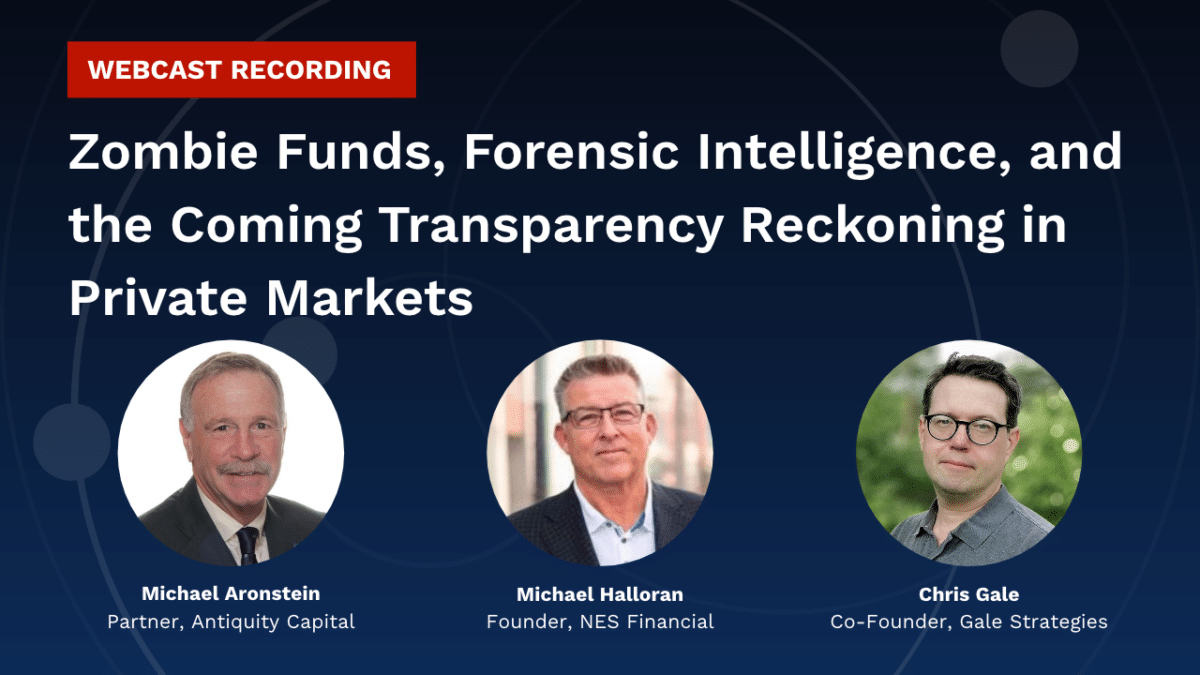
In this webinar, Michael Aronstein, Partner at Antiquity Capital, and Michael Halloran, founder of NES Financial and former CEO of JTC Americas, join Chris Gale, Co-Founder of Gale Strategies, for a timely discussion about how sophisticated investors are navigating zombie funds and why operational transparency may become one of the most important themes in private markets over the coming decade.
The discussion will connect three increasingly important questions: How are LPs independently evaluating aging private assets? How are technology and forensic intelligence reshaping private market oversight? What happens if transparency becomes an operational and regulatory expectation rather than a voluntary best practice? Disclaimer: For informational purposes only; not financial advice.
Chris Gale: Zombie Funds. Sounds like a horror movie title. Michael shared shared with me earlier that maybe zompires is is a better term. I think I saw some reporting from PitchBook recently. So these are vehicles, as we all know, that are functionally dead but still feeding off fees, and we might hear some better definitions to the course of of the minutes ahead.
So let’s use that at the doorway, and let’s get into the structural operational strategy questions, and we’re going to start with Michael Aronstein, and then as the course continues, you’re going to hear more from Michael Halloran, and if you don’t know Michael Aronstein, I really encourage you to look at Antiquity Capital. They do amazing work there, and you probably do know that he’s a veteran investor, former president CEO, chief investment officer at Market Field Asset Management. And Michael Halloran is founder of NES Financial, former CEO of JTC Americas, and develops has developed expertise that come from his Silicon Valley background that you’ll get to hear. Spends a fair amount of time in Washington DC even though he’s on the West Coast today getting up early for us, and has done quite a bit in developing technologies and processes for areas of investment like opportunity zones, EB-five, ten thirty one that can suffer from some degree of opacity and trying to bring them to the surface so you can see what’s going on, and you can imagine where this conversation is going to head today. Michael Aronstein, I don’t know if you would like to say some more about Antiquity Capital, but in addition to that, maybe you could set the stage for us about why are we talking about zombie funds in the first place today.
Michael Aronstein: Thank you, Chris. Just briefly on Antiquity Capital, we are more or less a forensic intelligence analysis and advisory firm that attempts to detangle the opacity and the other complexities that are inherent in the private markets. Both my partners, Scott Siemens, and I have fairly long histories of analytics. I’m much more on the macro side. Scott has been on the actual company analysis and funds analysis nitty gritty portion.
And so between the two of us, we… We’ve had a sneaking suspicion that something major has changed in the private markets for several years. And now I’ve been watching this for a long time. I knew David Spencer when he was first hired by Yale. I knew all the people at the investment committee there that actually hired him in, I think it was ’84.
And by then, I was I was well into my career on the strategy side at Merrill Lynch. Just hinting at how how old I am. I’m sure the video probably seconds that. But I have seen about seven or eight of these cycles, and they are all fairly similar in form, but the content varies, which is… That is what makes modeling them very, very difficult. You cannot look at the same sector time and time again and say this is where the problem is. It always moves, but the forms don’t really vary, and particularly when you get leverage involved.
And that’s kind of the key element here. You know, you have each cycle we’ve been through the last fifty years, there’s been some sector that’s really taken advantage of the availability of leverage. And it’s changed. You know, it was… When I got into business in the seventies, it was the energy sector.
If you had anything to do with energy, you could borrow any amount of money, and, you know, gold mining was was second in close pursuit. And then it went from there into the S and L land and development lending. And then you had the whole high yield era where if you were a friend of Drexel, you could borrow any conceivable amount of money. Then you went to Japan, etcetera. And I think for those of you who are younger than I am, which is a lot of the audience, Some of you might remember the whole cycle that unfolded, the big one between 2002 and 2008, which that was almost the apotheosis of a giant lending cycle.
And of course, the collateral was different. It was single family homes, which had never been tried as a generalized source of collateral. And this time, you know, it’s been since they got put in the penalty box for a long time, we weren’t gonna go through that whole subprime deal as long as the people who were there were still alive. We we had a new… When the Fed essentially made money free and began the helicopter money kind of episode, which I would say lasted from 2009, reached its absolute peak intensity in 2001 when you not only had the balance sheet of the Federal Reserve exploding, but rates were functionally zero.
And so all of that was a propellant behind this tremendous wave of private asset leveraged investing, which began in the 80s, had spectacular performance because so few people were doing it, and then became more and more popular. And then it was you know, the ’80s performance was not aided by the fact that you had zero interest rates. You had declining rates, but never got close to zero. So we had a very, very interesting conjunction of positives for that industry take place in the early 2000s. And you ask why now?
Why should we be concerned now? Well, you have two things. The sector became tremendously overpopulated. It was like most high fee, easily manipulated sector, very attractive to lots and lots of new participants who weren’t as skilled as the originals. And secondly, you had the perfect monetary environment, which three years later changed into something that was a lot less than perfect.
I was just revealing the Federal Reserve dot plot their expectations at the end of 2021. And for ‘twenty two, ‘twenty three, and ‘twenty four, rates were assumed to be between 1.82.5% with a long term ceiling of 2.5%. So surprise, surprise, that didn’t work out. And so in every one of these cycles, whenever you get a big rise in rates from the assumed level, you have to look around and say somebody’s going to get hurt by this. And you look and you try to point out, okay, what was the sector that benefited the most?
Where was the excess consumption of leverage and people who really took advantage of the opportunities? And again, it was clear in two thousand five, two six, seven you could just point to the mortgage market and single family homes. This time around, you, I think, have to point to the whole private asset complex. And the reason these things tend to last longer than anyone believes and tend to become more difficult is because it always occurs in a place that the general population isn’t familiar with. People didn’t know anything about subprime mortgages.
They didn’t know anything about that whole world of mortgage derivatives. People knew about single family homes. And today, very, very few people outside of professionals in the industry or advisors have any idea really of the whole matrix that involves private credit and private letter ratings and LDOs and buyouts and continuation funds. It’s very, very opaque. And you combine that with the fact that these are naturally opaque vehicles.
There’s very little in the way of a forcing mechanism that would make this resolve in the way that the public markets might have selling cascades, which is why the process of unwinding is so tedious. And it’s why it’s a topic that when people say, watch out for this, you could come back in two years and say, well, nothing much has happened. But under the surface, there’s quite a bit happening. And that, I think, I’ll stop talking now, which I will come back to that. But I’d like to give Michael a chance to comment a little bit about some of the structural aspects of the transition that’s taking place and why that’s maybe indicative of a stage that we’re reaching.
Chris Gale: And Michael, coming out of Silicon Valley, because there’s a lot of headlines about SaaS, its data centers, and and and Michael Aronstein, I think you’re you’re saying it’s something bigger, Michael Halloran. Not to jump in between the two of you, but, yeah, what what what would you say to the… To what Michael Aronstein was saying?
Michael Halloran: Well… So first of all, just on on the intro, I just wanna make sure everybody understands. I sold NES Financial in 2020. I worked for a couple… Two and a half years for The Buyer, And now I’m out of that.
And right now, I’m just fascinated with kind of the challenges of what’s going on in private markets. And I’ve been focused primarily in the area of, I believe, there is transparency debt in private markets. They’ve grown at such an incredible rate. You know, it’s $16,000,000,000,000 of capital today, forecast to grow to $30,000,000,000,000 of capital within the next five years. And there’s lots of signals that we’ve got an underlying problem.
And so you can look at everything from the annual reports of allocators, pension funds, foundations, endowments, identifying that opacity within private markets is creating a risk for them. You’ve got some where they’ve actually even stopped allocating capital to private markets over $10,000,000,000 with one particular allocator. You’ve got the Opis sending a letter to the SEC signed by 38 member companies identifying opacity as an issue. You got three consecutive SEC chairman identifying that this is a risk. And at the same time, you have the federal government opening up alts to 401s.
And the primary benefactors of alts within those major allocators are individuals like firemen, police officers, teachers. So big market growth, huge impact. But what we’ve got is an underlying structure that was built years ago. And while technology is advancing, and while the level of reporting is actually greater and at a faster velocity than it’s ever been in the past, the data is not coming out in comparable fashion. So you can have an allocator that has multiple funds therein, those funds will come back with NAVs.
And those NAVs are concluded entirely correctly, but using different methodologies. So the allocator looks at it, and it’s not comparable data. You’ve got portfolio companies that, because of what’s going on in the market, have to restructure their debt. When they do that, they’re compliant. They’re not out of compliance with that debt.
However, ratings agencies will look at that and say, That is a nonconforming loan. And so you’ve got two different methodologies that are perfectly correct that are giving a different signal to the marketplace. I And think that gets to kind of some of the fundamental issues. And in the context of continuation vehicles, or here, we’ll call them zombie funds in the market, refers to them as zombie funds, the pain is particularly acute because it’s a compressed window. You’ve got, I would say, from creating a company and running a company, it’s a legitimate situation.
This is not somebody acting as a bad actor. You’ve got a company that didn’t fit within the legal construct of a ten year window, but it’s an economic result that you’re looking for. And so allowing an extra cycle, or right now it might have a thin acquisition potential universe of buyers out there. Allowing that to continue to develop and to continue to cycle is a legitimate way to provide return on capital. However, there are other…
There are some funds that are working specifically towards that. I say would there’s probably some instantiations where the funds are just trying to maintain the fee base, and they’re not necessarily working diligently at, you know, maximizing that return. And the problem in the market is you can’t really tell the difference. The information that comes to the limited partner, they have a finite window to evaluate it. And the person who produces the data, who sets the valuation and negotiates the deal, the same entity.
Is And so there’s kind of a natural conflict or concern. And what happens is the market then in turn prices that doubt, that lack of visibility across everybody. You’ve got somebody that’s really working towards doing the right thing. You’ve got somebody that may not be, and there’s no way for the market to really tell the difference. And looking at it from a…
The title in this is forensics. Well, forensics are looking at things after the fact. It’s expensive, it’s specialized, and it’s not the signal that an intelligent investor needs. An intelligent investor needs to be able to see the operating reality that’s preceding this particular event to make an informed decision. And the challenge is, most of the time, that’s not really provided.
So I have an actual example of how that played out in what… My company was a big provider in the EB5 visa sector, and I’m not going to explain all of the nuances of EB5. But one unique attribute of that sector was that capital flowed into funds, which was then allocated into a separate company, a separate entity that was… And most of this was commercial real estate development. So it was a developer that was producing some sort of project, and then it flowed into a job creating entity.
And the challenge in the structure in the sector, massive regulatory complexity and oversight because of how it flowed, and it was an immigration product, a financial product, a banking product with foreign capital. But you had in that structure very often related parties in all three transactions. And so the opportunity to do bad things was really prevalent. And so surfacing the information, using technology and process to make everything transparent, would evidence those risks and allow people to make informed decisions of what projects they wanted to throw their capital into. And that’s what we did at NES.
And eventually, it even had federal support. So instead of regulating the industry, all the regulators did is they just defined, here’s the guardrails. You can use anybody you want, but the guardrails are there needs to be process transparency. Investors need to be able to see where their capital is. It needs to be protected.
There needs to be audit trails that show how it moved through all these different entities. And that ended up allowing the sector to grow and to expand. And it was not the natural inclination of the sector out of the gate. They looked at it initially and said, This would be more work. This exposes potential issues along the way.
And so the inclination would be not to do that. But when they realized it allowed them to raise capital faster, it allowed them to manage processes better, they dealt with much less from an investor or limited partner servicing perspective, because they were constantly surfacing information versus doing it retroactively. And it just created an efficiency. And I think that that is particularly true, and it’s acute in the continuation vehicle environment. But I think from a bigger perspective, it’s true across private market capital altogether.
Chris Gale: I’m going to jump in the middle there for a second because I don’t think we pointed out there’s a Q and A button down there in the bottom and we very much welcome any questions you have. When you have them feel free to put them in, and then as we approach the end of the session, we’re going to see how many we can go through, and any that we can’t cover will be, we’ll see if our panelists will be able to come back to you off the webinar. Michael Halloran, thank you very much for that, and Michael Aronstein, coming back to your description of antiquity, are there certain triggers or things, in previous conversation I’m gonna date myself right along with everybody else maybe, but you know I’m a fan of all creatures great and small, and I kind of think of you as the vet who gets that call from the farmer saying something strange is happening with this flower horse. Can you come take a look at it? Because I really don’t want it at the next call to be the knacker.
But are there certain things that LPs are looking for? Are there certain things you think they should be looking for that that that that you’re involved with?
Michael Aronstein: Well, that… That’s a very interesting question and a good one. One of the difficulties, one of the reasons that this process is elongating and is really becoming more and more, I think, difficult is because if you look at the whole ecosystem and you try to identify the structure of incentives, which to me is the way you can look at any financial system and really understand it, what everybody’s incentive is. The problem is, and this is not specific to LPs, but there’s almost nobody within the entire private asset system that’s incented to increase the scrutiny of the actual valuations, provide granular bottom up analysis, or question some of the apparent conflicts in valuations, methodology, and ratings. I know this is quite a buffet, and everybody’s feeding off it.
There’s so much money involved. And the LPs, to the extent that they’re institutional professionals, get paid on the basis of the aggregate return statistics. Whether or not those returns are durable or they reflect an actual valuation, the same is, to a certain extent, exactly comparable with the general partners. I mean, clearly, you have more of a clear potential there for lack of incentive. But you have agency problems where you have people dealing with other people’s money who are looking for statistical confirmation.
Then you have the knowledge problem that people who might be the principals, just for example, say the administration of a university, They don’t really have the first idea about what is actually going on. And they certainly trust the investment team, which they should. But the incentives on the investment team side is to present a rosy picture of what the results have been. And that goes throughout the entire system. I would say that there’s no forcing mechanism for transparency other than I will say that the family office and the advisory side have an awful lot of people who really are concerned about the actual result and the actual valuations.
And that’s probably, to my mind, where the most of the discovery impulse is going to come from. The rest of the system is quite happy to be led along and say everything is great. And, you know, it’s something, to my experience, it’s been typical in every one of these cycles. Until you have a forcing mechanism that absolutely terminates the pretense of everything is terrific, even in a circumstance where everybody kind of knows that everything is not terrific. And I think back to the SNL crisis.
Know, SNLs or thrifts, as they were called, used to be really simple. You give them some savings deposits, they lend it out for twenty or thirty years to somebody for a mortgage. Well, that was all well and good until the seventies when the mortgage rates went from six, 7% to 16. All of a sudden, the loans they had made were way out of the water. They’re making 6% out of a whole lot of their portfolio, and now in order to pay the depositors, they’re paying them 10, 12, 13 competing for deposits.
So it was pretty clear that the die had been cast then, and there were all kinds of mechanisms put in place to try to forestall the reckoning. You you had Gaur and Saint Germain say, well, you guys now can do anything. So they got into development. They got into roll land, they got into building golf courses, so they could value assets wherever they wanted. But the actual forcing mechanism that put an end to it was when the SNLs in Texas, which were among the most aggressive, ran out of the cash to pay their depositors.
They couldn’t pay the interest on the deposits because they were operating at a negative cash flow, even though they kept showing everything is great. We have earnings here. The earnings are coming from the proposed value of the golf courses that we’re building. But the cash flow, the actual entity level cash flow was upside down. Their portfolio was just not producing the cash they needed to keep up with the liability costs.
And we have a similar thing that’s going on quietly, and you’ve seen it in some of the headlines with the private credit funds now. They can’t provide liquidity because the cash flows are really not adequate for them to create a reserve. You’ve got a real bid offer spread occurring now between the stated valuations and what the market considers to be the valuation of the loan that was perhaps originated when rates were zero and the company could afford it. So that’s created a liquidity seizure, you know, where almost nobody’s willing to pay the stated NAV. So you’ve got a real gulf between people wanting to get out, the ability of the providers to provide.
Now the structures are designed to be able to throw up gates, and I think people will argue, well, that’s what they’re meant to do, to stop a forced recognition of the valuation. But I would say that’s not exactly a virtue of the system when the actual valuation could be substantially below where it’s carried on the books. So you’re starting to see there are more and more headlines about this or that fund is only paying out 15% of your requested quarterly liquidity. Now it’s hitting it’s starting to hit the press and has been for the past year. And it’s another sign.
It’s kind of, I think, a harbinger of more acute problems. And the latest macro consideration is, you know, we’ve got a strong economy every… Everywhere else except in the… In a lot of the, private financial structures. We’ve got tremendous liquidity still left over from the Fed’s experiment.
You know, when they… Their balance sheet just exploded and to grow at rates that you’ve never seen before. Rates were zero. So you’re dealing with a residual of that, which is driving inflation higher, global markets on the equity side higher, activity higher, and now people are beginning to realize that, well, it doesn’t look like the Fed’s gonna go back to 2% ever, and in fact, they may raise rates. So you’re getting now to the, in my judgment, you’re at the kind of acute phase where more and more people, more and more creditors are going to be forced to reckon with the fact that the extend and pretend kind of path out is just not viable anymore.
So it’s gradually happening. These things tend to happen. They accumulate stress. And then there are generally events that precipitate a recognition. That’s, know, that’s happened in every cycle.
It’s like in 2007, New Century Financial was forced to recant and restate two years’ worth of their earnings. They went from being highly profitable to pretty much circling the drain. And all of a sudden, everybody who was in the subprime space looked more closely, and there were clawbacks, and there were people forcing more collateral up. And that really started the spiral down in the first quarter of two thousand and seven. So we haven’t really had anything like that yet, but my sense, and I can’t substantiate this with particular facts, is that we’re getting closer.
And I don’t have a specific candidate in mind, but it feels like with the passage of time, this is not getting any better. So I will leave you on that cheery note and see if there are any questions that have come forward here.
Chris Gale: Not yet though. You have scared me more than I was anticipating for this. It sounds like to me at least… So there’s option one, which is a crash and things go badly. There’s option two coming back to something that Michael said which is if I heard correctly in his illustrative example, the government steps in and addresses things, and then a third one could be at least some participants in the market attempt to implement solutions so that they’re doing as little retroactively and as much proactively as possible if those three or at least three different options.
Michael, before we get to number three, which is what can market participants do and how technology can play a role, Anything you can share from the government side in terms of where the government is on this as far as you’re aware?
Michael Halloran: Yeah. So first of all, Michael, I agree with everything you’re saying. And I think one thing that I would really focus on as an operator and somebody who built up the company and everything, I totally agree with the incentives aren’t aligned. You have players in the market, and each one has a different objective and incentive, right? So the challenge is the actual work, the actual operations is done at a portfolio company level.
The idea of reporting up to their GPs, I’m sure anybody who’s on this call who’s a GP has been chasing portfolio companies for data for years. Mean, it’s just the challenge that… PwC did a survey recently. I’m trying to remember the numbers. I think it was 54 of the portfolio companies reported financial data and the information that GPs needed, but with an attachment on an email.
30 some percent, I think it was like 36%, actually just put it in the body of an email. And 40% of them said, If we could automate this and have nothing that drained our internal resources on this ongoing frequency, that would be fantastic. We’d provide whatever data they wanted. So I think at the portfolio company level, there’s no benefit to them to provide the data. Operationally, they just look at it as a bird.
You go up to the general partner level, the general partner does not want their data being exposed in a way that their secret sauce is exposed to the market, or it can be weaponized against them by a competitive fund. And so they want to cap the amount of information that’s released, and they want to be able to maintain their privacy and their secrecy. The limited partners look at it and say, I need as much data as I can possibly get, and I need it in a comparable format that minimizes the cycles I have to go through to try and determine how are these valuations created. I need more information to make better decisions, better allocations, minimize risk. The federal government looks at it, and their priorities and their incentives are entirely different.
And to your point, it’s usually some sort of market dislocation that happens that drives a blunt instrument response from the federal government. They come up with a well intentioned legislative initiative that in reality has this cascading effect on the markets to where the only real benefactors end up being the accounting firms and the lawyers. And they make out great every time there’s a big legislative change, but the markets have to adapt and efficiencies are sapped away. Maybe ultimately it gets to something that’s better. And to your point, we’re getting to one of those tipping points because the market has gotten so big.
And so finding a way to align the incentives, so the actual signals, the data, the operating data is flowing up from the bottom of that pyramid through the entities along the way, and privacy respecting secure ways where there’s some sort of standard of how we get the information we need to accurately assess and manage risk, maximize capital. And in doing that, the benefit to everybody is not having the big market dislocation, but it also opens the market up for more capital. The idea that suddenly there’s a level of transparency and accountability within the sector that allows more private capital through 401s or through better allocations out of large LPs, that’s a win for everybody. But to your point, you got to align all the incentives, and it’s a big ask.
Chris Gale: So jumping into that, because I think we’re talking about solution mode. There’s sort of a big solution across the market, and then there’s what individual… Let me focus maybe on GPs. Well, Michael Aronstein, I didn’t mention… You and I have messaged back and forth.
What’s the proper pronunciation of second? Yeah.
Michael Aronstein: Okay. Good. K O N D, second. Yes.
Chris Gale: Are there some solutions out there? I mean, there’s stuff you can do. And then there’s also we live in the AI age. Are are there other solutions out there that that you’ve explored? Any any tactical advice?
Then Michael, I’ll come… Michael Halloran, and I’ll come back to you.
Michael Aronstein: Well, yeah. As you mentioned, we have a very close affiliation with Second, which is a data provider and analytic platform that is, I would say, the most granular, the most robust that we have found at the fund level. We have utilized it and I think we’ll continue as it builds out to really compare structures across various components and see if there are outliers, really, and to double check the accounting and the flows that are being reported by the general partners and see whether or not there is consistency. The amount of data required to do it is overwhelming. Think the CEO of Second, who’s an affiliate and advisor to us, Rasmus Kausker, has I think he pointed out last week to us that for each fund over a year’s period, there’s something like 1,300 or 1,400 separate data series that feed into the proper analysis of the fund.
And there are tens of thousands of funds. So the data management problem is extraordinary. But I completely agree with Michael that before this progresses to the stage where you’re distributing all these assets to the policeman’s beneficial fund and to mom and pop in their 401s, I think that some kind of structure, reporting structure, and some sort of valuation parameters that are really consistent across the industry are going to be necessary. And unfortunately, kinds of solutions, as Michael pointed out, tend to arise after an event when somebody has a real issue that starts spreading, and then the emergency alarm goes off in Washington or at the state level. And yeah, the solutions tend to be very blunt and maybe not, in the long run, conducive to the actual results that they’re seeking.
But now our feeling is that these markets will settle into a sustainable and properly organized form as we go through this transition stage from vehicles that were never intended to be mass market or widely distributed. When David Svensson started putting money into private equity in the mid-80s, there were about a dozen or two dozen firms, serious firms that were operating. And the agreements were all perfectly, I think, aligned with both parties’ incentives. He stipulated that he was going to get access to granular data on an update basis and that the incentives for the managers were going to be on performance. They weren’t going to take fees for originating investments and fees on fees, and they weren’t going to take consulting fees and all of that.
And, no, they they were very, very carefully raw limited partnership documents. That was never intended to accommodate thousands and thousands and thousands of investors, in the same way that the business development corporations that began in the early ’80s as a way to get capital into a starving sector. Nobody was left to lend to small businesses. Now, they’ve been used as the conduit for these gigantic private credit funds. And the reason is because now they fall under the ‘forty Act.
There’s tremendous flexibility with fees, tremendous flexibility with leverage, enormous discretion for the general partner to set their own values, mark their own homework, and really dictate their own compensation. When you look closely at the private credit universe, annual fee burden on these funds is typically between 39%, which on a credit product is almost unheard of, and I would say is really insurmountable. And the way people have tried to surround it is by leveraging them and taking the carry spread between what you can borrow as a fund manager and what the aggregate portfolio yield is. But now that’s a risk additive process without, I think, adequate compensation. But it does permit the addition of a tremendous fee burden.
But again, there’s the people on the receiving end don’t quite understand this. They look at the coupon level. It’s like, oh, here’s a fund that pays 9 percent. What’s wrong with that? And and there’s very, very little incentive to go deeply and explore.
And some of these funds have 500 page annual reports with 30 to 50 pages effectively of footnotes. So the universe of people willing to go through those closely, either using AI or by the end is quite limited.
Chris Gale: Imagining a battle between AIs producing it and AIs attempting to interpret it and staying on top of each other. Though on that point, Michael Halloran. And we have we have a question, so I wanna get to that question before we do. Michael Halloran, any tactics, technology, or things that you’re looking at approaches that can help attendees, especially the the GPs, but also LPs in the audience?
Michael Halloran: So I think… Well, I mean, technologically, as has always been, as it continues to shift and change, enables all sorts of new capabilities. I think you got to start with the fundamental premise, and it kind of fits with what Michael’s been describing, it’s opacity is the enemy of efficient markets, right? All of those things create risk, and it shrinks the market, it minimizes values, And you have to get the whole sector to start to understand that it is collectively a benefit to be transparent. And that needs to start all the way at the bottom with operating companies through the GPs, up to the LPs and to the federal government, and ultimately to beneficiaries of those pension funds or individual investors.
And technology certainly gives us an ability to do that. To me, this is not a technology challenge. To me, this is a cultural challenge. It’s the willingness to embrace a different way of doing things and aligning the interests within the complete sector to create standards, to report those standards, to do it for the collective benefit. If you look in, there’s corollaries.
A good corollary would be in the credit data provisioning space. The major credit providers, because they had really high charge off rates, and those liabilities were really substantial. And they agreed, We’ll share credit data together. We’ll contribute it to a pool. We’ll share that data so we can make better provisioning decisions, reduce charge offs, and manage risk more efficiently.
And that’s how we have TransUnion, Equifax and Experian. And if you look at somebody like Equifax, for them, I’m pretty sure, I spent some time working with them years ago, their consumer credit file represents over 14,000 different providers that are providing consumer credit behavior data. That was the benefit of everybody. It’s the benefit of individuals now who can manage their credit better. It’s better to the credit providers who could go out and free capital up for markets.
And I think this is a good analogy to this, is that if we can find ways to align the incentives so it benefits everybody, then you can get to that result. And one thing I would throw into the continuation vehicle side of it, which I don’t think gets accurately represented, or the need’s certainly not being met, is portfolio companies should provide the data and be aggressive about it just as much as they did when they originally sought the capital. Because this is about perpetuating their business in a successful fashion and working with their existing investors. Their responsibility is to provide the information and do it in a comprehensive fashion. And this is where their investor is at an inflection point, where they need LPs to make decisions.
They want to reflect the best interest of those LPs, and so they should embrace it. Now technology can allow that to happen. Technology now can go in with agentic processing, and we can pull data out of ERP systems. We can surface that data, and we can do it in a consistent common taxonomy. We can do it in near real time.
Now, Priyanna, you’re going to put gates on it, but you can create differential privacy mechanisms, you can have hardware enclaves that ensure that nobody’s data is being used or is being able to be weaponized against them. And so technologically, the capabilities are there. It’s does the industry have the will and the foresight to see that this will prevent market dislocations if they can get ahead of it? I think we’re at that point where if they don’t, federal government’s going to come in and they’re either going to restrict the flows of capital into the market, or they’re going to put mechanisms in place that load it up with cost and actually create inefficiencies to try and accomplish a good objective, but doing it in a probably less than optimal way.
Chris Gale: I’m going to hold myself back from asking some following questions. And so we we have a question here. Do either of the panelists have a view on the NAVs being put out by fund administrators for private funds versus the prices being transacted in the secondaries market? Is there a solution for the large discounts that are seen?
Michael Aronstein: I tend to be a person that trusts the markets quite well. I think the argument that the secondary markets are revealing distressed levels of exchange are incorrect. I certainly think, and I believe this is an accounting standard that is being compromised now, that every fund has the obligation, or at least their auditors, to see whether there have been actual arm’s length marketplace transactions in secondary markets and use that as a valuation benchmark. Now, to date, the argument has been, well, these are so low compared to our NAV because the seller is distressed. The seller obviously shouldn’t be in here because they need the money and they’re selling it at an artificially depressed price.
Well, that’s a funny argument to make, where now you have the two largest sellers in the PE market, I think, are the Harvard Endowment and the Yale Endowment. So they may be under pressure for the money, but they’re not likely to take a rock bottom distressed bid. And the same is true in the credit markets that there are so many people who can evaluate loans and whose business it is to find mispriced loans. And I really do think that the again, this is really a regulatory issue that probably is not going to be addressed until after something occurs. I think one of the things that can be insisted on when a potential LP or buyer of a fund is doing the due diligence is that the manager of credit funds does not get paid.
And the same would hold true for private equity funds on unrealized gains, that the payments should be at realization and the marks to market that create immediate incentive payments, should not be permitted. The other thing I would say also is that the incentive structure in private credit funds should really be re examined, because in most private credit funds or in many, the manager is entitled to an incentive bonus if they exceed some extremely modest target rate. And in some cases, the target rate is the same as the current single or double A bond yield. So if you’re making private triple C or B minus loans and you can’t exceed that, I think the telling point is I think 98% of the incentive fee payments to private credit managers actually get made. In other words, almost none of them are in a position where they fail the hurdle test.
So, I think that’s something that would really encourage more accurate NAV marks across the board. But again, the incentives, you have to take into account the fact that the fee flows in this industry are basically unprecedented. The amount of money involved here is, really beyond imagination in a lot of ways. And you can really see that when you look at the compensation structures, how many individual managers’ returns from certain funds. So it’s a very, very difficult problem.
And again, there’s almost nobody in the system who is incentive to stand up and say, wait a minute, we should stop this. Everybody who’s even remotely attached to the process is making a great deal of money now in one way or the other. So the difficulty is that it usually takes something traumatic before people step back and say, wait, that was out there all the time. We should have known that. So that’s just…
I mean, it’s human nature. It’s just all of us try to act in our own self interest and, you know, the the industry… I think Michael’s earlier point is that it’s really in the interest of the people who are doing their best to be the best stewards and to be actually on the side of their LPs and their investors. They really have a strong interest in trying to promote transparency and really eliminate some of the capacity that enables some people to kind of play at the very edge of sort of what we would call good behavior. So I think it’s coming.
And clearly I’d like to see it come sooner rather than later. And, you know, I’m I’m hopeful that, as Lloyd Blankfein recently said publicly, he said, haven’t most of these guys made enough money? He was he was commenting on, some of the behavior problems, but, I thought that was a very, very apropos comment from somebody who who actually really knows.
Chris Gale: Thank you. And we’re at the four minute mark. Michael, I don’t know if you, also have a response.
Michael Halloran: Okay, yeah, I have a quick response. Actually, it’s just from what I experienced and what we did. So at NES Financial, we started in ten thirty one tax deferred exchange sector. The incentive in that sector was for the providers, the qualified intermediaries, to aggregate capital and chase yield. They were doing it in a way that wasn’t evident to the exchangers.
And they made tons of money doing it. And the way it was written in the tax code, they weren’t doing anything wrong. And so I’m not saying these were bad actors. They weren’t thieves. They weren’t doing anything wrong.
They were working within the structure that had already been created. We came into the sector and felt like we could do something different. We established a set of best practices, a process of transparency and restrictions on how capital could be used and deployed. And then we audited everything with third parties, so everybody knew we were above board. We entered the sector, and within five years, we were processing over $85,000,000,000 of ten thirty one assets.
A year. We were the largest vendor in asset volume by far. And we did it by just trying to do the right thing. And doing the right thing is actually a really good business model. And that’s kind of what when I look at all of this, it’s if people can realize that they can grow their businesses, they can be massively successful by serving the interests of everybody that’s involved in what they do.
I think that’s the solution to it, because otherwise it is the blunt instruments. Instruments. It is the massive market dislocations that happen. And as much money as you’re making here, you’re going to suffer reputationally and you’re going to suffer economically at some point. So what do you do to get ahead of it?
Chris Gale: Thank you very much.